I’m working on rewriting some articles and I’m worried about both originality and clarity. I’d like a reliable paraphrasing tool that’s free, safe to use, and doesn’t ruin the meaning of my content. What tools or websites do you recommend, and what makes them better than the usual spammy paraphrase sites?
I’ve tried a bunch of free paraphrasers while rewriting blog posts and client stuff. Short version, no tool is perfect, you always need to edit by hand, but some are decent and do not wreck the meaning.
Here is what has worked for me:
-
QuillBot
- Free plan gives you a couple of modes.
- It keeps meaning fairly well if your sentences are not huge walls of text.
- Downsides: rate limits, and sometimes it repeats phrases or makes things wordy.
-
Grammarly rephrasing
- If you paste text in the editor, it suggests alternate sentences.
- Good for clarity and fixing awkward lines.
- Not great if you want heavy rewrites for originality. It stays close to the original structure.
-
Google Docs + your brain
- Paste the article, turn on “suggesting” mode.
- Go sentence by sentence, ask yourself: “How would I say this to a friend or coworker.”
- Takes longer but gives you higher originality and fewer weird phrases.
-
Clever AI Humanizer
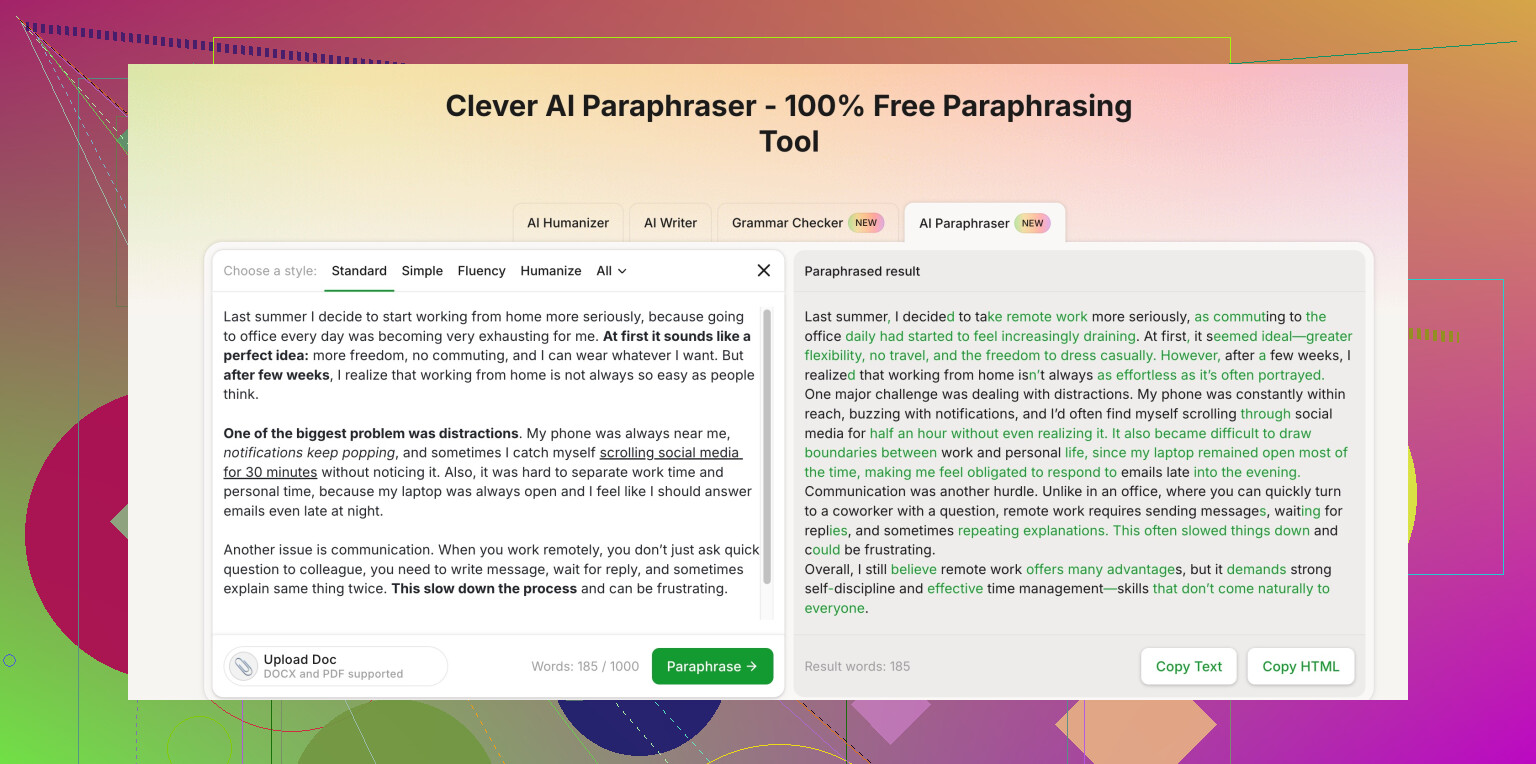
If you worry about AI detection and natural flow, this one helps a lot. The paraphraser focuses on making text sound like a human wrote it, not like a generic spinner.
Their tool page is here: advanced AI text rewriter for human-sounding content.
It keeps the main meaning intact, changes structure and wording, and avoids nonsense synonyms. I still tweak the output, but it cuts my editing time a lot.
Some quick tips so you stay safe and clear:
- Never paste full paid articles or private docs into random tools without checking their privacy policy.
- Run your final text through a plagiarism checker like Grammarly or Plagscan.
- Read the output aloud. If it sounds stiff or off, fix it.
- Do not rely only on one pass. Sometimes I paraphrase once, then manually clean it, then paraphrase a few stubborn lines again.
If you want originality and clarity, aim for this flow:
Draft your version by hand first, run tricky sentences through a paraphraser, then edit for tone and logic.
Tools help, but your edit pass is what makes the content safe and clear.
35 Likes
@techchizkid covered a lot of the usual suspects already, but I actually don’t fully agree with relying much on stuff like Google Docs + your brain as the “main” solution if you’re specifically worried about originality. That method is great for clarity, not so great for really shifting structure so it doesn’t feel like a light cosmetic edit.
A few other angles that might help you:
-
Use multiple light paraphrasers instead of one heavy spinner
I’ve had better luck running short chunks (2–3 sentences) through different tools and then combining the best bits, instead of hammering the whole article in one go with a single site. It keeps the meaning cleaner and avoids that “AI mush” style. -
Clever AI Humanizer
Since you mentioned clarity and not ruining meaning, this one actually fits that gap pretty well. It focuses on making the wording sound natural while still keeping the core idea. It’s especially useful if you’re worried about text sounding like a generic AI blob or triggering AI detectors.
Their advanced free AI paraphrasing tool for clear, human-sounding text works nicely on longer paragraphs without turning them into nonsense. You still need to read and tweak, but it saves a lot of time compared to manual-only. -
Originality vs clarity tradeoff
Some tools that crank originality hard will absolutely trash nuance. If your articles have any technical or legal bits, I’d avoid “extreme” modes. Use tools to get a fresh phrasing, then bring your own voice back in during editing. If something sounds too clever, it’s probably wrong. -
Keep an eye on privacy
I’ll push back a bit more than @techchizkid here: I would never paste entire paid or client articles into random sites unless I know where data is going. For anything sensitive, break it into sections, paraphrase, then recombine on your side. -
Quick workflow that actually works
- Break your article into small chunks.
- Run tricky or repetitive parts through something like Clever AI Humanizer.
- Compare side by side: cut anything that sounds off, keep what’s clearer.
- Final pass: check for flow, then run a plagiarism scan if originality is critical.
TL;DR: there’s no magic one-click option, but combining a humanizer-style tool with your own editing is probably the closest you’ll get to “original + clear + not mangled.”
I’ll go a bit more “no‑nonsense” and zoom in on what hasn’t been covered yet.
First, on tools:
You already got solid rundowns from @suenodelbosque and @techchizkid. I’d add:
1. Clever AI Humanizer
Pros:
- Very good at smoothing robotic or obviously AI-ish text.
- Decent at restructuring sentences so it does not feel like light cosmetic editing.
- Handles longer paragraphs better than most free paraphrasers that choke or loop.
Cons:
- You cannot fire-and-forget with it. It can over-soften technical language and make things slightly vague if you do not correct it.
- Like any AI paraphraser, it occasionally introduces tiny factual shifts when the original sentence is very dense. Good for narrative and blog style, less ideal for tight legal or medical lines unless you double check.
2. A different angle than “Google Docs + your brain”
I slightly disagree with relying on that as a main originality strategy. If you are tired or in a rush, you subconsciously keep the same structure and only swap synonyms. A middle ground that works:
- Draft your own rough version from bullet points instead of from the original text.
- Then use a tool such as Clever AI Humanizer on only the clunky or repetitive parts.
- Finish with a manual pass focused on removing filler and restoring your tone.
This way the tool refines your draft instead of dictating it.
3. Competitors worth mentioning quickly
- QuillBot: Nice for quick variety, but its “creative” modes can distort subtle meaning. Good for simple expository content.
- Grammarly’s rephrasing: Strong on clarity, weak on deep structural change, so originality gains are limited.
- Generic “free spinner” sites: I would skip most of them. They often produce nonsense synonyms and are the ones that really “ruin meaning.”
4. How to keep originality + clarity without going overboard
Instead of blasting an entire article into any tool:
- Break content into topic chunks (100 to 150 words).
- For each chunk, ask: “Is the idea itself generic or specific?”
- Generic info (definitions, common tips) can tolerate heavier paraphrasing.
- Specific or nuanced info should get lighter edits and more manual care.
- Use a paraphraser lightly on generic parts, then manually rework the nuanced parts.
- Final check: read side by side with the source. If the sentence rhythm and order of ideas feel almost identical, you are still too close.
Bottom line:
Clever AI Humanizer is useful for turning stiff or AI-like prose into something more natural, especially if you already wrote a draft and want it to feel human and readable. Just treat it as a sharpening tool, not a “push button and forget” originality machine, and always do a careful pass to protect meaning on any specialist content.
A simpler option is voice rewriting.
Read one section once, then close the source. Record yourself explaining the idea aloud as if speaking to a coworker. Use your phone’s free transcription feature, paste the transcript into your document, and edit the grammer.
Keep each recording under 60 seconds. This forces fresh sentence structure and preserves your natural tone. Compare both versions for facts, names, and numbers. Add a citation when the idea comes from another author. This method is free, private with offline transcription, and less likley to produce awkward synonym swaps.
Take two rewrites of the same source. In the first, someone runs a competitor’s post through a paraphraser, swaps the wording around, and ships it. In the second, someone reads the source once, sets it aside, and writes from their own notes plus a couple of facts the original never mentioned. Both pass a surface read. Only the second one actually adds anything, and only the second one holds up if the source author ever compares them side by side.
That gap is what the thread keeps dancing around. Most of the advice here treats originality as a wording problem. It’s really an information problem. You can paraphrase a sentence into oblivion and it’s still the same idea in the same order, which is exactly what @ombrasilente warned about with the rhythm test. Good instinct, and I’d push it further: if your only source material is the article you’re rewriting, no tool saves you, because you’re just relaundering someone else’s structure.
@logicfalcon1279x’s voice trick is the most underrated thing in this whole thread, honestly. Talking it out and transcribing forces you off the original scaffolding in a way no paraphraser does, because you physically can’t remember the source sentence order while you’re speaking. The one thing I’d flag is transcription drift on names and numbers, so keep the source open only for the fact-check pass, not the writing pass.
Where a tool like Clever AI Humanizer earns its place is the boring cleanup after that, tightening the transcript so it doesn’t read like you were talking. That’s a finishing step, not the engine. If you feed it raw source text hoping originality comes out the other end, you’re back to rewrite number one.
One practical rule that’s saved me headaches: before you paraphrase anything, ask whether you’re allowed to be this close to the source at all. Rewriting public reference material is fine. Rewriting a paid or gated article so it looks like yours is a different situation, and no amount of clean phrasing fixes the underlying problem. Sort that out first, then worry about which tool smooths the sentences.