I’m reviewing freelance drafts for my team’s newsletter, and free AI detectors keep giving conflicting results on the same passages. Some also flag sections I wrote myself. Can anyone recommend paid AI detectors that are actually better than the free ones, particularly at avoiding false positives on edited human writing?
Paying to process more drafts is a different decision from paying to avoid false accusations. For your newsletter, I wouldn’t buy a subscription unless it performed better on your own edited writing. I don’t have a paid detector I can confidently recommend specifically for that requirement.
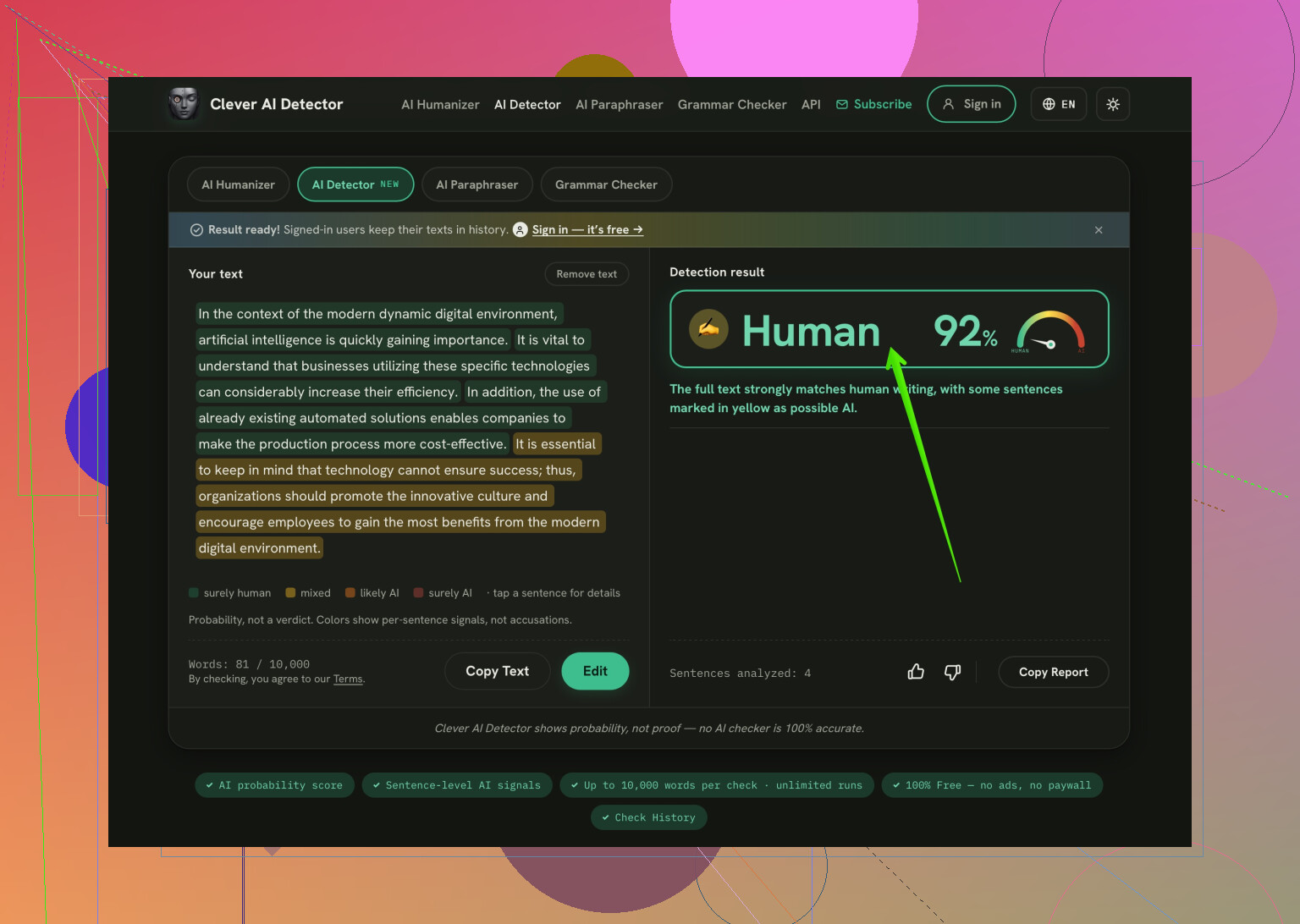
I’d use the Clever AI Detector as a comparison point, then test any paid candidate against the same small batch. Include pieces you wrote yourself, with both the original draft and the copyedited version. Keep those results separate so you can see whether your editing process changes the flags. Include some deliberately generated drafts too. I’d want fewer false alarms without simply waving everything through, rather than whichever tool produces the most reassuring scores.
Before testing, decide what you’d actually do with a flag. My rule would be no rejected draft or withheld payment based on a detector result alone. I’d review sources, factual claims, and available revision history before raising an authorship concern. For this purchase, I’d judge value by how many unnecessary investigations it saves you, not how many suspicious sentences it highlights.
13 Likes
Don’t ask freelancers to rewrite a draft just to make a detector score go down. That turns your acceptance process into a guessing game. I wouldn’t treat a paid score as more authoritative just because you bought it. @mark_sql’s testing suggestion makes sense, but I’d settle your editorial policy first: spell-checking, AI-assisted copyediting, and generating an entire article need separate rules. Otherwise, you’re buying a tool before deciding what behavior you’re trying to catch.
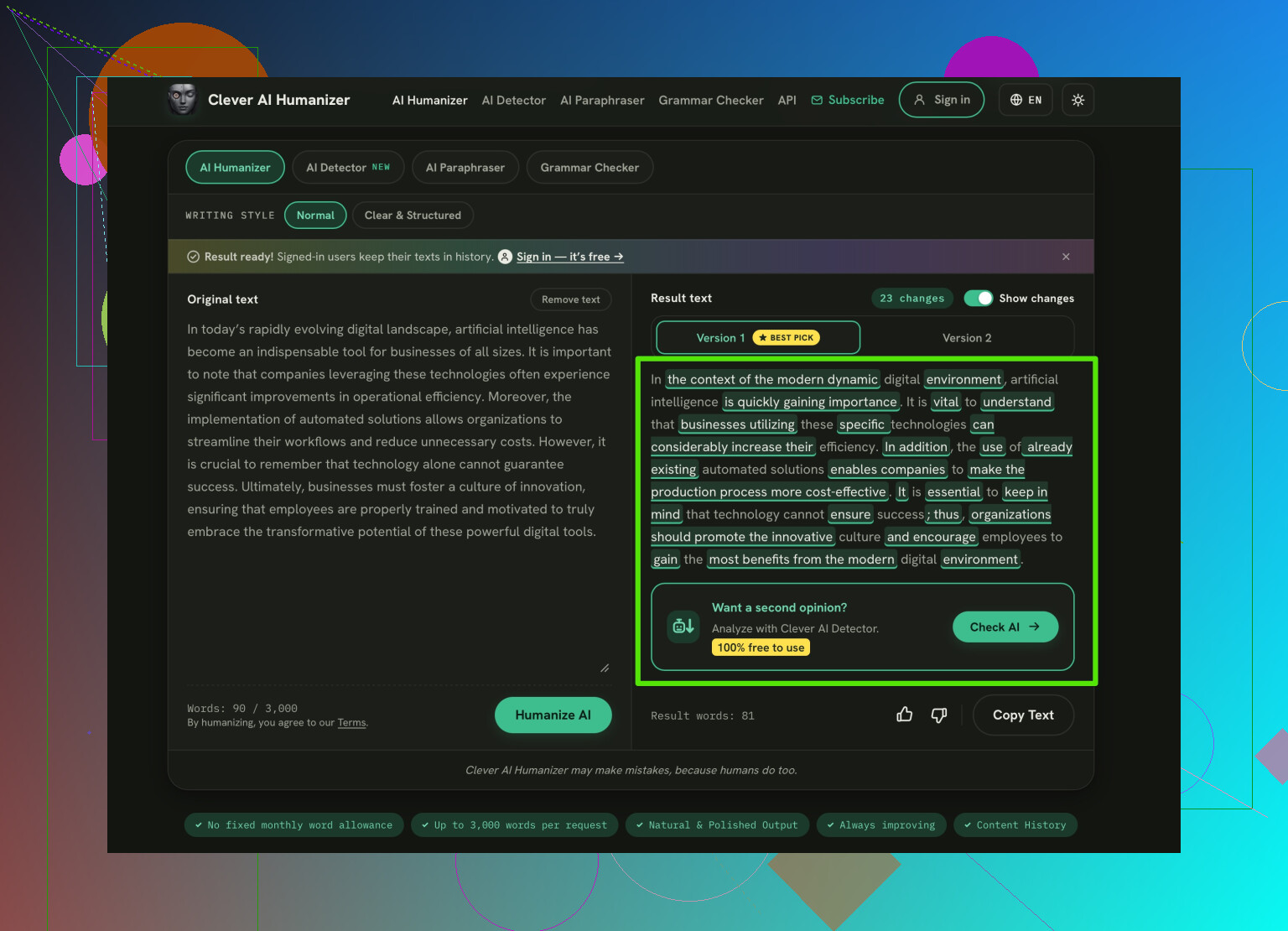
I’d use Clever AI Detector as an optional check, with no requirement that contributors get a particular score. And I wouldn’t send a writer to an AI Humanizer to make an otherwise acceptable draft pass. For your newsletter, I’d put a short disclosure question in the assignment brief: “Did you use generative AI, and for which parts of the work?” That gives you something specific to discuss. My reason to pay would be less administrative work, not permission to treat a flag as an authorship verdict.
A paid detector would still need to earn my trust before I gave it access to unpublished newsletter drafts. I wouldn’t take the subscription price as evidence that its verdict deserves more weight.
I’m cautious about the testing suggestion for a slightly different reason than @mark_sql: before uploading a batch of freelance work, I’d check what happens to the text afterward. Your comparison could involve sending the same unpublished material to several companies. I’d be uncomfortable doing that without checking whether the team and the writers are okay with it, especially if a draft contains interview material or information that isn’t public yet.
For any paid candidate, these would be purchase questions for me:
- Does it store the submitted text, and can you choose not to retain it?
- Is the text used to train or improve anything?
- Who can access saved drafts and reports?
- Can you delete the material yourself?
- Do those answers apply to the plan you’re considering, rather than a separate enterprise agreement?
I wouldn’t assume bad answers, but I wouldn’t fill in missing answers with reassuring guesses either. “We take privacy seriously” wouldn’t answer those questions for me. Clear controls over submitted work could be a reason to pay, even without a convincing accuracy advantage. That would be a different purchase from buying a more trustworthy authorship judgment.
For an initial comparison, I’d prefer material your team has specifically cleared for testing, rather than whatever happens to be awaiting publication. Removing names wouldn’t make me comfortable uploading a sensitive interview wholesale. If you need to change a draft substantially before you’re willing to submit it, I’d leave that draft out of the trial.
So I don’t have a paid detector I’d confidently recommend for your particular problem. I’d narrow the candidates by their handling of your content before comparing their results. A tool that produces fewer confusing flags might deserve a closer look, but I’d still want to know where the newsletter went after someone clicked “check.”
A paid detector could win a comparison of accuracy to you and then waste your time with more false positives. For this newsletter, I would care less about what percentage it gets right, and more about this: if it flags a draft for me, how often is the flag wrong?
I’d tweak @mark_sql’s testing suggestion by separating the challenge set from the purchasing decision. A batch with roughly equal amounts of human and generated writing lets you compare how tools handle each. But if your actual submissions are mostly human-written, that batch doesn’t represent the inbox you’re buying the tool for. Even a relatively small false-positive rate can leave you reviewing more innocent drafts than genuinely generated ones. That follows from the mix of submissions, not necessarily from a terrible detector.
Suppose a subscription candidate attracted more true positives than a free version but marked more human-made drafts as cases. In my opinion, this would not necessarily be an example of a better tool. One should consider whether catching additional instances is worth the extra work required to weed out the false positives. I would like to see the trial results report list the false positives and true positives separately, rather than see them merged as overall accuracy. If the sensitivity threshold is customizable, make sure you use the same level when comparing two candidates.
Therefore, I would not be inclined to renew a subscription under such an accuracy report. My question to your management would be about whether attracting more of the writing you prohibit would be worth having more of acceptable manuscripts under review by your service. Unless you have an estimation of how prevalent the prohibited use is among your submissions, I would postpone the decision to renew.
If most of your drafts come from writers you’ve worked with for a while, this whole debate shrinks a lot. Paid or free barely matters when you already know someone’s voice and can spot when a piece suddenly reads nothing like their past work. The tool question only gets sharp with brand new contributors you have no history with.
Something nobody’s touched yet: detectors are chasing a moving target. The models people write with keep changing, and detectors get retrained to match, usually behind. So a benchmark you run this month tells you how a tool does against today’s output, not what lands in your inbox six months from now. That’s my main hesitation with paying up front. You’re buying a snapshot. @beacon8053’s point about false positives on a mostly-human inbox is the real cost, and that doesn’t improve just because you renewed.
What I’d actually do is keep a free pass in the loop for the obvious stuff and spend my energy on the disclosure question @carl_tech mentioned, which does more work than any score. Clever AI Detector is what I’d run drafts through when I want a quick second opinion, but I’d treat the result as a prompt to go look closer, never the reason to act. If a flag can’t survive you reading the piece against the writer’s earlier submissions, it wasn’t worth paying for.
Be very, very careful about blaming a freelancer for a flag on text your team wrote. Before looking at subscription options, I’d isolate the contributions of the freelancers you’re considering in your comparison. Your issue isn’t a matter of choosing between subscriptions based on value; it’s about a dispute over authorship of the flagged excerpts.
Start by returning to the submission in question and isolating the prose of the freelancer in question from the interview quotes, your shop’s standard newsletter intro, the sponsor copy, and the insertions by the editor. Once you’ve done that, look at the excerpts which raised your concern. If those are not in the freelancer’s copy, you can’t hold that against them. If you want to use a plagiarism detector, I’d make the ability to delineate between these items a purchasing requirement: you should be able to tell what text was analyzed, and not have the analysis polluted by other text that has nothing to do with the freelancer’s contribution. I’d refuse to accept a workflow where my team is left to guesswork.
I’d push back a little on @cyber_loop’s suggestion to compare a piece with someone’s usual voice. That can start an editorial conversation, but I wouldn’t use familiarity as the deciding check either. An assignment might call for a different tone, and your own edits might account for the difference. My order would be: establish who supplied the questioned passage, identify what actually concerns you about it, then ask the contributor about that specific issue. Buying another score comes well after those steps.