I’ve been using Originality AI’s humanizer to make sure my AI-written content passes AI detection for clients, but I can’t afford the paid plan anymore. I’m looking for a genuinely free tool or workflow that can help humanize text without hurting readability or SEO. What no-cost substitutes or strategies are you using that actually work right now?
- Clever AI Humanizer, after a month of abuse
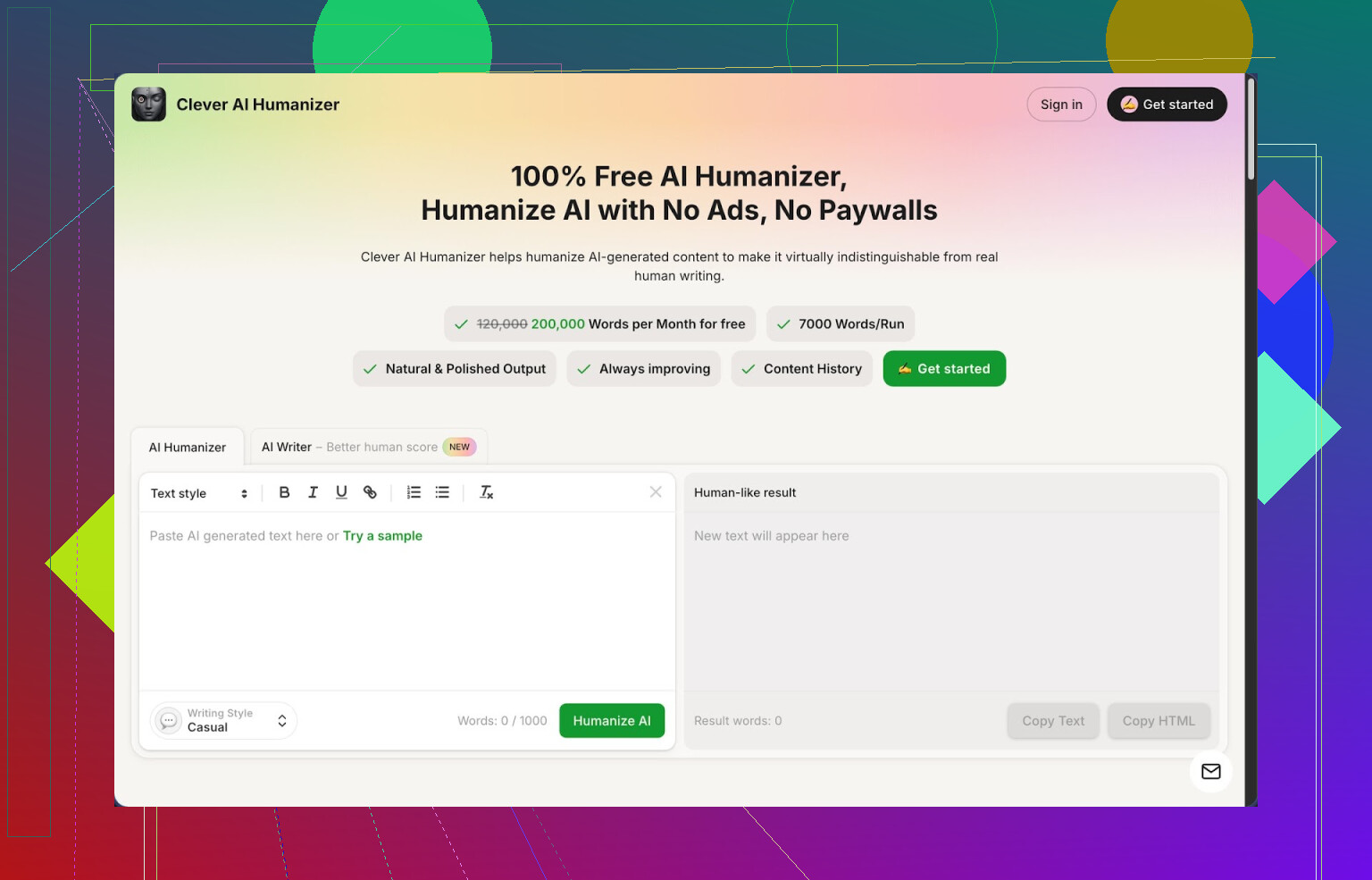
Link: https://cleverhumanizer.ai
I have been hammering this thing for a while, mostly for school stuff, client drafts, and some dumb personal projects that started in ChatGPT and sounded like an instruction manual. This is what I ran into, good and bad.
First, the part most people care about: limits and money.
Clever AI Humanizer lets you run about 200,000 words per month, with up to around 7,000 words in a single run. No paywall, no credits, no trial countdown. I expected a catch, but so far it behaves like a normal free tool.
I pushed three different samples through it in the Casual style and then checked them on ZeroGPT. All three came back 0 percent AI on that detector. That does not mean every detector on earth will pass it, but for ZeroGPT it did fine for me across essays, a product guide, and a long blog-style post.
What it does, from my side of the screen
I usually start with text from some AI writer, paste it into their main “Humanizer” box, set the style to Casual, Simple Academic, or Simple Formal, then hit the button and wait a few seconds.
What comes back:
• The structure is still close to what I wrote.
• Meaning stays intact most of the time.
• Sentences lose that flat, repetitive AI rhythm.
• It often gets longer by 10 to 30 percent, which looks like the price you pay for breaking those AI patterns.
I had a few edge cases where it softened strong claims a bit, so if your topic is technical or legal, you should re-check important details after humanization. For normal content, it stayed faithful enough that I did not have to re-edit from scratch.
What else is packed in there
They squeezed a few tools into one interface, all under the same site.
-
Free AI Humanizer
This is the core feature. Paste text written by any AI, pick a tone, click, read the output, maybe run another pass if it still feels stiff.
Useful for:
• School essays that started life in an AI.
• SEO drafts that sound robotic.
• Client outlines that you generated before polishing. -
Free AI Writer
This is where I got lazier than I planned. You type a topic, maybe a short prompt, then it writes an article, essay, or post.
The useful part is you can humanize the result in the same pipeline, so you go from “raw AI output” to something that scores more human in one flow.
In my testing, the pieces that were written and then humanized in the same run usually scored better on detectors compared to text I wrote in ChatGPT then pasted over. -
Free Grammar Checker
I threw some messy drafts at this. Typos, missing commas, weird phrasing.
It went through and fixed spelling, punctuation, and some basic clarity issues.
Not as detailed or nitpicky as tools like Grammarly, but enough to make text look clean for emails, blog posts, and school assignments. -
Free AI Paraphraser
This one rewrites sentences while holding on to the original meaning.
I used it for:
• Rewriting sections that sounded too close to a source.
• Changing tone from stiff to casual.
• Making different versions of product descriptions for separate pages.
It is more aggressive than a simple synonym swap, but it did not flip the meaning in my tests on general topics. For niche or technical stuff, I did a quick read over to be safe.
How it fits in a daily workflow
My rough workflow lately:
- Generate a draft in any AI writer.
- Paste into Clever AI Humanizer, use Casual or Simple Academic.
- If the topic is public facing, run the result through ZeroGPT or another detector, and tweak once more if needed.
- Run the final pass through the Grammar Checker.
- If I want a version for another platform, push pieces through the Paraphraser.
Because the word limits are generous and free, I stopped worrying about wasting credits on multiple passes. That part removes a lot of friction.
What I did not like
There are downsides.
• Some detectors still flag parts of the text. I had one university tool mark a chunk as “likely AI” even after humanization, so do not treat this as a magic invisibility cloak.
• Word count tends to grow. If you need to stay under strict limits, you will need to trim.
• Occasionally it leans a bit too “safe” in tone, especially in more opinionated content. I had to put some personality back in afterward.
But for a zero cost tool, it stayed in my bookmarks, which is rare for this kind of thing.
If you want more detailed tests, they have a long review with screenshots and AI detection results here:
Video review on YouTube:
There is also some discussion and other options mentioned here:
Best AI humanizers on Reddit
General thread about humanizing AI text
31 Likes
If you want a no-cost substitute for Originality AI’s humanizer, you need two things:
- A decent free tool.
- A manual workflow on top so you are not relying only on detectors.
Quick note on @mikeappsreviewer’s take. I agree Clever Ai Humanizer is one of the few free tools that is not fake‑free. I’m a bit less impressed with detector scores in some niche topics, but for blog and client content it holds up.
Here is a workflow that avoids repeating what they already wrote and keeps your cost at zero:
-
Use a free humanizer as the “first pass”
• Clever Ai Humanizer is worth trying, especially since it stays free and the word limits are decent.
• Use it only to break the AI “rhythm” and vary sentence structure.
• Avoid maxing out “over‑humanization”. Longer is not always safer. Trim hard after. -
Add a manual “voice layer”
After the tool output, go through and force in signs of a real person:
• Add 1 or 2 short personal lines: “I’ve seen clients run into…” or “I tried X last month and…”
• Add one specific detail per 300–400 words: numbers, dates, product names, odd examples. Detectors often flag generic, context‑free paragraphs.
• Change 10 to 15 percent of verbs and transitions. Swap “therefore, additionally, moreover” with “so, also, plus, though”. Do this fast, do not overthink. -
Tight “anti‑detector pattern” edits
Most AI text, even after humanizers, still shows patterns:
• Too many sentences 18–22 words long. Shorten every third sentence. Throw in a 4–6 word line here and there.
• Repetitive openers like “Additionally, Furthermore, In addition”. Replace half of them with direct starts.
• Overly neat paragraph structure. Combine two short paragraphs. Split one long paragraph. -
Build a re‑usable template per client
For repeat clients, detectors tend to like consistency. Make a tiny style sheet:
• Typical greeting or intro line.
• Preferred point of view (first person plural “we” or neutral).
• A list of 20 common phrases you often use. Reuse those. That gives your content a stable “human fingerprint”. -
Use multiple cheap or free detectors
Originality AI is good, but you can still cross‑check with others without paying:
• Rotate 2 or 3 free ones instead of trusting one score.
• Aim for “mixed” output. If one flags 30 percent AI and another says human, you are closer to natural text than a perfect 0 percent every time. Perfect is suspicious in some academic tools. -
Keep your prompts more human at the start
If you keep using ChatGPT or any AI writer, tweak the prompts so the base text is less robotic:
• Ask it to include your own examples or opinions you provide.
• Ask for shorter paragraphs and varied sentence length.
• Feed in a short sample of your real writing and say “match this tone”.
This reduces how much humanizing you need. -
Quick “time‑boxing” workflow
For each 1,000 words of client text:
• 1 minute: AI draft.
• 1 minute: Clever Ai Humanizer or similar.
• 5 minutes: manual edit with the steps above.
• 2 minutes: detector checks and small tweaks.
This keeps you from over‑editing and saves your sanity.
Last point. No tool will guarantee a pass on every university or client detector, including Originality’s own. Treat Clever Ai Humanizer and similar tools like a helper, not a shield. Your manual fingerprints, specific details, and slight imperfections do more for “human” scores than any single app.
Short version: there’s no magic 100% free “drop‑in” Originality AI Humanizer clone, but you can get pretty close with a combo of tools and how you write in the first place.
I mostly agree with @mikeappsreviewer and @cacadordeestrelas on using Clever Ai Humanizer as your main free option. It really is one of the only “actually free” humanizers with usable limits. Where I slightly disagree is on relying on it as the center of the workflow. The more your pipeline is “AI → humanizer → detector,” the more your stuff starts to feel like it was manufactured to dodge filters, and some clients/unis are starting to pick up on that pattern.
What’s been working better for me for client content:
-
Draft differently so you need less humanizing
- When you use ChatGPT or any writer, feed it 2–3 short samples of your own writing.
- Ask it to mimic your quirks: shorter lines, mild slang, little asides.
- Force it to include specifics you choose: dates, niche examples, local refs, etc. Those “weird” bits often survive any detector.
-
Use Clever Ai Humanizer sparingly
- Instead of dumping a 1,500 word article in once, I’ll humanize only the stiffest sections: intros, conclusions, and any paragraph that sounds like a textbook.
- Run smaller chunks (300–500 words), then stitch and edit. The output tends to look less like it all came from the same template.
-
Swap in your own “tells”
Detectors still miss things like:- Mild hedging and self‑correction: “Honestly, I thought X at first, but that turned out wrong because…”
- Imperfect structure: a half sentence, a parenthetical with a quick side note, a slightly rambly line.
- Very specific context: “In Q3 2024 I had a client in construction who…”
These are cheap to add and harder to fake with tools alone.
-
Don’t chase perfect detector scores
I know Originality AI spoils people into chasing 100% “human,” but trying to get 0% AI on every free checker is how you end up with bloated, weirdly padded paragraphs. I usually settle for “looks mixed” instead of “miracle human.”
So yeah, if you want a no‑cost substitute, I’d treat Clever Ai Humanizer as a surgical tool, not a full replacement for Originality’s whole ecosystem. Combine it with smarter prompting and a few of your own fingerprints, and you’re close enough that most clients won’t flinch.