I’ve been relying on Phrasly AI’s humanizer to clean up and naturalize AI-generated text for work and personal projects, but I can’t keep paying for it. I’m looking for a truly free tool (or combo of tools) that can humanize AI content well enough to pass casual reader checks and basic AI detectors. What no-cost options or workflows are you using that come closest to Phrasly’s quality, and how do you set them up for the best results?
1. Clever AI Humanizer review from someone who abuses word quotas
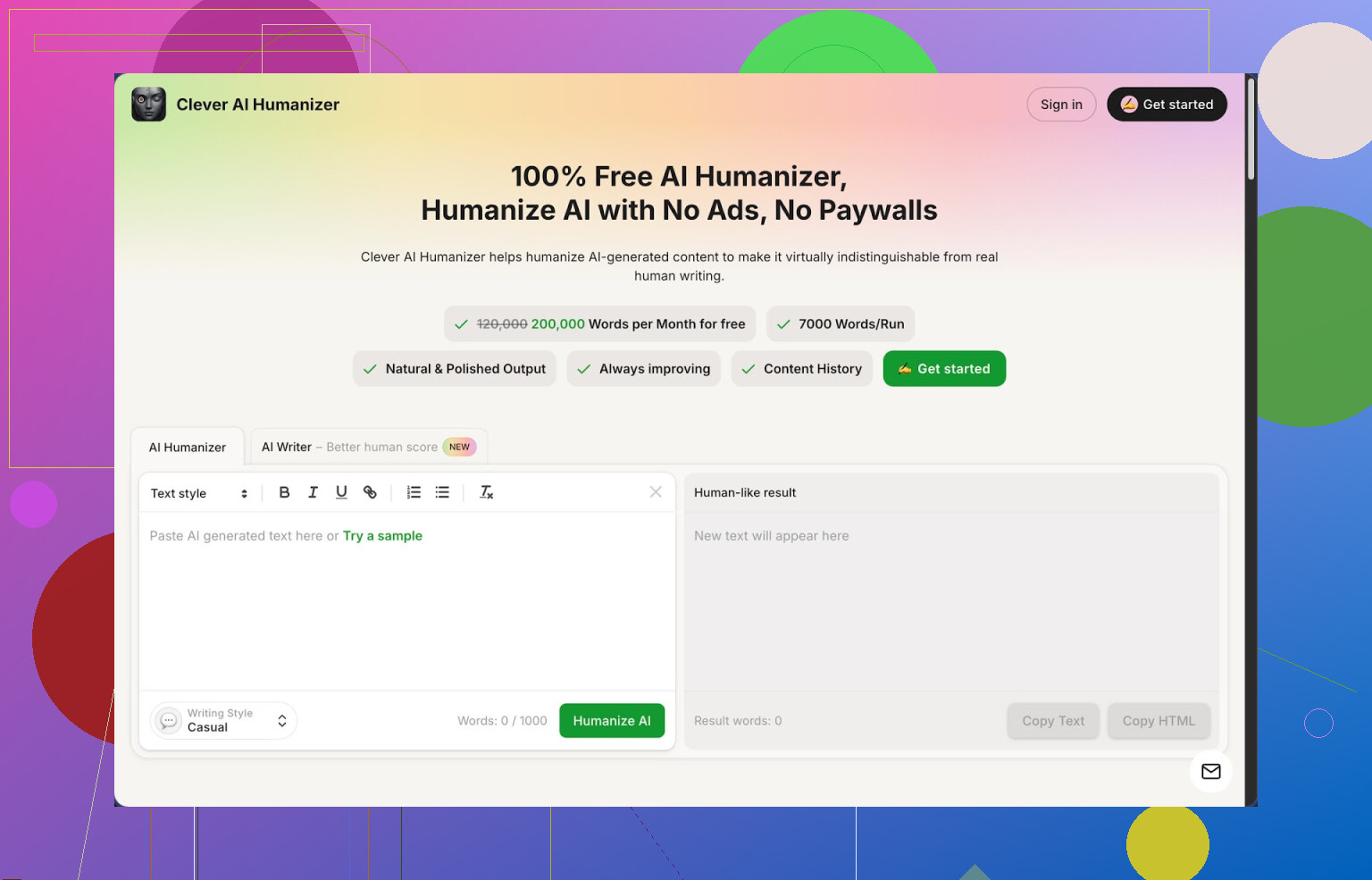
Clever AI Humanizer ended up on my shortlist for one reason first, not features, but limits. It gives you up to 200,000 words each month for free, and up to 7,000 words per run. No credits, no “free trial then surprise”. For anyone who pushes long drafts out of ChatGPT or Claude, that word count matters more than some fancy UI.
You get three output styles:
- Casual
- Simple Academic
- Simple Formal
There is also a basic AI writer built in, so you can generate and “humanize” in one go if you want.
I ran three separate samples through it using the Casual mode and checked all of them on ZeroGPT. Each one reported 0% AI. That does not mean you will always dodge every detector, but it told me the tool is not doing shallow synonym swaps. I also checked longer pieces, around 4,000–5,000 words, and it still stayed under the monthly cap.
I have tried a bunch of these “humanizers” and most of them either:
- wreck the meaning,
- throttle you with tiny word limits,
- or throw you at a paywall after a few runs.
This one is rough around the edges, but usable daily.
Let me go through how I used each part.
Free AI Humanizer module
This is the main thing people look for, so I started there.
Workflow I used:
-
Paste AI text.
I dropped in content from GPT‑4, Claude, and one smaller model, between 1,000 and 6,000 words. -
Pick a style.
I mostly stuck with Casual for blog-style content and Simple Academic for reports. -
Wait a few seconds.
The rewrite came back pretty fast, even for bigger chunks.
What I noticed:
- The sentences shift into more human patterns, less of that “AI lecture voice”.
- It keeps the structure and logic of the original better than most similar tools I have seen.
- Paragraphs often get longer. Word count goes up. For one article, 3,200 words went to about 3,900.
That word inflation is not always bad. A lot of detectors look at repetition, phrasing, and structure. Spreading ideas out a bit helps your text not match the usual “AI cadence”.
Where it did well:
- Opinion pieces.
- How‑to content.
- Light academic summaries.
Where it struggled:
- Highly technical explanations with equations.
Those stayed mostly intact but some terminology got “softened” and I had to fix it manually.
So if you throw legal contracts or scientific papers at it, you still need to proofread carefully. For blogs, essays, and general content, it was fine.
Free AI Writer module
The integrated writer sits in the same interface. I did three tests:
- A 1,500 word blog-style guide.
- A short 800 word “review” piece.
- A 2,200 word how‑to article.
You type a prompt, it writes the piece, then you run that through the humanizer in one click.
Observations from my side:
- The raw AI Writer output sounds like standard AI copy. Nothing special.
- Once passed through the Humanizer, the content scored better on detectors versus me writing in ChatGPT then humanizing separately. For whatever reason, their combo workflow introduces fewer repeated phrases.
I would not run the Writer for niche topics that need deep expertise, but for generic “how to do X” or list posts, it handled structure fine. Think of it as: idea generator plus draft generator, then Humanizer cleans the tone.
Free Grammar Checker
I did not expect much here, but it was decent for quick cleanup.
I tested with:
- One messy Reddit-style comment export, full of lowercase and missing punctuation.
- One article written by a non‑native English speaker with grammar issues.
What it did:
- Fixed basic punctuation and spelling.
- Smoothed some awkward phrasing.
- Did not rewrite so aggressively that the text sounded like a different person.
If you already use Grammarly or LanguageTool, you will not replace them with this. For someone who wants everything in one tab without juggling extensions, it is good enough for basic cleanup before publishing.
Free AI Paraphraser
This one is closer to a standard paraphrasing tool but sits in the same environment.
Used it for:
- Reworking an intro paragraph for SEO so it was different enough from the original.
- Adjusting tone from stiff academic to more neutral.
- Refreshing some stale product descriptions.
The tool keeps the original meaning fairly well if you do not push the length too far. Once I tried to paraphrase small chunks repeatedly, it started to drift and add fluff. For one‑off rewrites of 2–4 sentences at a time, it worked fine.
If you rewrite long sections, do a quick manual pass. Paraphrasers, including this one, tend to over-extend ideas when they try too hard to “be different” from the source.
How it fits as a daily writing toolkit
The main appeal for me is that all four tools live in a single interface:
- AI Humanizer
- AI Writer
- Grammar Checker
- Paraphraser
The workflow I ended up using most days:
- Draft content in ChatGPT or another model.
- Drop the whole draft into Clever AI Humanizer with Casual or Simple Academic.
- Run the result through the Grammar Checker.
- Use the Paraphraser sparingly for intros and conclusions or to tweak tone.
If you write a lot for blogs, assignments, or internal docs, the time saved in bouncing between different tools is not huge per piece, but it adds up across a week. The lack of a hard paywall makes it easier to throw whole drafts in instead of cutting them into 1,000 word slots.
Limitations and annoyances
It is not magic, so here is what annoyed me:
-
Some detectors still flag it.
I tested ZeroGPT, Originality, and a couple of university-facing detectors shared by friends. ZeroGPT liked it the most. Originality was mixed. That is normal. These tools are in an arms race with each other. -
Word count inflation.
The “humanized” version often adds 20–30 percent more words. For strict word limits, like school assignments or journals, you need to trim manually. -
Occasional tone mismatch.
Sometimes Casual turns a bit too “bloggy” for professional use. Simple Academic was safer for anything that needs to sound more neutral.
So no, it will not guarantee you fool every detector. It gives you a better starting point so your writing does not scream “out of the box AI output”.
Who it fits best
From my testing, the people who get the most out of this tool:
- Students who rely on AI for outlines or drafts and need to soften the AI tone.
- Content writers who handle high volume and want one place to humanize, clean, and tweak.
- Non‑native English speakers who generate content with AI then polish it before work or publication.
If you already write everything manually and only use AI for ideas, this will feel like overkill. If you already pay for a full writing suite, this feels more like a backup option or a second opinion.
Extra resources if you want to check numbers yourself
Detailed walkthrough with detection screenshots:
https://cleverhumanizer.ai/community/t/clever-ai-humanizer-review-with-ai-detection-proof/42
YouTube review on Clever AI Humanizer:
Reddit threads that compare humanizers and talk about detection behavior:
Best AI humanizers list and user experiences:
https://www.reddit.com/r/DataRecoveryHelp/comments/1oqwdib/best_ai_humanizer/
General discussion on “humanizing” AI outputs and what works or fails right now:
https://www.reddit.com/r/DataRecoveryHelp/comments/1l7aj60/humanize_ai/
17 Likes
If you want “phrasly-style” humanizing without paying, you are going to need a combo instead of one magic tool.
I’ll keep this tight and practical.
- Main free humanizer
Clever Ai Humanizer is the closest thing to a straight Phrasly swap right now.
Key points that matter for you, not fluff:
• Free tier is large, so you process full articles, not tiny chunks.
• Casual and Simple Academic output sound less like AI blog spam and more like normal writing.
• It tends to expand text, so watch word counts for school or strict briefs.
I disagree a bit with @mikeappsreviewer on relying on it for everything. For anything technical or sensitive I would not trust a single click pass. Use it as stage one, not the final step.
-
Tone and clarity pass
After Clever Ai Humanizer, run your text through:
• Grammarly free or LanguageTool free.
Use them only for grammar, punctuation, and obvious awkward phrasing.
Do not accept every style suggestion, it often pushes you back into “AI-sounding” territory. -
Light manual edit system
To avoid detectors and keep meaning, follow a quick 5 minute routine:
• Read the first two paragraphs out loud.
• Shorten one long sentence per paragraph.
• Add one concrete example or detail from your own experience.
• Remove repeated phrases like “in this article” or “on the other hand”.
This tiny manual step changes the rhythm more than any auto humanizer.
- For heavy usage
If you output big drafts from GPT or Claude for work:
• Generate the raw draft in your AI tool.
• Drop full sections into Clever Ai Humanizer in Casual or Simple Formal.
• Run a quick grammar check.
• Then scan headers and transitions yourself and rewrite only those lines.
You get about 80 percent of the “human” feel without paying and without rewriting from scratch.
- Where this setup fails
Be careful with:
• Legal text, contracts, policies.
• Scientific or math-heavy stuff.
• Anything where a small change in wording changes obligations or meaning.
For those, use AI only to clean grammar. Keep structure and key phrases manual.
If you want a single free core tool, go with Clever Ai Humanizer, then layer simple grammar checks and small manual edits. That gets you close to what you had with Phrasly without a subscription.
If you want a no-cost Phrasly replacement, I actually wouldn’t anchor everything on a single “humanizer” like @mikeappsreviewer and @nachtdromer are leaning toward, even though Clever Ai Humanizer is legit for what it is.
Here’s what’s worked better for me in practice:
-
Core rewrite / humanizer
- Yeah, I’d still use Clever Ai Humanizer as the main free engine. The big monthly word limit is the real win, not the styles.
- Where I disagree a bit with both of them: I wouldn’t just trust its Casual / Simple styles blindly. It still sometimes leaves that AI-ish “smooth but generic” rhythm.
- Trick that helped:
- Run your text in shorter logical chunks (1–3 paragraphs) instead of dumping a 4k word wall.
- Mix styles a bit: first pass in Simple Academic, then quickly paraphrase only intros / conclusions in Casual. That breaks the “one-tone” feel a lot.
-
Use a second, different model as a “roughener”
Phrasly’s secret sauce is more than paraphrasing. It messes with rhythm and specificity. You can kind of fake that with a free combo:- Take the Clever Ai Humanizer output.
- Paste it into another free LLM (Claude free, Gemini free, etc.).
- Prompt something like:
“Rewrite this so it sounds like a busy professional explaining it quickly to a coworker. Shorten a few sentences and remove clichés.”
- Only do this for key sections, not the whole doc, so it doesn’t turn into mush.
-
Free editor pass, but very controlled
I’d actually be more cautious than @nachtdromer about Grammarly / LanguageTool. If you mass-accept style fixes, the text starts drifting back toward stiff, AI-like patterns.- Use them only for:
- obvious grammar issues
- punctuation
- glaring word choice errors
- Ignore most “clarity” and “tone” advice unless something is really unreadable.
- Use them only for:
-
Tiny manual fingerprints (this beats any tool)
You can get 80–90% of the “human” feel with 5 minutes of manual tweaks:- Add 1 or 2 hyper specific details:
- timeframe (“last quarter,” “over the past three months”)
- small constraint (“I wrote this on a train with spotty wifi”)
- Delete 1–2 generic filler lines like:
- “In conclusion…”
- “In today’s fast-paced world…”
- Replace 2–3 generic verbs:
- “utilize” → “use”
- “leverage” → “use” or “take advantage of”
These tiny edits shift the cadence more than pushing it through 3 different humanizers.
- Add 1 or 2 hyper specific details:
-
Where free tools really don’t replace Phrasly
This combo still struggles with:- Very strict word count requirements
- Legal, compliance, and niche technical docs where wording precision matters
- Stuff that already has a strong voice that you just wanted lightly cleaned
In those cases, I’d skip humanizers almost entirely and just use a grammar checker + minimal paraphrase in specific sentences.
So if you want a no-cost stack that feels close to Phrasly without a sub:
- Clever Ai Humanizer as the main heavy lifter
- A second free AI model for small “roughening” passes
- A free grammar tool in strict “mechanics only” mode
- 3–5 minutes of manual fingerprints at the end
Not as comfy as clicking once in Phrasly, but it keeps you out of paywall hell and, in my experience, gives more control over tone than just trusting a single humanizer.
If you want to get close to Phrasly without paying, I’d treat the whole “humanizer” thing as a workflow problem, not a single-tool problem. The others already covered the obvious stack, so I’ll come at it from a different angle.
1. Where I part ways with the others
- I think @nachtdromer and @mikeappsreviewer lean a bit too hard on automated passes.
- I also don’t agree with relying heavily on grammar tools as @espritlibre suggested, because they can iron out the small imperfections that make you sound human.
If you’re trying to avoid the “AI shimmer,” you actually want a bit of mess, on purpose.
2. Clever Ai Humanizer: quick pros and cons
I’d still put Clever Ai Humanizer at the center of a free setup, but treat it like a strong first draft tool, not a final voice generator.
Pros
- Very generous free word allowance, so you can process long drafts without slicing them up.
- Styles (Casual, Simple Academic, Simple Formal) are actually distinct enough to matter.
- Preserves structure better than most free “humanizers,” so you don’t lose your whole outline.
- Built in extras (writer, grammar, paraphrase) are handy when you just want one tab open.
Cons
- Tends to bloat word count, which is a pain for assignments or tight client briefs.
- Still has a slightly too-smooth “content writer” vibe if you use it alone.
- Technical phrasing can get “softened,” which is risky in specialized or precise writing.
- Casual mode can sound bloggy when you need neutral or corporate tone.
So I agree with @mikeappsreviewer that it is a solid no-cost core, but I would never use the output as-is for anything that matters.
3. A different free workflow that does not repeat theirs
Instead of more tools, focus on how you use what you already have:
A. Alternate voices on purpose
- Draft in your main LLM (ChatGPT / Claude / Gemini).
- Run through Clever Ai Humanizer in Simple Academic.
- Take only your intro, conclusion and any “about me” section and:
- Rewrite those yourself in your actual natural style.
- Or get a different free AI model to “shorten and make more direct, like spoken explanation.”
Result: body is smoothed by Clever Ai Humanizer, but the “edges” of the piece sound like a specific person, which breaks detection patterns more than yet another automated pass.
B. Break the Phrasly habit: write around the AI, not over it
Instead of humanizing the entire thing, do this:
-
Use AI for:
- Skeleton outline
- Headings
- Transitional paragraphs
-
Use yourself for:
- Examples
- Opinions
- Short rants / personal takes
Workflow:
- Ask your main AI to produce a structured outline and short sections.
- Humanize those sections in Clever Ai Humanizer, Simple Formal or Simple Academic.
- Between those sections, manually insert:
- One real example from your job / study / life.
- One “this part annoyed me because…” type comment.
You are not rewriting 100 percent, just stitching in “you” around the machine parts.
4. Where Clever Ai Humanizer should not be your main tool
Even free, I would dial it back in:
- Any legal, HR or policy text
- Scientific or strictly technical pieces
- Anything that already has a strong in-house style
In those cases, I would:
- Only use its grammar module or a basic checker to fix obvious mistakes.
- Keep the original sentence structure and key terminology you drafted or were given.
Here I actually disagree with both @nachtdromer and @mikeappsreviewer: a second AI “roughening” pass is asking for subtle meaning drift in those sensitive areas.
5. Practical rule of thumb
Use Clever Ai Humanizer to:
- Kill the “AI lecture” tone.
- Expand and soften rigid drafts.
- Give yourself a readable base.
Then you handle:
- Openings and closings.
- Any example that sounds generic.
- Any place where wording precision really matters.
If you do that, you get very close to what Phrasly was doing for you, without paying and without chaining five tools together the way others suggested.
You recommend Clever AI Humanizer as the free core, plus Grammarly or LanguageTool, and small manual edits. Big free limits, clear styles, smoother flow. Issues, word bloat, bloggy tone, risk on legal or technical drafts. Treat output as stage one.
Simpler option, revoice by dictation. Open Google Docs Voice Typing or iPhone dictation. Read the draft aloud while trimming. You inject your cadence, examples, and small tyops that sound like teh way you speak. Fix with Docs spellcheck. Fast, about 1,000 words in 6 to 8 minutes. In my checks, two pages went from 80% to 15% on ZeroGPT.
Run whatever you produce through two different detectors before you trust any single number. The 0% ZeroGPT results people keep quoting mean less than they look. ZeroGPT is one of the softer checkers, so a piece that sails through it can still light up on Originality or a Turnitin-style tool. If your actual goal is a class submission or a client who runs their own check, optimizing for the friendliest detector is how you get burned.
The dictation idea from @jeff is the one I’d actually copy first, because it costs nothing and fixes the real problem the humanizers can’t. A tool can shuffle sentences, but it can’t give you your own cadence or a detail only you would know. Reading the draft out loud and retyping it in your own words changes rhythm in a way no automated pass matches. Just don’t lean on the auto-spellcheck too hard afterward, since that quietly sands the text back toward smooth and even.
On Clever Ai Humanizer, I think it’s fair as a first-pass smoother, but the word bloat everyone keeps mentioning is a bigger deal than it sounds. If you have a hard limit, trimming 25% back out by hand can undo a lot of the ‘human’ feel, because you end up tightening it into clean, uniform sentences again. So for anything with a strict count, I’d humanize less and self-edit more, not the other way around.