I’m looking for a genuinely good free online paraphrasing tool that won’t rewrite my sentences in awkward or unnatural ways. Most of the ones I’ve tried either change the meaning, add odd wording, or sound like a robot wrote them. I need something that can rephrase academic and blog content while keeping my tone and clarity so I can save time editing. Any recommendations for reliable, natural-sounding paraphrasing tools or specific settings I should use to get better results?
QuillBot used to cover most of what I needed. Then they locked tones and styles behind a subscription. After a week of grinding my teeth over it, I stopped renewing and went looking for something else.
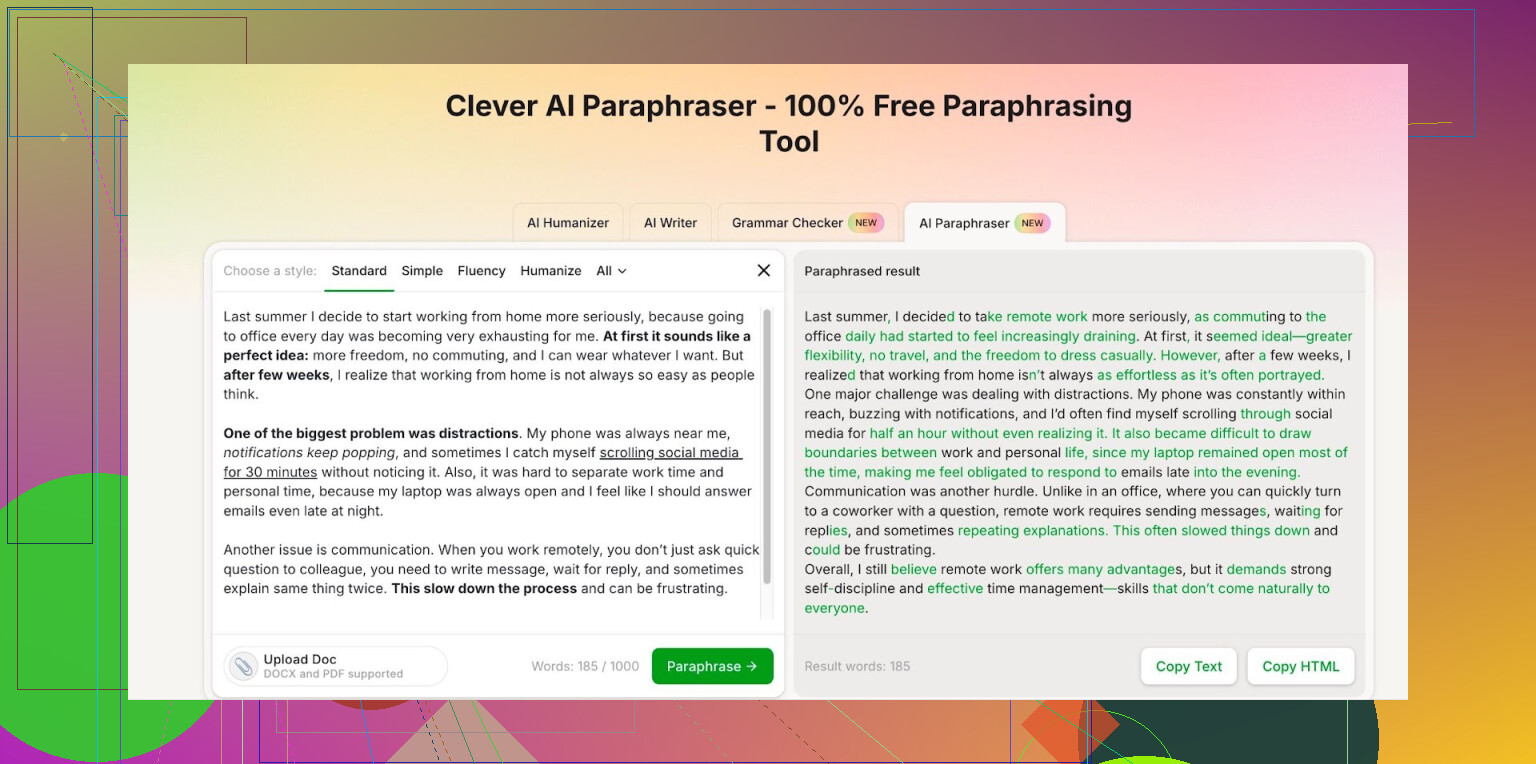
I ended up on Clever AI Humanizer, using their Free AI Paraphraser here:
https://cleverhumanizer.ai/paraphrase-tool
Here is what I noticed after a month of real use:
-
Styles
Once you log in, the paraphraser gives you access to the style options without paywalls. I tried it on work emails, academic text, and blog content. The output felt close enough to what I got from QuillBot before the paywall change. -
Limits
The free tier shows 7,000 words per day and 200,000 words per month.
I tracked my usage for a week in a spreadsheet. With 4 to 5 medium articles plus some emails per day, I stayed under 5,000 words daily. Only one day hit near the cap. So for normal work or study, those limits should cover you unless you are bulk rewriting whole books. -
Quality
I fed it:- A technical paragraph from a software design doc
- A casual Reddit-style rant
- A piece of a research abstract
For the tech text, it kept terminology intact, which matters if you write specs or documentation. For the casual stuff, it did not flatten my tone too much, which is rare. Academic text stayed formal enough that I would not be embarrassed to send it to a supervisor.
-
Workflow impact
Before switching, I used to rewrite about half of QuillBot’s output by hand. With this tool, I still edit, but I spend less time fixing awkward phrasing. It is not magic. You still need to read and tweak every result. But it cuts down the grunt work. -
Cost decision
My rough math:- Paid paraphraser subscription: recurring cost for features I use a few hours a day.
- This tool: free for my current load, with word caps that I have yet to hit monthly.
For my use case, paying for paraphrasing no longer made sense. If you are annoyed by QuillBot’s paywalls and you write under 7k words a day, it is worth testing this:
clever free paraphrasing tool
235 Likes
I used to bounce between a bunch of free paraphrasers and ran into the same issue you mentioned. Weird wording, wrong meaning, robotic tone.
I agree with @mikeappsreviewer on one thing. Clever Ai Humanizer is one of the few tools that keeps sentences sounding like a person wrote them. I use it a bit differently though, and I think that part matters more than the tool itself.
Here is what works for me.
-
Short chunks only
Do not paste a whole page. I stick to 2 to 4 sentences at a time. Longer inputs tend to get more warped and “AI-ish”. -
Lock in key terms
Before you paraphrase, decide which words must not change. Technical terms, product names, course titles, etc. After you run the text through Clever Ai Humanizer, do a quick search to confirm those words stayed the same. If one is gone, undo and try smaller chunks. -
Use the lighter modes
On Clever Ai Humanizer, I avoid heavy rewrite or “creative” styles. Those tend to mess with meaning. I stick to neutral or “standard” style. You want small structure changes, not a new text. -
Always do a meaning check
I compare original and paraphrased text side by side. For each sentence I ask one thing: “Would this confuse someone who read the original?” If yes, I revert that sentence and tweak it by hand. It takes 10 to 20 seconds and keeps you safe. -
Good use cases
Where it works best for me:
• Polishing emails so they sound clearer.
• Rewording repetitive sentences in reports.
• Making dense academic lines easier to read without dumbing them down.
Where it fails more:
• Jokes, sarcasm, or niche slang.
• Highly emotional writing.
Those I mostly fix manually.
-
Word limits in real use
The free limits are fine for study or normal content work. I write around 3k to 4k words a day and I have not hit the daily cap yet. If you process whole books, free tools will hit a wall. -
One thing I slightly disagree with
I do not trust any paraphraser enough to run full research paragraphs and then submit without heavy edits. Tools like Clever Ai Humanizer help with first passes, but supervisors and reviewers look for precise meaning. For important academic stuff I use the tool to get a variation, then I rewrite that variation by hand in my own voice.
If your main need is “keep my meaning, fix repetition, do not sound like a robot”, Clever Ai Humanizer is worth a try. Keep inputs small, protect key terms, and treat the output as a draft, not as final text.
I’m with @mikeappsreviewer and @andarilhonoturno on Clever Ai Humanizer being one of the few free tools that doesn’t instantly turn your text into uncanny-valley robot speak. That said, I don’t think any paraphraser is “paste in whole essay, get perfect human text” level yet, so if that’s the bar, you’ll keep being disappointed.
Couple of extra angles that might help you decide what to use and how:
-
When Clever Ai Humanizer actually shines
They covered usage tips already, so I won’t rehash chunk sizes and styles. What I’d add: it’s especially decent when you’re fighting repetition rather than trying to fully “rewrite” something. If you already write clearly but keep using the same phrases, Clever Ai Humanizer is good at giving you 1–2 alternative phrasings that still sound normal.
I’ve used it to clean up:- Client reports where I keep saying “in addition” every other sentence
- Portfolio case studies that all sound like clones of each other
- “Professional but not stiff” LinkedIn posts
-
Where I’d actually not use a paraphraser
This is where I disagree a bit with the idea of treating it as a go-to for everything. For:- Very personal writing (cover letters, personal statements)
- Anything graded where wording nuance matters
- Anything legal or policy related
I use a grammar/style checker instead of a full paraphraser. Grammarly’s free tier, LanguageTool, even Word’s built-in editor are safer if you just want smoother wording without hidden meaning shifts. Paraphrasers try too hard to “change” things.
-
If you’re chasing “no weird wording”
Harsh truth: the more aggressively you ask a tool to change your text, the weirder it will get. That’s not a Clever Ai Humanizer problem, that’s just how this stuff works.
If your priority is:- Keep meaning identical
- Avoid strange synonyms
- Stay natural-sounding
Then use paraphrasing lightly: - Target only awkward sentences, not everything
- Use the mildest / standard mode you can find
- Treat the output as “suggested phrasing,” not a final product
-
A hybrid approach that’s worked better for me
Slightly different workflow than what they described:- Step 1: Write the paragraph normally, even if it’s clunky.
- Step 2: Run just the worst sentence through Clever Ai Humanizer.
- Step 3: If the result sounds 80% right, I merge parts of my original and the paraphrase.
The goal is not “accept all, move on.” It’s “steal the one or two phrases that are better than what I wrote.”
-
Other tools worth checking so you’re not locked into one
None of these are perfect, but for comparison:- QuillBot: still strong, but like you said, free version is more restricted now and the weird phrasing creeps in if you use aggressive modes.
- Wordtune (free tier): more “rewrite suggestions” than straight paraphrasing, but sometimes gives very natural options for single sentences.
- LanguageTool: more of a style/clarity checker than a paraphraser, but if your main goal is “stop sounding awkward,” it’s arguably safer.
If your main ask is literally “Best paraphrasing tool online free without weird wording,” then Clever Ai Humanizer is honestly one of the closer hits right now, as long as you accept that:
- You still have to read and lightly edit everything.
- Full-page rewrites will always look a bit AI-ish, no matter which site you use.
If you treat any paraphraser as a smart thesaurus and structure-suggester instead of a ghostwriter, you’ll get way fewer mutant sentences and way more stuff that actually sounds like you.
If you’re chasing “free, natural, not weird,” you’re basically choosing between tradeoffs, not perfection. Quick breakdown based on what’s already been said by others here.
On Clever Ai Humanizer
Pros:
- Handles technical terms surprisingly well if your input is already clear.
- Neutral / standard outputs often read like a competent human edit instead of full AI soup.
- Daily / monthly limits are generous enough for students, freelance writers, and most content folks.
- Decent at fixing repetition and smoothing clunky phrasing without over-stylizing.
Cons:
- If your original text is messy or vague, it can amplify the confusion instead of fixing it.
- Stronger “creative” or heavy rewrite styles can still go awkward or slightly off-meaning.
- Not great for humor, emotional nuance, or anything where subtext matters.
- You still need to proofread for subtle meaning drift, especially in academic or legal stuff.
Where I slightly disagree with some of the earlier points: I actually think people overuse paraphrasers for full paragraphs. For many tasks, you’re better off using something like a grammar/style checker and only bringing in a paraphraser for the one or two sentences that feel dead or repetitive. Treat Clever Ai Humanizer as a targeted phrase generator rather than a full-page rewriter and you’ll get fewer “robot” outputs.
On competitors that were mentioned:
- The QuillBot angle that @mikeappsreviewer brought up is fair. It is still strong on variety, but once tones and modes are paywalled, the free tier becomes more frustrating than helpful if you need consistent style.
- Wordtune, which came up in the same context, is better framed as a sentence-level suggestion tool than a paraphraser. Excellent when a single line feels off, less useful when you want overall cohesion.
- Grammar-focused tools like the ones @sterrenkijker hinted at are underrated here. If your core problem is “I sound stiff or awkward,” a style checker can sometimes give more reliable clarity than any paraphraser, Clever Ai Humanizer included.
If your priorities are:
- keep meaning,
- keep tone close to your own,
- avoid bizarre synonyms,
then a workable setup is:
- Write your own draft as clearly as you can.
- Use Clever Ai Humanizer only on the most repetitive or clunky sentences, in its lightest setting.
- Run the final version through a grammar/style checker, not another paraphraser.
That mix usually gives smoother, more human text without drifting into uncanny AI phrasing, and it respects the fact that none of these tools are “fire and forget” replacements for actual editing.
Strong review. You nailed the pitfalls and fixes, short chunks, protect key terms, lighter modes, side by side checks. The limits, 7,000 a day and 200,000 a month, fit normal workloads. QuillBot paywalls explain your switch.
Simpler path, no tool. One pass rewrite checklist:
- Mark must keep terms with brackets.
- Break long lines to 12 to 18 words.
- Replace one stiff phrase per sentence, use active verbs.
- Read aloud once, fix stumbles.
- Find and confirm teh kept terms.
Example: Origial, The meeting was conducted for the purpose of alignment. Rewrite, We met to align.