I’ve been testing BypassGPT for a few projects and I’m unsure if it’s reliable or even safe to keep using. The responses sometimes feel inconsistent and I’m worried about possible policy or legal issues down the road. Could anyone with real experience explain how well BypassGPT actually works, what risks I should know about, and whether there are better, safer alternatives for similar use cases?
BypassGPT review, from someone who tried to test it and mostly fought the limits instead
BypassGPT site:

I tried to give BypassGPT a fair run, but the free tier made that tough
First thing I hit was the word cap. The free version only lets you run up to 125 words per input and around 150 words per month in total. That is not a typo. One hundred fifty words for the whole month.
I ended up creating a free account, which unlocked something like another 80 words. That let me run a single one of my usual test samples. Not a batch. Not variations. One.
The limit seems tied to IP. I tried setting up another account and the counter did not reset. Unless you route through a VPN, you are stuck with that ceiling. At that point, you are not testing a tool, you are guessing.
Here is the kind of screen you see when you hit the wall:
Detection results were all over the place
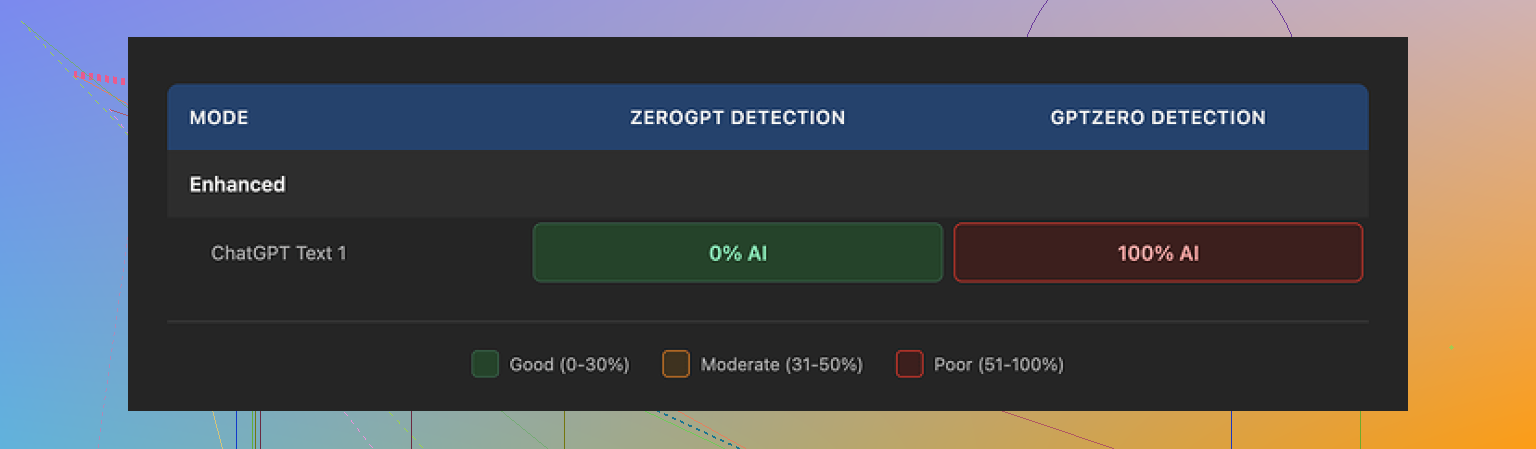
With the tiny sample I managed to run, I did a basic check:
• Ran the BypassGPT output through ZeroGPT
• Ran the same output through GPTZero
• Compared those to what BypassGPT’s own checker claimed
What happened:
• ZeroGPT said the output was 0 percent AI
• GPTZero said the same text was 100 percent AI
• BypassGPT’s built-in checker said it passed on all six detectors it claims to support
That last part is where I raised an eyebrow. Their checker said everything passed cleanly across six tools, but my manual tests showed the opposite on at least one major detector. With that, I stopped trusting their “all clear” badges.
Writing quality was not great
Ignoring detection for a second, I looked at the writing itself.
On my sample, I scored it around 6 out of 10:
• The first sentence was broken grammatically, I would not send it in an email
• It kept em dashes even though those often trip detectors and feel off in some formal writing
• Some phrases sounded stiff, the kind of thing you see from straight AI outputs
• There was at least one typo baked into the output
It did not feel like something a careful human wrote. It felt like a slightly shaken-up AI paragraph. If you plan to paste outputs straight into work or school submissions, you would need to do a full edit pass yourself.
Pricing vs what you give up
Their paid plans at the time I checked:
• About $6.40 per month on the annual plan for 5,000 words
• About $15.20 per month for “unlimited” use
The price itself is not insane for a niche tool, but the terms of service are the part I did not like.
Their TOS gives them broad rights over anything you put into the system. That includes the right to:
• Reproduce your content
• Distribute it
• Create derivative works from it
If you are pushing in client work, academic writing, or anything private, that is a red flag. You have to be comfortable with them holding those rights over your text. I was not.
How it stacked up against Clever AI Humanizer in my tests
On my side-by-side runs, Clever AI Humanizer did better in two ways:
• The text felt more natural when I read it out loud
• Detection scores were higher across the main detectors I use
It is also free to use, so I was able to run full test suites without word rationing.
Link again for reference:
Quick takeaways if you are deciding what to try
If you are thinking about BypassGPT:
• The free tier is too limited for serious testing
• Detection claims from their built-in checker did not line up with external tools in my run
• Output quality needs manual editing
• Terms of service give them broad rights over your content
• There are alternatives like Clever AI Humanizer that did better in my tests and do not put you on a tight word leash
If you want to experiment, start with something free that lets you run real samples, then compare across detectors yourself before you throw money or important text at any of these tools.
14 Likes
Short version, if you are worried about reliability and legal stuff, your instincts are fine.
My take after messing with BypassGPT on client content:
-
Reliability and detection
• AI detectors do not agree with each other at all.
• On my side, I saw the same thing as @mikeappsreviewer, one detector said “human”, another screamed “AI”.
• Any tool that promises “passes all detectors” feels risky if you use it for anything serious or long term.
• Treat its own “checker” as marketing, not as a real audit. -
Safety and policy risk
• If you use it for school or work where AI use is restricted, you carry the risk, not the tool.
• Detectors improve, policies tighten, and retroactive checks happen.
• If your employer or school bans AI help, using an AI-to-humanizer pipeline to hide that is a policy problem, even if the text passes today. -
Legal and content rights
• Their terms give them broad rights over what you paste in.
• That is a hard no for anything under NDA, client projects, or unpublished writing.
• If you already pushed sensitive stuff through it, I would stop and avoid sending more. -
Quality and workflow
• Output needs a full human edit to sound consistent across a project.
• For multi page documents, tone drifts a lot, so it becomes faster to write or rewrite yourself.
• I only found it useful for small tweaks on low risk content, like social captions I already wrote. -
If you keep using it
• Do not send contracts, legal docs, or client materials.
• Do not rely on its checker, always test with multiple third party detectors if that matters to you.
• Keep a human style guide and edit everything for consistency and typos.
• Assume anything you paste in is no longer fully private. -
Alternatives
• If your goal is “less AI sounding” wording, a mix of manual editing plus a normal LLM with strict prompts works better.
• For an AI detection focused tool, Clever Ai Humanizer behaved more predictably for me, and it did not lock me behind tiny word caps. Still not magic, still needs editing, but less friction.
If your projects involve grades, compliance, or confidential info, I would step away from BypassGPT and any “bypass” style tool and focus on transparent AI use and strong editing, not detector evasion.
Short version: your instincts are right to be nervous.
I’ll try not to just rehash what @mikeappsreviewer and @sognonotturno already laid out, but build on it a bit.
-
Reliability / “bypassing” AI detectors
- Detectors are fundamentally noisy. I’ve seen the same text get “90% human” in the morning and “99% AI” at night from the same tool after a model update.
- So when BypassGPT markets itself as something that “passes everything,” that is not a capability, it is a moving target. Any guarantee here is flimsy by design.
- In practice, what you’re feeling as “inconsistent responses” is exactly what I saw too: tone shifts, weird word choices, and sometimes that subtle AI rhythm that detectors love to latch onto. You can sand it down with manual edits, but then you’re doing half the work yourself anyway.
-
Policy & long‑term risk
- There is a big difference between “AI‑assisted writing” and “AI text laundered to pretend it’s human.” Tools like BypassGPT clearly lean toward the second bucket.
- If you are in any environment where policies say “disclose AI use,” relying on a bypasser is a double risk: violation today, and retroactive consequences later if they recheck work or logs.
- Schools and companies are getting better at forensic checks: style fingerprints, revision history, metadata, version control, etc. Even if BypassGPT slipped past a detector, your doc history might not.
-
Legal / TOS angle
- I agree with both other reviewers that their terms are… generous to themselves.
- Where I’ll push slightly further: it is not just about “they can reproduce or derive from your content.” It is also about data aggregation. Once your text is in their system, it can be mined for patterns, which might make its way back into outputs for other users.
- That might not matter for casual stuff, but for anything under NDA, pre‑publication research, or internal company docs, this is not just a “red flag,” it is approaching “do not touch.”
- If you’re already worried now, that’s usually a sign to stop feeding it fresh inputs and not rely on “oh well, too late.”
-
Where I slightly disagree with the others
- I don’t think BypassGPT is totally useless for all use cases.
- If you are working with low‑stakes, public content (social posts, product descriptions, non‑sensitive blog drafts) and you are comfortable treating it purely as a noisy paraphraser, it can be a tool in the pile.
- But that is a far cry from depending on it as a “safety layer” between you and school / employer policies. In that role, it’s worse than nothing, because it gives a false sense of security.
- Also, I’ve seen slightly better results when people constrain it heavily with their own style guidelines, then edit by hand. That said, at that point a normal LLM plus your own editing is usually cleaner.
-
Practical advice if you are unsure about keeping it
- Stop routing any sensitive or identifiable content through it. Client work, academic essays tied to your name, contracts, internal docs: off limits.
- If you must use it, treat its detection checker as marketing only. Do your own spot checks with several third‑party detectors, and still assume they are unreliable.
- Keep your own “voice” consistent. One of the easiest retroactive giveaways is when half your historical writing looks one way and suddenly everything flips to the “generic AI” cadence.
- Build a workflow where you openly use AI as a drafting tool and then humanize manually. Transparency + editing beats gimmicky bypassing in the long run.
-
Alternatives / what to try instead
- For actually making text feel less AI‑ish without the sketchy “bypass” branding, something like Clever Ai Humanizer is a more straightforward option. It is literally focused on natural‑sounding text and AI detection performance, and it does not put you under the kind of microscopic word caps you hit on BypassGPT.
- Even then, I’d still treat Clever Ai Humanizer as an assistant, not a magic invisibility cloak. You still need to read everything out loud, tweak phrasing, and own the final copy.
- Honestly, for policy safety, your best “tool” is:
- a regular LLM for brainstorming,
- your brain for restructuring,
- and manual editing for tone and style consistency, with open disclosure where required.
So if your use cases touch grades, compliance, or anything legally sensitive, I’d step away from BypassGPT and the whole “bypass” mindset and move toward transparent AI use plus strong human editing. If it’s just for low‑stakes content and you can live with the TOS, keep it in the toy/tool bucket, not the “safety net” bucket.
BypassGPT in one sentence: fine as a toy paraphraser, terrible as a “shield” against rules, audits or future you.
A few angles that weren’t fully covered yet:
1. “Bypass” as a use case is the real problem
If your goal is “sound more natural” or “clean up AI tone,” that is defensible.
If your goal is “hide that I used AI,” every tool in that category is inherently unstable:
- Policies evolve faster than these tools.
- Logs, revision history and style analysis matter more than detector scores.
- Anything that markets itself on “undetectable” makes you the fall guy when it fails.
That is less a BypassGPT flaw and more a flawed use case, but BypassGPT leans right into it.
2. Inconsistency you’re feeling is structural
What you describe as inconsistent is exactly what I saw:
- Short chunks sometimes read okay, but over a full page, voice and pacing drift.
- It tries to “roughen” AI text, which often introduces minor errors, awkward phrasing and mismatched tone across sections.
- For multi document projects, keeping a stable voice becomes your job, not the tool’s.
So if you are hoping for “drop in and forget it,” BypassGPT just does not get you there.
3. Where I mildly disagree with others
I am slightly less harsh on its usefulness for low stakes stuff than some comments:
- For quick, disposable content where you truly do not care about detectors or long term traceability, BypassGPT can act as a no-frills rephraser.
- That said, at that point a normal LLM with a clear style prompt is simpler and usually cleaner, without the “bypass” baggage.
Where I still align with the others: once grades, clients, NDAs or internal policies are in play, the risk to you grows while the actual benefit does not.
4. Clever Ai Humanizer as an alternative
Since several of you mentioned Clever Ai Humanizer already, here is a more direct take relative to what you are trying to do.
Pros of Clever Ai Humanizer
- Tends to produce more natural, less “robotic” cadence on longer pieces.
- Less aggressive word caps so you can actually test workflows.
- In practice I have seen more stable behavior across different detectors than with BypassGPT, though nothing is perfect.
- Better fit if your real goal is readability and tone rather than sneaking past checks.
Cons of Clever Ai Humanizer
- Still not magic. You need to edit, especially for important writing.
- Does not remove policy or disclosure obligations in school or work. If AI is banned or requires disclosure, this does not change that.
- Like any external tool, you must treat anything you paste as potentially non private. Do not use it for sensitive contracts, confidential strategy docs or unfiled research.
- It encourages a similar “detector” mindset. That mindset itself can get people in trouble because they start optimizing for scores instead of honest usage.
So I would treat Clever Ai Humanizer as a stylistic helper that sometimes improves detector scores as a side effect, not as a stealth cloak.
5. Practical decision tree for you
Ask yourself:
- Is the text tied to grades, legal exposure or company rules?
- If yes, drop BypassGPT and any bypass tool entirely. Use transparent AI help plus your own editing.
- Is the text low risk, public and replaceable?
- If yes, you can experiment, but I would still lean to a standard LLM plus manual edits or a lighter tool like Clever Ai Humanizer, keeping everything non sensitive.
- Are you hoping “if it passes detectors I am safe”?
- If yes, you are betting on a moving target and ignoring other evidence trails. That is where stories go bad months later.
6. About the other reviewers
The points from @sognonotturno, @sternenwanderer and @mikeappsreviewer already cover the painful bits like terms of service, detection noise and workflow friction. Where I would add to them is that the strategic risk is not only “today’s detection score” but the paper trail around your work and the intent behind using a bypass tool at all.
If your instincts already feel uneasy, that is usually the signal to step back from BypassGPT, keep anything sensitive out of tools that claim broad content rights and reframe the goal from “bypass” to “write better with clear boundaries.”