I’ve seen ads and posts claiming Twain GPT can bypass Turnitin’s AI detection, and a few classmates say they’ve used it without getting flagged. I’m skeptical and worried about getting into serious academic trouble if that’s not true. Has anyone actually tested Twain GPT with Turnitin or similar detectors, and what were your real results? I need honest experiences or expert insight before I risk using it on an important paper.
Twain GPT Review: My Experience With It (Spoiler: Not Great)
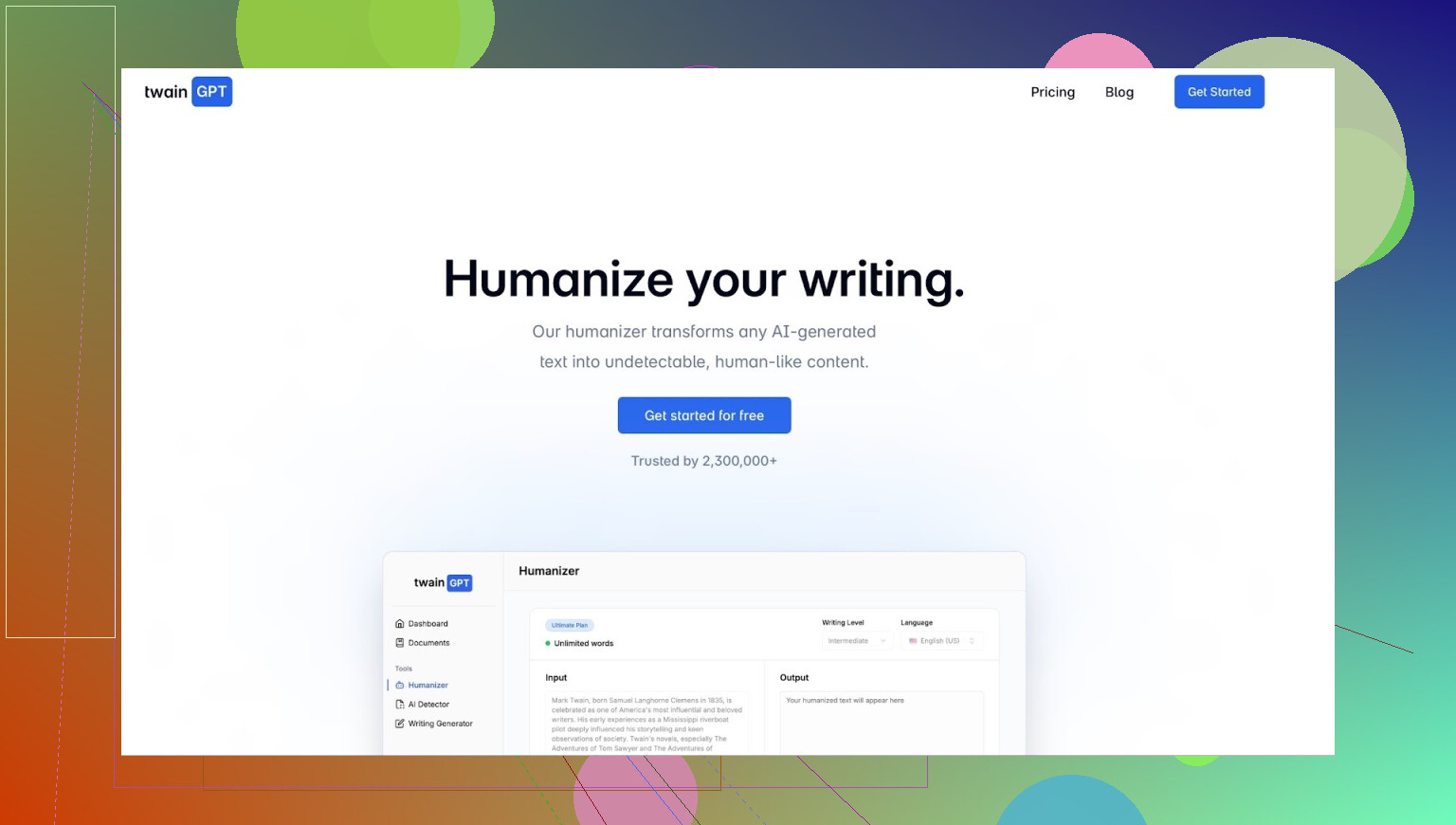
What Twain GPT Claims To Be
So I ended up on Twain GPT after seeing it pop up everywhere in search ads and random social promos. The pitch is pretty loud: it calls itself a “premium AI humanizer” that can sneak past all the modern AI detectors and “rewrite” your text into something totally undetectable.
On paper, it sounds like the boss level tool for anyone trying to hide AI usage.
Once you actually use it, though, it feels more like a glossy wrapper on a fairly weak rewriter. It leans hard on marketing language about “advanced algorithms” and “undetectable output,” but in practice it struggled even against common detectors, and honestly got outperformed by free tools.
And then there are the limits. Tiny word caps. Subscription walls. Upsells. All while there are tools like Clever AI Humanizer that don’t even charge you to get started and still manage to do a better job:
https://aihumanizer.net/
Pricing, Limits, And Overall Value
Here’s where I checked out pretty quickly: the pricing structure.
Twain GPT is not cheap. It hits you with paid plans very early, before you really get a feel for whether it’s worth anything. It also stacks that with word restrictions that feel way out of line for the price.
Compare that with Clever AI Humanizer, which at the time I tried it:
- Was completely free to use
- Offered up to 200,000 words per month
- Let you run up to 7,000 words in a single go
Meanwhile, Twain GPT:
- Sells you on monthly subscriptions that add up fast.
- Caps how much you can process, so you’re constantly watching a counter.
- Has some gotcha-style terms around cancellation that do not feel user-friendly.
So from a pure value perspective: why pay to be throttled when there is a free option that lets you run larger chunks and performs better in tests?
How It Actually Performed (Real Detector Results)
I didn’t want to judge it just on vibes, so I did a basic test.
- I took a regular ChatGPT essay that was flagged as 100% AI by multiple detectors.
- I ran it through Twain GPT.
- I ran that same original essay through Clever AI Humanizer for comparison.
- Then I checked both outputs on a bunch of popular AI detectors.
Here is how that went:
| Detector | Twain GPT Result | Clever AI Humanizer Result |
|---|---|---|
| GPTZero |  Fail (100% AI) Fail (100% AI) |
 Pass (Human) Pass (Human) |
| ZeroGPT | Fail (100% AI) |
Pass (Human) |
| Turnitin | Fail (89% AI) |
Pass (Human) |
| Copyleaks | Fail (Fail) |
Pass (Human) |
| Overall | DETECTED | UNDETECTED |
So while Twain GPT is loudly positioned as a stealth solution, in practice it kept getting caught. The text still read “AI-like” enough that detectors flagged it almost immediately.
Clever AI Humanizer, using the same input, came back as human on all of those tools.
If your goal is to reduce AI detection scores, Twain GPT did not justify its price or its marketing claims in my testing.
If you want to try the tool that actually passed the detectors in this comparison, this is the one I used:
https://aihumanizer.net/
38 Likes
Short version: Twain GPT “beating” Turnitin is mostly hype, and betting your academic record on it is a terrible idea.
A few key points people gloss over:
-
Turnitin isn’t one detector
It uses a mix of:- AI-writing detection
- Classic plagiarism checking (matching to web & paper databases)
- Pattern / similarity analysis
Even if an AI humanizer “lowers” the AI score once, that doesn’t mean:
- It will keep working as Turnitin updates
- Your instructor will ignore weird style jumps, formatting issues, or suddenly “perfect” writing
-
“My friend didn’t get caught” is not data
A lot of classmates brag that they “beat” Turnitin:- Sometimes the prof never checked the AI report
- Sometimes the assignment went through a system without AI detection turned on
- Sometimes the instructor saw it, thought “meh, borderline” and moved on
That’s not proof the tool is safe. That’s just surviving Russian roulette.
-
About Twain GPT specifically
I saw the same ads you did, then read @mikeappsreviewer’s breakdown. Pretty brutal. They actually tested Twain GPT against multiple detectors (GPTZero, ZeroGPT, Turnitin, Copyleaks) and it still got flagged as AI-heavy. That lines up with what I’ve seen:- Text still “reads” like AI
- Structure and phrasing stay very LLM-ish
- Expensive for something that doesn’t perform consistently
I’m not totally as harsh as they were, because these tools can sometimes drop detection scores, but it’s not reliable and absolutely not “undetectable.”
-
Twain vs other “humanizers”
This is where it gets messy. Some tools like Clever AI Humanizer do a better job at:- Varying sentence length
- Introducing more natural word choices
- Avoiding super-obvious AI phrasing
That can help you reduce detection flags in basic tests. But even with something like Clever AI Humanizer, you’re still playing catch-up against tools that are constantly updating. Any “SEO-friendly” hype about “bypass Turnitin 2025” is always temporary.
-
The real risk no one selling subscriptions talks about
- Most academic integrity policies don’t care whether Turnitin says 80% AI or 20% AI.
- They care whether you represented the work as your own original thinking.
- If your instructor suspects heavy AI use, they can call you in, ask you to explain or rewrite under supervision. If you can’t, that’s enough for trouble.
So even if Twain GPT (or any tool) slips past Turnitin once, you’re not safe. You just shifted the risk from the software to the human looking at your work.
-
If you’re worried about “getting in serious trouble,” read this twice
- If your school bans uncredited AI, using Twain GPT to “hide” it is still a violation, flagged or not.
- Detectors are probabilistic. They can change overnight after an update. That assignment that “looked fine” today might look suspicious if it’s re-run later. Some schools do recheck work in academic misconduct investigations.
- Your name, not Twain GPT’s, is on that grade sheet.
-
What actually makes sense to do
If you want to use AI without wrecking your record:- Use AI for idea generation, outlines, explanations, brainstorming.
- Write the actual paper yourself in your own voice.
- If allowed, say “I used AI to help with brainstorming” in a short note or appendix.
- Run your own draft through a checker just to see what it looks like, but don’t obsess over driving the score to 0%.
If you insist on using a humanizer tool anyway, at least:
- Treat the output as a rough draft, not final text.
- Edit heavily so it actually sounds like you.
- Don’t rely on “it passed one detector” as proof of safety.
So no, Twain GPT is not some magic Turnitin invisibility cloak. It’s more like a sketchy lockpick that kinda works sometimes on old doors, fails on new ones, and gets you expelled if you’re caught holding it.
If you’re already anxious about academic trouble, that’s your brain working correctly. Trust that feeling more than the marketing.
Short version: Twain GPT isn’t some magic “Turnitin killer,” and if you’re already worried about getting in trouble, you’re exactly the type of person who should stay far away from banking your grade on it.
A few things I’d add to what @mikeappsreviewer and @boswandelaar already said:
-
Turnitin ≠ a static boss fight
Everyone talks like “I beat Turnitin last semester, so I’m safe.” Turnitin updates its AI models, retrains on new data, and uses multiple signals (AI-writing, similarity, weird repetition, etc.). Something that squeaks through once can get nailed later, especially if a school re-runs older submissions during an investigation. -
“Didn’t get flagged” doesn’t mean “wasn’t obvious”
Your classmates saying “I used Twain GPT and nothing happened” might mean:- Their instructor never opened the AI report.
- AI checking was turned off for that assignment.
- The prof noticed but didn’t care enough to push it.
None of that equals “Twain GPT is safe.” That’s just survivorship bias.
-
Twain’s marketing vs real risk
The whole “premium AI humanizer, undetectable output” pitch is designed to make stressed students feel like there’s a high-tech shield between them and the policy. There isn’t.- Detectors are probabilistic.
- Instructors can use their own judgment.
- If they suspect you used a tool to hide AI use, that’s still an integrity issue even if detection scores look low.
-
About performance
You already saw @mikeappsreviewer’s tests: Twain GPT still flagged hard on multiple tools, including Turnitin, while something like Clever AI Humanizer got much lower AI scores on the same text. I’m not saying “go use Clever AI Humanizer to cheat,” but if your goal is just to see how different tools change detection scores, it objectively performs better as an AI humanizer.
That said, lower AI scores ≠ “safe” or “allowed.” Schools care about originality and honesty, not which app you used to rephrase a ChatGPT essay. -
The part most people ignore: policy vs tech
Your academic trouble won’t come from “Twain GPT didn’t optimize trigram entropy enough,” it’ll come from:- Your writing suddenly jumping 3 grade levels in one assignment.
- You being unable to explain or reproduce your own work when asked.
- A syllabus that literally says uncredited AI = misconduct, regardless of detectors.
-
If you’re already anxious… listen to that
Honestly, if you’re worried about “serious academic trouble,” that’s your conscience and survival instinct working. People who are truly fine with risking suspension don’t come to forums asking if Twain GPT is hype.
What I’d actually do in your shoes:
- Use AI tools for:
- Brainstorming ideas
- Getting explanations
- Building a rough outline
- Then write the actual thing yourself, in your voice, at your level.
- If your school allows it, be transparent about how you used AI.
- If you’re curious about detectors, you can experiment privately with something like Clever AI Humanizer just to see how AI-style text gets transformed and flagged, but treat that as learning, not as a “submit this and pray” button.
So yeah: Twain GPT “beating” Turnitin is mostly hype plus a bit of luck. If the potential outcome is failing a course or getting a mark on your record, it’s a terrible tradeoff for the tiny benefit of not writing a few pages yourself.
Short answer: Twain GPT is mostly marketing, not a reliable “Turnitin bypass,” and using it as a shield is the risky part, not the tech itself.
A few angles that haven’t been hit yet:
1. Turnitin isn’t your only problem
Everyone focuses on the AI score, but instructors look at:
- Sudden shift in vocabulary and structure compared to your past work
- Inability to explain key points orally or in a quick quiz
- Overly generic content that doesn’t match the prompt or course material
Even if Twain GPT or any “humanizer” dropped your AI percentage, a prof only needs reasonable suspicion plus your weak explanation to move forward with an academic integrity case. That part no tool can “beat.”
2. Why tools like Twain GPT often fail technically
Without repeating full detector theory:
Most of these “premium humanizers” rely on:
- Synonym swaps
- Shuffling sentence structures
- Tweaking phrasing at a surface level
Turnitin and other detectors look at deeper patterns: burstiness, repetitiveness, typical LLM phrasing, and even how ideas are structured across paragraphs. If the underlying logic is still very “ChatGPT-ish,” cosmetic edits are easy to catch.
That’s why what @mikeappsreviewer showed makes sense: Twain GPT got nailed while another tool produced something that scored “more human” in those tests.
3. About Clever AI Humanizer (pros & cons)
If you’re comparing “humanizers” like in this thread, then yes, Clever AI Humanizer is the one that comes up a lot, including from @boswandelaar and @nachtschatten and also in those detector comparisons.
Pros:
- Tends to produce text that reads less like straight LLM output
- Handles longer chunks than Twain GPT without choking
- In testing (like the table shared above), it reduced AI scores much more effectively
Cons:
- Can still flatten your personal voice into something “generic human,” which is a red flag if your prof knows how you write
- If your school bans uncredited AI assistance, using it is still a policy violation no matter how “undetectable” the output looks
- Overuse can create weird inconsistencies across your assignments, which instructors notice
So yes, Clever AI Humanizer looks stronger as a rewriting tool than Twain GPT, but that does not convert into “safe for cheating.”
4. Where I partially disagree with others
Some replies make it sound like “if detection scores are low, you’re mostly fine unless the prof is super strict.” I’d push harder here: many universities are adjusting policies so that any attempt to conceal AI use can be treated like using a contract cheating service. You might never hit a detector threshold and still be in trouble if an instructor sees your draft history, version changes, or calls you in for a quick explanation and you freeze.
5. A safer way to involve AI at all
If you are going to touch AI tools:
- Use them to brainstorm, clarify confusing concepts, or outline
- Write the actual draft yourself, in your own level of language
- Use something like Clever AI Humanizer, if at all, only to study what makes text look more or less “AI-ish,” not as a submit-ready output
- Check your syllabus and, if allowed, be transparent: “Used AI for idea generation / outlining.”
If you’re already nervous about “serious academic trouble,” trusting Twain GPT’s hype is exactly the wrong move. It is not a Turnitin killer. It is, at best, an over-priced paraphraser that still leaves you exposed to the one thing that matters most: your school’s integrity policy.
Alternative, simpler fix: speak, then write.
- Open Voice Memos. Explain thesis, three points, evidence, counterpoint, conclusion. Five minutes.
- Transcribe with phone or Google Docs voice typing. Edit into your tone.
- Build a source grid, 4 sources, 3 quotes each, page numbers. Cite while drafting.
- Do two 25 minute sprints. Expect 600 to 900 words.
- Save outline, transcript, drafts. Add a short process note for your instructor.
Five minutes of speech often yields 700 to 800 words for editing. This keeps your voice, speeds output, lowers risk. Try it tonight. Dont overthink teh intro.