I’m looking for a free AI humanizer similar to WriteHuman AI that can rewrite AI-generated content so it sounds more natural and human-written. Most tools I find are either paid, limited, or change the meaning too much. Does anyone know reliable, free alternatives or workflows that keep the original intent while passing AI detection as much as possible?
1. Clever AI Humanizer Review, from someone who actually used it
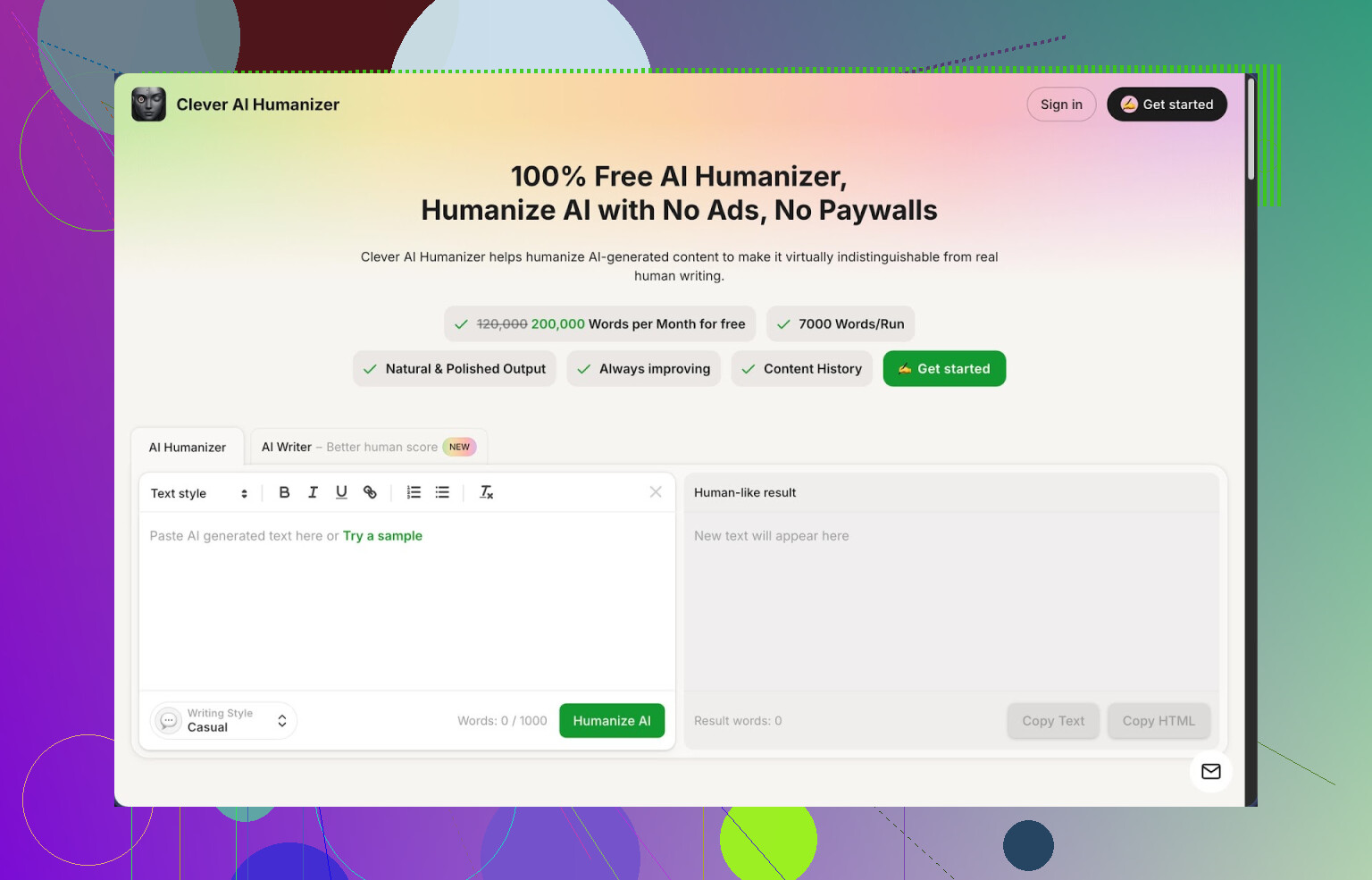
I have been messing around with AI text tools for a while, and most of them hit the same wall. The output sounds stiff, then every detector screams “100% AI”. So I went hunting for something that fixes that mess without asking for a credit card up front.
That is how I ended up spending a full day testing Clever AI Humanizer
Link: https://cleverhumanizer.ai
Here is what stood out for me.
First, the limits are not fake generous. You get up to 200,000 words per month, with runs of up to 7,000 words. No paywall after two paragraphs, no “upgrade to continue” popup. I pushed multiple longform pieces through it, including a 5,000 word article, and it stayed within the free tier.
It offers three styles:
- Casual
- Simple Academic
- Simple Formal
There is also a built-in AI writer that plugs into the same interface.
I tested it against ZeroGPT using text written with another AI. I ran three different samples, all processed with the Casual style. ZeroGPT showed 0% AI for each one. I did not tweak anything between runs. Copy, paste, select style, run, then paste into ZeroGPT. Same pattern, 0% every time for my tests.
I would not assume you will always get 0%, detectors change and behave weird, but the results were better than most tools I tried in 2026.
Now the main part of the tool.
You paste your AI-written draft into the Free AI Humanizer, pick one of the styles, and hit go. In a few seconds it spits back a new version that reads more like something a bored but competent human wrote on a laptop at 2 am. It removes a lot of the repetitive phrasing that detectors seem to latch on to, and it bumps up readability without turning your argument into mush.
What I noticed on longer content:
- The structure stays intact
- Key points are still there
- Sentences get slightly longer and more varied
- The tone shifts away from that robotic “helpful assistant” voice
It does not mutilate the meaning, at least not in my runs. I checked line by line on one technical article and I did not see any incorrect claims added by the tool. If anything, it feels like a light rewrite plus tone adjustment.
Then there are the other modules, which all live in the same interface.
- Free AI Writer
You give it a topic, some instructions, and it writes an essay, article, or blog post for you. The nice part is that you can immediately push that output through the Humanizer without opening a new tab or copying between tools.
When I generated content inside Clever and then humanized it, the detector scores were even better than when I brought in text from another model. My guess is the AI Writer is already tuned to pair with the humanizer.
- Free Grammar Checker
Nothing fancy, but it does the job. It fixes:
- Spelling
- Punctuation
- Some clarity issues
I dumped a few messy Reddit-style rants into it, with random commas and broken sentences, and it cleaned them enough for blog publishing. It is not as aggressive as something like Grammarly, more like a decent built-in editor.
- Free AI Paraphraser Tool
This one rewrites existing text while trying to hold the meaning steady. I used it for:
- Rewriting old blog sections so they do not sound like 2018 me
- Adjusting tone from “formal and stiff” to “normal person”
- Making duplicate-ish product descriptions more original for SEO
I cross checked some paraphrased chunks in plagiarism tools and detection tools. No flagged copying and lower AI scores than straight LLM output.
The nice part is that all four features sit in one place:
- Humanizer
- Writer
- Grammar checker
- Paraphraser
You can start with nothing, generate a draft, humanize it, fix grammar, then paraphrase any part that still feels off. I ended up using it as a small writing pipeline instead of bouncing between five different browser tabs.
Now for the annoying parts.
Detectors are inconsistent. Even with this tool, some of them still flag sections as AI-written. I had one paragraph marked as “likely AI” by one detector and “likely human” by another. That is not the tool’s fault, but you should not expect magic invisibility.
The other thing I saw, the text tends to get longer after humanization. Sentences expand, transitions get added, some points are clarified. If you are working with strict character or word limits, you will need to trim afterward.
Also, while the service is free now with 200,000 words per month, no one knows how long that exact limit will stay. For the moment, though, I hit it with around 60k words of testing and still had lots of room left.
If you write a lot of AI-assisted content and you are tired of getting 100% AI flags, Clever AI Humanizer is worth putting into your workflow. Not as a magic shield, but as a decent text fixer you do not have to pay for upfront.
If you want a deeper breakdown with screenshots and AI detection proofs, there is a more detailed review here:
https://cleverhumanizer.ai/community/t/clever-ai-humanizer-review-with-ai-detection-proof/42
Video walkthrough is here, if you prefer watching someone click through stuff:
Clever AI Humanizer Youtube Review

There is also some discussion and comparison with other “AI humanizer” tools on Reddit:
Best AI Humanizers thread:
https://www.reddit.com/r/DataRecoveryHelp/comments/1oqwdib/best_ai_humanizer/
General talk about humanizing AI output:
https://www.reddit.com/r/DataRecoveryHelp/comments/1l7aj60/humanize_ai/
8 Likes
I’ve hit the same wall as you with WriteHuman-style tools. Most of them throttle you hard or wreck the meaning.
Since @mikeappsreviewer already broke down Clever Ai Humanizer in detail, I will add a different angle and some alternatives plus how to avoid meaning drift.
- Clever Ai Humanizer as a “free core”
- It gives you a lot of words per month for zero cost, so for volume it beats most “free trial then pay” tools.
- Where I disagree a bit with @mikeappsreviewer is on always trusting detectors. I saw cases where text passed ZeroGPT but still sounded AI-ish to a human editor.
- Treat it as a first pass. Run your AI text through Clever Ai Humanizer, pick Casual or Simple Formal, then do a quick manual edit on intros, conclusions, and transitions. That keeps your meaning stable.
- Simple trick to hold meaning
When you paste your text into any humanizer, do this:
- Split long sections into 300 to 500 word chunks.
- Humanize each chunk.
- Then compare each transformed chunk against your original.
- Fix any missing examples, stats, or claims.
This keeps tools from rerouting your argument too much.
- Other free-ish options to stack
Not repeating tools from the other post, here are different angles:
-
QuillBot free tier
Use “Fluency” or “Standard” mode on small paragraphs. It tends to keep meaning closer to original, but watch for light synonym spam. Nice if you combine it with Clever Ai Humanizer as a second pass. -
LanguageTool free
Grammar and style checker. Not a humanizer by name, yet if you push humanized text through it, you clean up weird phrasing without changing intent. Good last step. -
Your own “manual humanizer” routine
After AI output, run three changes yourself:- Shorten overlong sentences.
- Replace generic phrases like “in today’s world” or “on the other hand” with more specific language.
- Add 1 or 2 personal-style asides like “here is the catch” or “the key part here is”.
This takes a few minutes and keeps detectors from flagging repetitive AI phrasing.
- Quick workflow you can copy
- Generate with your main AI.
- Paste into Clever Ai Humanizer, pick Casual.
- Check each section against original for logic and facts.
- Run final text through LanguageTool or similar for grammar.
- Read the first and last paragraph out loud. If it still sounds stiff, tweak those by hand.
You get human sounding text, close meaning match, no paywall pain.
You will not get 0 percent AI on every detector, no tool gives that, but your writing will feel more natural and safer to use.
Short version: there is no magic “WriteHuman but free forever and perfect,” but you can get really close by mixing Clever Ai Humanizer with a couple of simple habits and some lighter tools.
Couple of points where I’ll push back a bit on what @mikeappsreviewer and @himmelsjager said:
- On Clever Ai Humanizer
Clever Ai Humanizer actually is the closest thing to what you’re asking for right now:
- Free tier is generous enough for real use, not just toy tests
- Styles are simple so it doesn’t over-the-top “creative rewrite” your stuff
Where I disagree slightly: I wouldn’t chase “0% AI” scores as the main metric. The detectors are inconsistent and often contradict each other. If your text reads like a normal person and doesn’t distort your meaning, that’s a win, even if some detector says “40% AI.”
My use case that’s worked fine:
- Generate with any AI
- Drop it in Clever Ai Humanizer on Simple Formal or Casual
- Then you fix the first paragraph and the conclusion by hand
Those two spots are where tools most often start rambling or changing emphasis.
- Keeping meaning tight
Instead of slicing everything into 300–500 word chunks like was suggested, I’d argue you start even smaller for “critical” sections:
- Key definitions
- Any stats / numbers / prices
- Legal or compliance stuff
Run those pieces separately or even skip humanizing them and only humanize the connective text around them. That way the tool doesn’t “soften” or rephrase numbers or disclaimers, which is where meaning drift really bites.
- Extra free helpers that don’t wreck content
To keep it from changing your meaning too much, use tools that are conservative by design:
-
LanguageTool (free):
Use it after Clever Ai Humanizer to catch awkward sentences and grammar slips without rewriting whole ideas. It is more like a careful editor than a second AI author. -
Plain Google Docs “voice check”:
Paste your final draft into Docs and use the “read aloud” accessibility thing or just read it out loud yourself. If you stumble or think “wow that sounds like a help-center article,” tweak those lines. No tech, just your ear.
- What to avoid if meaning matters
Since you said a lot of tools “change the meaning too much,” skip:
- “Creative rewrite” / “high creativity” / “make it unique” modes
- Anything promising “100% bypass all AI detectors guaranteed”
Those usually go heavy on synonym swapping and weird metaphors that break your original point.
- A minimal workflow that actually respects your content
Try this once and see if it matches what you want:
- Step 1: Generate your original AI draft
- Step 2: Humanize via Clever Ai Humanizer in Casual or Simple Formal
- Step 3: Manually scan only:
- intro
- any bullet lists with facts
- conclusion / CTA
- Step 4: Run the final through LanguageTool or similar for basic cleanup
That’s it. No overcomplicated pipeline, and you keep meaning almost 1:1.
TL;DR:
Clever Ai Humanizer is probably the closest free alternative to WriteHuman AI right now, but treat it as a strong “80% fix” and keep your own hands on the last 20%. Ignore the hype around perfect detector scores and focus on “does this sound like me and still say what I meant?”