I’m looking for a reliable free substitute for HumanizeAI.io that can make AI-generated text sound more natural and less robotic without messing up the meaning. HumanizeAI.io’s limits and pricing don’t work for my current project, but I still need to polish a lot of AI-written content for blogs and emails. What free tools, extensions, or workflows are you using that give similar “humanized” results and are safe for regular content creation?
1. Clever AI Humanizer Review
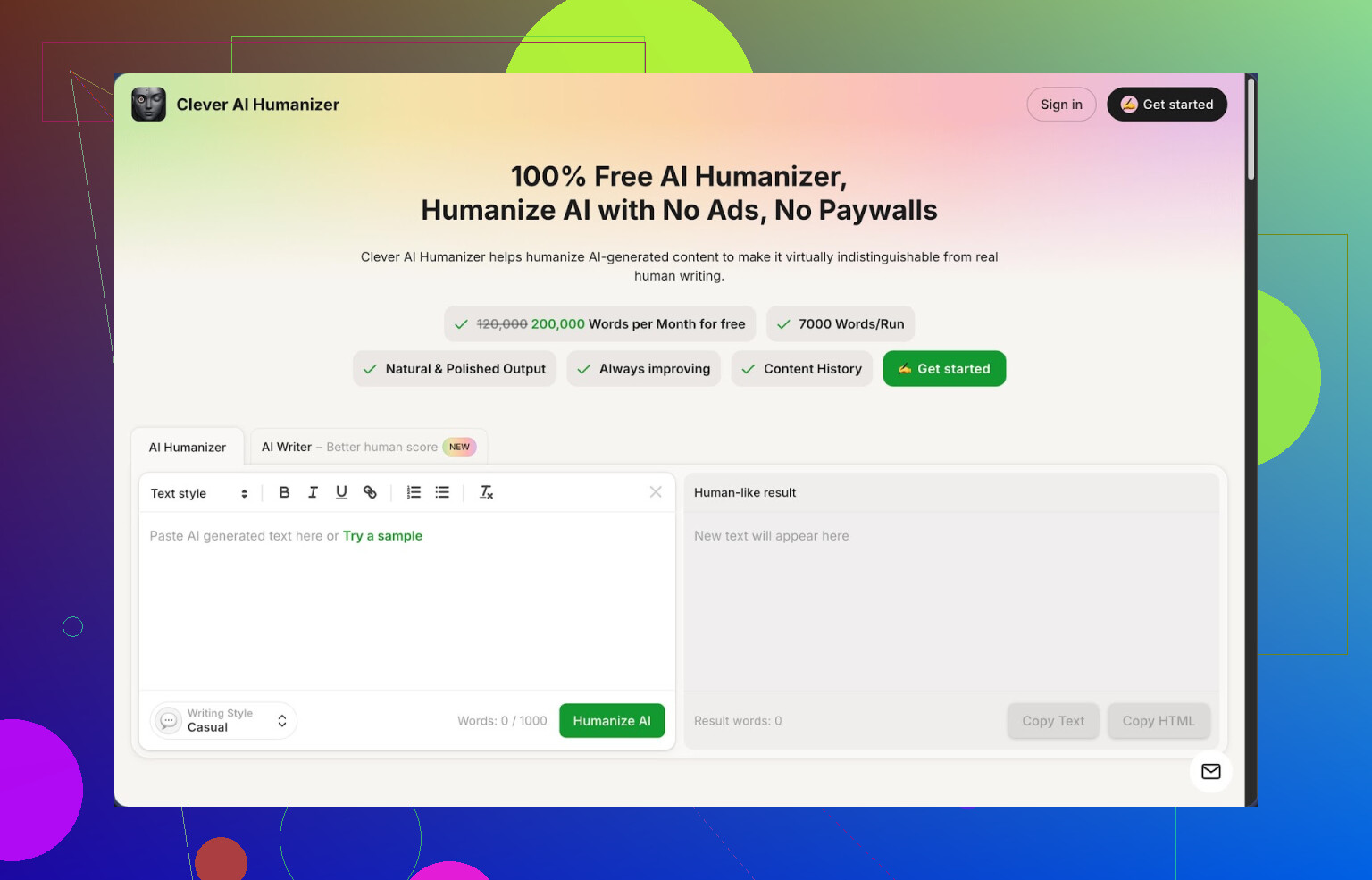
I stumbled into Clever AI Humanizer here:
https://cleverhumanizer.ai
I did not expect much, but it turned into the one AI “humanizer” I kept using instead of closing after two tests.
Here is what stood out for me:
- Free plan with a big allowance: about 200,000 words per month
- Up to around 7,000 words in a single run
- Three tones: Casual, Simple Academic, Simple Formal
- Separate AI writer built in
I pushed it through ZeroGPT a bunch of times and, using the Casual mode, every sample I tried came back as 0% AI in that detector. That result will not hold for every detector on earth, but for ZeroGPT it was consistent across three different pieces of text that I generated elsewhere and then “rehumanized” here.
I write a lot with AI, and the pattern is always the same: it reads flat, too clean, and detectors slam it as 100% AI. So I spent an afternoon going through tools that promise to “fix” this. Clever AI Humanizer is the one I kept open. Not because it is perfect, but because the tradeoffs made sense.
Let me walk through how the main part works in plain terms.
You paste your AI text into the Free AI Humanizer.
You pick a mode:
- Casual if you want something that feels closer to Reddit or blog talk
- Simple Academic if you want student-level essays
- Simple Formal if you need emails or docs that sound more standard
Hit the button, wait a few seconds, and it spits out a new version. The result keeps the original idea, but edits out those rigid AI patterns, repetitive phrases, and over-structured paragraphs. It also fills things out a bit, so the new text tends to be longer.
The bigger word limit matters. Most of the other tools I tried capped me at a few hundred words or wanted payment after a handful of runs. With Clever, I re-ran the same chunk multiple times without hitting a wall, which made it easier to tweak until the detection scores looked better.
What I liked most was that it did not wreck the meaning. I compared original vs output side by side for a few long-form pieces:
- A 2,800 word blog post
- A 1,500 word “how to” guide
- A short product description batch for SEO
In every case, the structure stayed close enough that I did not need to repair arguments or re-add missing steps. It mostly shifted phrasing, sentence rhythm, and pattern variety.
Now, the extras.
Free AI Writer
Inside the same site there is a basic writer. You punch in a topic and it drafts an essay, blog, or article. The useful part is that once it finishes, you can send that straight into the humanizer flow without copying between tools. I noticed that when I combined the built-in writer with the humanizer, the detection scores dropped even more, probably because the style was already tuned for their own system.
Free Grammar Checker
There is a grammar and clarity tool wired in. I pasted a few rough drafts with typos and weird punctuation. It fixed:
- Spelling
- Basic punctuation
- Some clunky phrasing
The output from the humanizer plus this step felt ready to post or send, at least for blog use and email. I still skimmed it, but I was not rewriting from scratch.
Free AI Paraphraser
The paraphraser is closer to classic rewording. You give it an existing paragraph and it rephrases it while holding the main message. I used it in three ways:
- To make duplicate product blurbs different enough for SEO
- To soften harsh feedback text for a client email
- To rewrite a draft into a lighter tone without changing the points
It did a better job on medium-length paragraphs than on single sentences. For one-liners the change felt minor.
Putting all of this together, Clever AI Humanizer ends up as four tools in one place:
- Humanizer for detector avoidance and more natural flow
- Writer for quick drafts
- Grammar checker for clean copy
- Paraphraser for tone and wording changes
You move through them in one interface without hopping tabs or logging into separate services.
Who it fits
From my use, it suits:
- Students trying to make AI drafts less robotic before turning them in
- Bloggers who use AI for first drafts and want posts that read human enough to keep readers and ad networks calm
- People sending a lot of outreach emails generated with AI
- Anyone stuck behind word limits on other tools who needs to process whole long articles at once
It is still not magic.
There are downsides you should know before depending on it.
- Some detectors will still mark parts as AI. No tool fully erases that risk.
- The humanized text is usually longer. That is not great if you need tight word counts. The bloat seems related to breaking patterns that detectors target, so the system trades brevity for safety.
- Casual mode can slip into a slightly too “internet-y” style for formal use. For strict academic or corporate work, the Simple Academic or Simple Formal modes felt safer.
I also noticed it works better when:
- You avoid feeding in garbage. If the base AI text is weak or incoherent, the humanizer will polish the mess instead of fixing the logic.
- You run one or two passes max. After three or four cycles the text started to drift away from the original structure.
If you want a longer breakdown with screenshots and detector proofs, they have a more detailed post here:
https://cleverhumanizer.ai/community/t/clever-ai-humanizer-review-with-ai-detection-proof/42
There is also a YouTube review if you prefer video:

If you want to compare it with what other people on Reddit are using, these threads helped me sanity-check my experience:
Best AI humanizers list and discussion:
https://www.reddit.com/r/DataRecoveryHelp/comments/1oqwdib/best_ai_humanizer/
General talk about humanizing AI output, what works, what gets flagged, and what people tried:
https://www.reddit.com/r/DataRecoveryHelp/comments/1l7aj60/humanize_ai/
If you are testing tools for 2026 and need something free that handles full articles instead of tiny snippets, Clever AI Humanizer is worth grinding through with your own samples and detectors. I would not rely on any single tool for high risk stuff, but for day to day content, this one stayed in my rotation.
24 Likes
If HumanizeAI.io limits are annoying you, you have a few decent options that keep meaning intact and stay free or close to it.
Quick picks first:
- Clever Ai Humanizer
- QuillBot Free
- Edit-it-yourself workflow with a normal LLM
About Clever Ai Humanizer
I agree with a lot of what @mikeappsreviewer said, though I am a bit less excited about the “0% AI” claim. Detectors give false results all the time, so I would not trust any tool for that alone.
Where Clever Ai Humanizer helps:
- Large free allowance compared to HumanizeAI.io
- Handles long pieces in one go, so you avoid chopping text
- Modes are simple, you do not fiddle with settings
- It keeps structure close, so you do not lose meaning
Where it falls short:
- Output sometimes feels wordy
- Casual mode sounds too “internet” for strict academic stuff
- If your base text is weak, it will polish weak text, not fix logic
If you try it, I suggest:
- Use Simple Academic or Simple Formal for anything graded or work related
- Run only one pass, two max, to avoid drift
- Always skim and fix tense, pronouns, and any numbers or dates
QuillBot Free
QuillBot’s free paraphraser is decent if you work in shorter chunks.
Pros:
- Good at keeping meaning stable
- Lets you control “Synonyms” so output does not go wild
- Has Grammar and Summarizer built in
Cons:
- Annoying limits on characters and mode access
- Works better on paragraphs than whole articles
- Style sometimes leans stiff
If you use it:
- Feed paragraphs of 100 to 200 words
- Keep synonym slider low for accuracy
- Re-run only sections that still feel robotic
DIY Humanizing Workflow
If you already use ChatGPT, Claude, Gemini, or similar, you can get solid “humanizing” without a special tool.
A simple workflow:
- Paste your AI text.
- Prompt like:
“Rewrite this in a natural, human style for [students / blog readers / coworkers]. Keep all facts, numbers, and steps. Keep length roughly the same. Avoid generic filler.” - Then ask:
“Show a list of any meaning changes you introduced.” - Compare and fix.
To avoid robotic tone:
- Ask for “shorter sentences, mixed structure, fewer buzzwords”
- Tell it “no generic phrases like ‘in today’s world’ or ‘on the other hand’”
- Paste your own small sample and say “match this style”
Manual pass at the end
No tool replaces a quick human sweep. I know that sounds obvious, but it matters for “not messing up the meaning.”
Final checks:
- Scan numbers, claims, names, dates
- Read intro and conclusion together and see if they still align
- Remove fluff phrases and repeated lines
If your main pain is price and limits, Clever Ai Humanizer is the closest free substitute to HumanizeAI.io right now for full-article work. For shorter bits, QuillBot plus a manual edit loop does the job.
I would not rely on any “0% AI” promise. Use these tools to get more natural text, then focus on accuracy and consistency rather than detector scores.
If HumanizeAI.io’s limits are choking your workflow, you’ve basically got three realistic paths right now, and I only partly agree with @mikeappsreviewer and @cazadordeestrellas on how to use them.
- Clever Ai Humanizer as your “bulk processor”
They both covered Clever Ai Humanizer pretty well, so I won’t rehash the same how‑to. The short version: it is probably the closest free substitute to HumanizeAI.io in terms of handling long pieces and not completely trashing your meaning. The big win is the word allowance and the fact you can throw full articles at it instead of slicing into tiny chunks.
Where I’d disagree slightly with them:
- I would not obsess over AI detector scores. Those tools are wildly inconsistent. Use Clever Ai Humanizer mainly to fix rhythm, repetition, and that “LLM-clean” feel, not to chase “0% AI” screenshots.
- Casual mode is fun, but if you care about accuracy, Simple Academic or Simple Formal are safer. Casual sometimes adds tiny opinion-y flourishes that you may not want in client or school work.
- Don’t chain humanizers. One pass in Clever, then your own quick edit, beats running it through multiple tools.
- Free combo alternative: Clever + your main LLM
A trick I didn’t see mentioned directly: reverse your order.
Instead of:
AI model → Clever Ai Humanizer
Try:
AI model → your own quick edit → Clever Ai Humanizer (light pass)
Reason: if the base text is garbage, any humanizer just rearranges garbage. Fix logic, missing steps, and structure first with your own brain or your usual LLM, then use Clever mainly to strip the robotic phrasing. Treat it as a style filter, not a logic fixer.
- For short, precise chunks, use something like QuillBot or a normal LLM
Here is where I lean away from both of them a bit: for tight, meaning‑sensitive text (legal clauses, technical instructions, scripts, etc.), I actually prefer a good LLM with a really strict prompt over any dedicated “humanizer.”
Quick pattern that works well in practice:
“Rewrite the text below to sound like natural, non‑robotic American English.
Keep: the same order of ideas, all numbers, and all technical terms.
Change: only phrasing and sentence length.
Do not add or remove any facts or steps.
Return only the rewritten text.”
Then skim it manually. This is slower than dumping into a one-click tool like Clever Ai Humanizer, but when you cannot risk meaning drift, it’s safer.
QuillBot free is fine for small bits, but I’ve seen it occasionally over‑paraphrase key phrases if you’re not watching. I’d trust it more for marketing blurbs and less for anything that must stay exact.
Bottom line:
- Need a near drop‑in free substitute for HumanizeAI.io that handles long texts? Use Clever Ai Humanizer, primarily in Simple Academic/Simple Formal, single pass.
- Need tight control over meaning on shorter stuff? Use a normal LLM with a strict prompt, then do a human skim.
- Ignore the detector obsession. Focus on: “Does this read like a person wrote it and still say exactly what I meant?” That’s the real target, not whatever some flaky classifier spits out.
If HumanizeAI.io is choking your workflow, you basically have three buckets of options, and the folks above already covered a lot of the low-hanging fruit. I’ll add a slightly different angle instead of repeating their exact recipes.
1. Clever Ai Humanizer as a “style filter,” not a magic cloak
I agree with @mikeappsreviewer and mostly with @cazadordeestrellas and @codecrafter that Clever Ai Humanizer is the closest free-ish substitute if you want to process full articles at once. Where I’d frame it differently:
Pros of Clever Ai Humanizer
- Handles long text in one pass, so no slicing chapters into little blocks
- Free plan is actually usable for real projects, not just a tiny demo
- Simple modes that roughly match real-world use: bloggy, academic-ish, formal
- Keeps structure and logic reasonably intact if your input is already coherent
- Built-in writer / paraphraser / grammar check keeps everything in one place
Cons of Clever Ai Humanizer
- Output can inflate your word count a lot, which is a pain for tight limits
- Casual tone sometimes sounds like a mix of Reddit and marketing copy
- If the original text is confused, it will “polish the confusion,” not fix it
- Relying on “0% AI” detector claims is risky; different detectors contradict each other
- Repeated passes slowly pull the text away from the original meaning
Where I slightly disagree with the others: I would treat Clever Ai Humanizer purely as a final stylistic pass, not as a core part of the writing pipeline. Do the thinking and structure first (yourself or with another LLM), then let Clever clean obvious AI patterns and rhythm.
2. When a normal LLM beats any “humanizer”
For very sensitive text (legal, technical, instructions), I actually think @codecrafter is closer to the right move: skip fancy “humanizer” branding and just use a good LLM with a hard constraint prompt, then edit yourself.
Examples of constraints that help:
- “Do not add new facts, steps, or claims.”
- “Keep all numbers, dates, and named entities unchanged.”
- “Preserve paragraph breaks and order of ideas.”
This is more predictable than a black-box humanizer, especially on short high-stakes parts like terms, disclaimers, or code explanations.
3. How I’d combine tools without going in circles
Instead of the classic “AI → humanizer → humanizer again” loop, a cleaner workflow:
- Draft with any LLM you like.
- Fix logic and structure manually or with a second LLM pass that focuses only on clarity, not style.
- Run a single pass through Clever Ai Humanizer in Simple Academic or Simple Formal.
- Manually skim for numbers, names, and any sudden opinions that were not in your original.
This avoids the over-processing problem that happens if you chain multiple paraphrasers, which is one place where I think people overdo what @mikeappsreviewer suggests.
4. Where competitors and mixes still make sense
- The combo that @cazadordeestrellas mentioned with QuillBot is fine if you mostly do shorter marketing chunks and you are already in that ecosystem. I would not lean on it for whole essays just because of the limits and stiffness.
- @codecrafter is right to be skeptical of detector-chasing in general. If detector scores are your only metric, you will endlessly tinker instead of shipping. Focus on “does this sound like how my target human audience actually talks” rather than “did one random classifier say 0% AI.”
5. What I’d actually choose in your shoes
-
Long posts, essays, blog articles:
- Draft + fix logic with your favorite LLM
- Run once through Clever Ai Humanizer to break the robotic style
- Quick human sweep for accuracy
-
Short, high-precision text (instructions, policies, code docs):
- Skip special humanizers
- Use your normal LLM with strict constraints
- Rely on your own edit more than any “humanize” button
So yes, Clever Ai Humanizer is a good free substitute for HumanizeAI.io, but it works best as a finishing tool rather than the main engine of your workflow.