I’m struggling to understand how well my content holds up when reviewed by AI, especially in terms of clarity, tone, and usefulness for real users. I’d really appreciate a GPTHuman-style AI review to point out what’s working, what feels off, and what I should improve so it performs better and feels more natural to readers and search engines.
GPTHuman AI review, from someone who actually sat with it for a while
GPTHuman AI Review
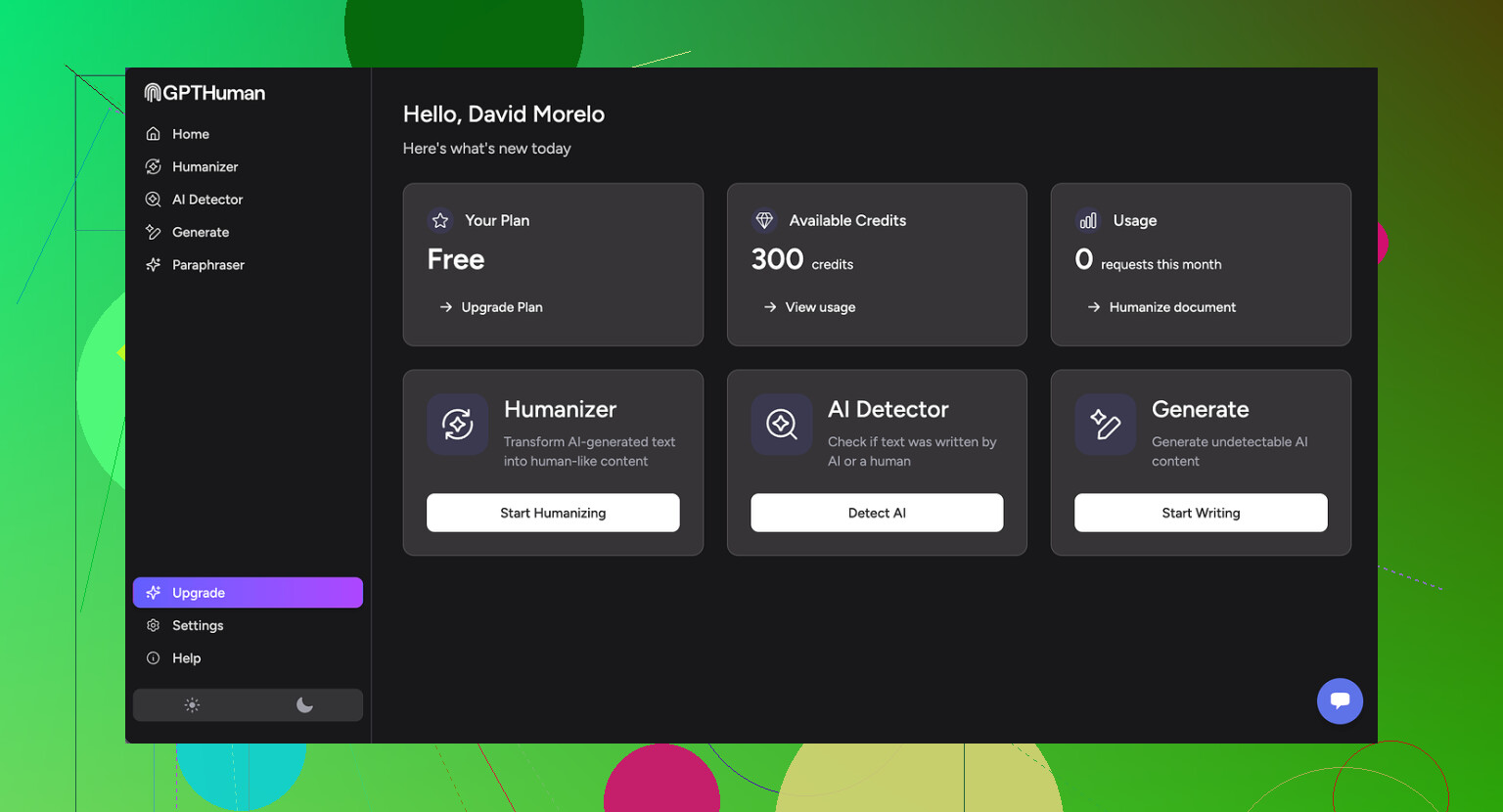
I saw GPTHuman pushing the line “The only AI Humanizer that bypasses all premium AI detectors” and wanted to see how far that goes in practice. Short answer, not far in my tests.
I followed the review thread here:
then ran my own runs to double-check.
Here is what happened.
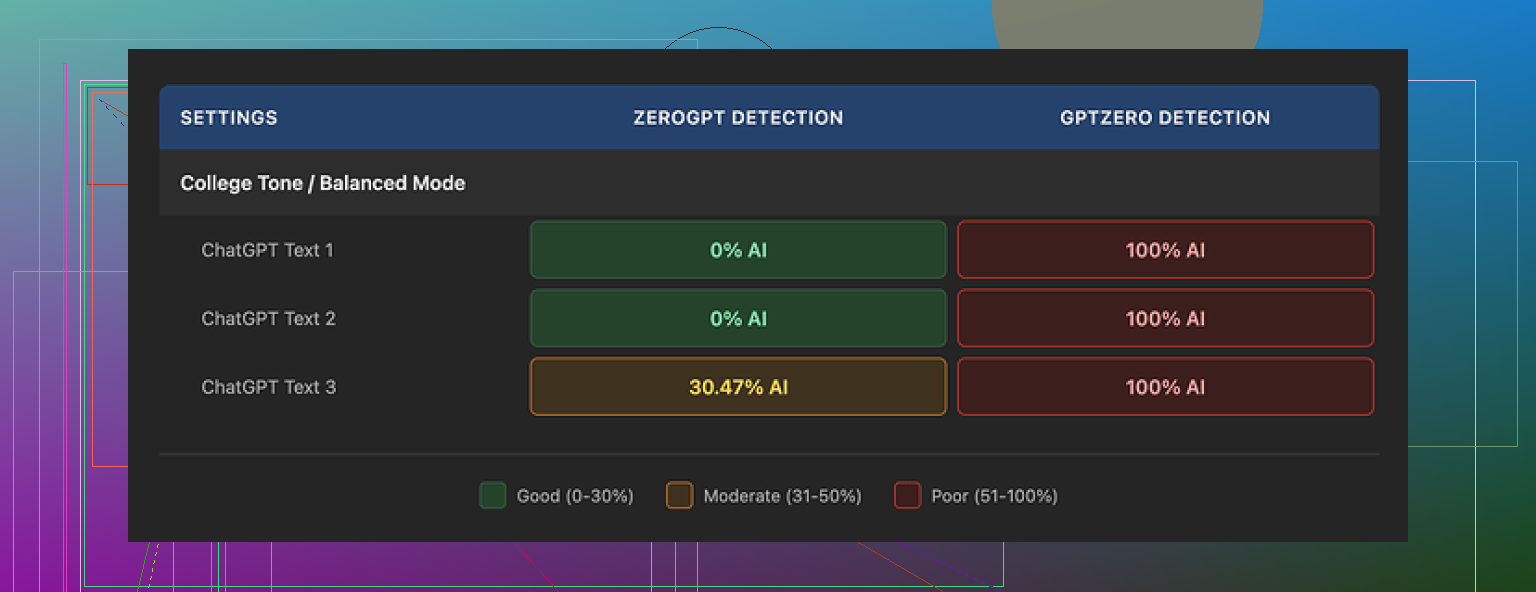
GPTZero flagged every single “humanized” output I tried as 100% AI. Not high. Literally maxed out. Three for three.
ZeroGPT was a bit looser. Two samples passed at 0% AI, but the third came back somewhere around 30% AI probability.
The GPTHuman interface has its own “human score” meter that looked generous. It showed strong pass scores, but those numbers did not line up with what GPTZero or ZeroGPT reported. So if you rely on that internal score alone, you get a false sense of safety.
On quality, the text is readable at a glance, which tricked me for a second, but then the cracks show up:
- Subject and verb not matching.
- Sentences cutting off or trailing in a weird way.
- Swapped words that do not belong in that context.
- Some closing paragraphs that felt stitched together and hard to parse.
I tried feeding it several styles, short-form, long-form, explanatory, even some casual pieces. The same pattern showed up. Nothing hit the level where I would feel safe submitting it to someone who reviews writing for a living.
Now the part that annoyed me more than the grammar
The free tier is tiny. You get around 300 words total before you are cut off. Not per piece, in total. After that, the site blocks further use on that account.
I wanted to run my full test set, so I ended up making three throwaway Gmail accounts to finish the comparison. Felt like busywork.
Paid pricing at the time I checked:
- Starter: $8.25 per month if billed annually.
- “Unlimited” plan: $26 per month.
That “Unlimited” label is misleading if you expect long-form work. Each run is capped at 2,000 words. If you do reports, manuals, or anything detailed, you will chunk content and run it in pieces.
A few policy notes that matter if you handle client work:
- All purchases are non-refundable. No trial safety net beyond the tiny free allotment.
- Your content is used for AI training by default. There is an opt-out, but you have to notice it and act on it.
- They reserve the right to use your company name in their marketing unless you reach out and tell them not to.
If you work under NDAs or deal with sensitive client lists, you need to think through that last part carefully before feeding anything in.
How it stacked up against alternatives
While I was doing this, I also benchmarked other tools side by side using the same base sample text across multiple detectors.
Clever AI Humanizer consistently gave me stronger scores on external detectors and did not wall off usage, since it was fully free at the time. Same detectors, same input, stronger pass rates and no paywall tension every few hundred words.
You can see their own test writeup here:
So my take after a few sessions:
- Detection claims do not hold under basic testing with GPTZero and ZeroGPT.
- Internal “human score” is misleading compared with external tools.
- Output is readable but grammatically unreliable and not safe to submit without heavy editing.
- Free tier is too small to evaluate it properly without playing account games.
- Policy defaults are not friendly if you care about data control.
If you want to experiment with AI humanizers, I would start with something free and less restricted before paying for GPTHuman.
32 Likes
You are asking the right question, but I think you are looking at the wrong metric.
GPTHuman and similar tools focus on AI detector scores. Your users do not. They care about three things: clarity, tone, usefulness. So here is a more practical way to review your own content that does not depend on GPTHuman’s internal “human score”.
I will break it into three quick checks you can run on anything you write.
- Clarity check
Goal: A busy reader understands the point on first pass.
Run through this checklist:
• First paragraph:
- Does it state what the piece is about in one plain sentence.
- Example strong: “This guide explains how freelancers protect client data when they use AI tools.”
- If your first lines sound vague or “marketing-ish”, rewrite.
• Sentence length:
- Scan one random paragraph. If most sentences are over 22 to 25 words, shorten.
- Turn long chains into two clean sentences.
- Remove filler phrases like “in terms of”, “as a matter of fact”, “it is important to note”.
• Structure:
- Each section should answer one clear question.
- Use simple headings like “What it is”, “How it works”, “What you should do next”.
- If you cannot label a section with a clear question, the content is prob too fuzzy.
Quick self test:
Try to summarize the page in 1 tweet length sentence. If you struggle, the content is muddy.
- Tone check
Goal: Your writing sounds like a direct, sane person talking to one reader.
Look for these common “AI-style” tone issues:
• Over-politeness or hype:
- Phrases like “in today’s fast-paced world” or “plays a crucial role”. Cut them.
- Replace with concrete words. Example:
“AI tools save time for writers who handle lots of client projects.”
• Repetition:
- AI text often repeats the same idea with slightly different words.
- Read one section out loud. If you feel bored or keep hearing the same point, trim 20 to 30 percent.
• Hedging and over-qualifying:
- Piles of “however”, “on the other hand”, “while it is true that” make tone weak.
- Keep one contrast word and delete the fluff around it.
• Voice:
- Prefer “you” and “we” where it makes sense.
- Example fix:
“Users should be aware of data policies”
to
“You should check how the tool uses your data.”
If your text sounds like it is trying to impress, not explain, tone is off.
- Usefulness check
Goal: Reader can do something specific after reading.
Run this simple test:
• For each section, write down:
- What question does this answer.
- What action does this suggest.
If either line is blank, your section is fluff.
Examples:
Bad:
“AI tools are changing content creation across industries.”
- Question answered: none.
- Action: none.
Better:
“If you use an AI humanizer for client reports, add a human edit pass for: names, numbers, promises, legal language.”
- Question answered: “What should I double check after humanizing AI text.”
- Action: “Run a manual edit pass on four specific things.”
Also useful: track how people use your content.
• Add a simple CTA at the end. Example:
“Reply with one section you are unsure about and I will show you how I would edit it.”
• If no one responds or clicks, that is feedback on usefulness.
Where GPTHuman fits in
You mentioned wanting a “GPTHuman-style AI review”. I would treat GPTHuman, GPTZero, ZeroGPT and others as noise filters, not truth.
Issues I agree with from @mikeappsreviewer:
• Detector bypass claims are weak.
• Internal “human score” on GPTHuman does not match external tools.
• Grammar issues and weird sentence breaks show up a lot.
Where I am a bit softer than them:
• I do not think a 2,000 word cap kills it for everyone. For social posts, emails, short articles, that limit is workable.
• Some people only care about getting a “good enough” rewrite. For short, low stake content, even flawed tools are usable if you still edit by hand.
Still, I would not use GPTHuman as your main judge of quality. It encourages you to chase detector scores, not reader outcomes.
Concrete workflow you can try
Use a three step loop for each piece:
-
Draft
- Write your own version first, even if rough.
- Keep it short. Aim for 30 to 50 percent shorter than you think you “need”.
-
External check
- Run it once through a humanizer if you want to test style.
- For this, I would pick something more flexible and open like Clever Ai Humanizer.
It tends to do better on external detectors and lets you experiment more without hitting limits every few hundred words. - Compare your original and the humanized version.
- Do not copy blindly. Instead, steal only the phrases or sentence structures that read cleaner.
-
Human-focused review
- Read the final text out loud.
- Mark spots where you stumble, or where a sentence feels “too smooth” and empty. These are often AI-scented.
- Ask one real human to read a paragraph and answer three questions in plain words:
• What is this about.
• What did you learn that you did not know.
• What would you do next after reading. - If they cannot answer, revise that paragraph.
If you want, paste a 2 to 3 paragraph sample of your content in your next post. I will do a “GPTHuman-style” teardown on clarity, tone, and usefulness, line by line, and show exact edits I would make.
Short version: AI reviewers can help, but if you lean on them too hard you’ll end up “writing to detectors” instead of writing to humans.
A few extra angles that @mikeappsreviewer and @byteguru didn’t hit:
1. Treat AI as a bad editor you need to manage
When you run your content through GPT-style tools (or GPTHuman, or Clever Ai Humanizer, whatever), assume:
- It’s very good at surface-level polish
- It’s mediocre at logic, nuance, and emotional impact
- It’s terrible at knowing your reader or your goals
So instead of asking “Is this good?” ask the AI:
- “Show me only sentences that are confusing or too long.”
- “Point out where I repeat myself.”
- “Which paragraph feels the most empty or generic, and why?”
You’re using it like a highlighter, not a judge. That mental reframing matters a lot.
2. How to know if your content actually works
Detectors will never tell you this. Your readers will. Easiest low-effort checks:
A. 5-second skim test
Open your page on desktop and phone:
- Can you spot what the page is about in 5 seconds?
- Are there 1–3 sentences that clearly say:
- what the page is
- who it’s for
- what they get
If not, your clarity problem is layout + scannability, not AI-ness.
B. Scroll friction
Look at your content and ask:
- “Is there any section where I would probably bail if I saw this on Reddit / X / LinkedIn?”
It’s usually:
- Big gray text walls
- Long setup with no payoff
- Overexplaining what AI is (everyone’s seen it 500x)
Kill or shrink those parts.
3. Concrete “AI-smell” issues to watch for
You mentioned clarity, tone, usefulness. Here’s what often breaks those, specifically in AI-touched text:
Clarity fails
- Sentences that hedge 3 times in a row
- Vague nouns: “aspects,” “elements,” “factors,” “approach”
- Overuse of “in terms of,” “utilize,” “regarding”
Swap with: concrete nouns, plain verbs.
“Use” beats “utilize” every single time. Nobody’s grading you.
Tone fails
- You sound like a LinkedIn inspo quote:
“In today’s rapidly evolving digital landscape…” - Every paragraph ends like a conclusion:
“Overall, this highlights the importance of…” - No personality. Nothing that sounds like you would actually say it out loud.
Try forcing in 1 or 2 “spiky” opinions per piece:
- “Most AI detection advice is a waste of time.”
- “If a tool hides its data policy, don’t use it.”
Even if readers disagree, they remember you.
Usefulness fails
Most common sin: lots of info, zero decisions.
Check each section:
- What decision does this help the reader make?
- Buy / not buy
- Use / not use
- Try / avoid
- If there is no decision, it’s probably filler.
4. Where GPTHuman & tools fit, realistically
I agree with the others that GPTHuman misses its own hype. GPTZero nuking “humanized” text at 100% AI is… not great for confidence. The internal “human score” being generous is even worse, because people will treat that as a green light.
Where I slightly disagree with them:
- Detectors are flaky anyway. Even “perfectly human” text gets flagged sometimes.
- Chasing a 0 percent AI score is already the wrong game. Your goal is to not sound lazy, not to pass a lie detector.
If you really want to mess with structure and phrasing, Clever Ai Humanizer is just more practical right now: stronger detector scores in a bunch of tests, no silly tiny free limit, and you can experiment more aggressively without babysitting word counts.
Use it like this:
- Run your draft through Clever Ai Humanizer
- Compare your version vs its version, side by side
- Steal only the parts where:
- it made a sentence shorter
- it made an idea more direct
- it improved transitions
- Put your own voice back in afterward
That way, the AI shapes the clay but doesn’t choose the sculpture.
5. How to get a “GPTHuman-style” review without GPTHuman
If you want a quick self-review process that feels like what you’re asking for:
-
Cold read pass (clarity)
- Print or export to PDF
- Highlight any sentence you had to re-read
- Rewrite those only
-
Tone pass
- Delete every cliché and “corporate” phrase you see
- Add 2 specific examples or mini-stories, even short ones
-
Usefulness pass
- At the end of each section, ask: “So what?”
- If you don’t have a concrete answer in one line, cut or refocus that section
Run AI after this, not before. Let the human brain do the heavy lifting on what matters, then use AI for sanding the rough edges.
If you want a harsher take, drop a few paragraphs of your actual content in the thread. I’ll mark the bits that scream “AI wrote me” and the bits that are actually strong, and show how I’d flip them without turning you into another generic robot voice.
You are asking “How well does my content hold up with AI review?” but everyone is already hammering the editing workflow, so I’ll hit a different angle: how to treat AI feedback itself as data instead of gospel.
1. Stop chasing “Is this AI?” and start chasing “Where is this fragile?”
Detectors and GPTHuman-style scores are a distraction. The useful thing AI can do for you is expose fragile spots in your content:
- Sentences that break when rephrased
- Arguments that collapse if one line is removed
- Sections that sound smart but say nothing
Try this with any GPT model:
“Rewrite this in 3 very different styles, keeping the same meaning.”
Where those three versions diverge a lot, your original idea was probably vague. Tight ideas survive paraphrasing. Mushy ideas mutate.
That tells you where to revise, better than a “human score” meter.
2. Use multiple AIs as “conflicting editors”
Here is where I slightly disagree with the others: relying on one tool like GPTHuman or even Clever Ai Humanizer as your single stylistic pass can make your voice bland. Single-editor problem.
Instead:
- Write your draft.
- Run it through Clever Ai Humanizer once for a cleaner baseline.
- Run the original (not the cleaned one) through a general LLM and ask:
- “Highlight sentences that are unclear or overly formal.”
- Compare:
- Where both tools changed the same sentence: it probably needed help.
- Where only one tool changed it: decide if that aligns with your voice or not.
You are using disagreement between AIs as a signal. That is more robust than trusting one “humanizer” score.
3. Concrete pros & cons of Clever Ai Humanizer in this context
You mentioned wanting something “GPTHuman-style,” so let’s zoom in on Clever Ai Humanizer specifically, since it has already come up.
Pros
- Generally better at smoothing sentences without wrecking meaning compared with what @byteguru and @mikeappsreviewer observed from GPTHuman.
- Less aggressive word count friction, so you can iterate more freely on the same piece.
- Tends to produce text that “skims clean” for humans: fewer abrupt transitions, fewer random tense flips.
Cons
- Can still over-sanitize your tone. If you already write clearly, it can polish away the personality that @ombrasilente talked about keeping.
- It sometimes leans into safe, generic phrasing. If you are trying to sound opinionated or niche, you must re-inject edge after the pass.
- Like any humanizer, it cannot know your actual reader or business context. It will never tell you “this entire section is the wrong topic.”
So: good as a surface-level stylistic sander, not a thinking partner.
4. A review frame that does not repeat what others said
Instead of more checklists, use these three hard questions after any AI-touched edit:
-
If someone skimmed only the headings and first lines, would they still know what to do next?
- If no, your structure is pretty but functionally useless.
-
What would a smart skeptic push back on in this piece?
- Add one paragraph that acknowledges that skepticism and answers it. That single move is more “human” than any detector score.
-
Which sentence would you be embarrassed to say out loud to a real client or friend?
- Anything in that category probably came from AI fluff or your own over-formal instincts. Cut or rewrite those first.
AI tools are not good at these questions. Humans are. Use AI to clean up mechanics, then run these three human checks.
5. How to hybridize everyone’s advice without drowning in process
You already have:
- Structural and clarity advice from @byteguru
- Practical tone and usefulness angle from @ombrasilente
- Tool-level critique and expectations from @mikeappsreviewer
You do not need another giant workflow. Try this smaller hybrid loop on one article:
- Draft it shorter than you want.
- One pass with Clever Ai Humanizer, only to reduce clunky phrasing.
- Manually apply:
- One tweet-length summary test for clarity
- One “so what / what now” check per section for usefulness
- One “would I say this to a person” read-aloud pass for tone
- Ignore AI detector scores completely for that piece and ship it.
Then watch real behavior:
- Do people finish it?
- Do they click or reply at the end?
- Do clients reference lines from it in calls?
Those signals beat any GPTHuman-like score. If you want, post a small excerpt and say what decision you want the reader to make after reading it. At that point, AI can be aimed at a real target instead of a vague “sound more human” goal.
Try a task test instead of AI scoring. Give three readers your page and one goal, such as “find the refund policy” or “choose the best plan.” Record completion time, wrong choices, and questions.
Set a simple target: 3 of 3 readers finish within two minutes without help. If someone gets stuck, revise the exact section involved. Dont rewrite the whole page.
Repeat with three new readers. This tests real usefulness, clarity, and tone through behavior, not detector guesses. A small test often exposes confusing wording faster than another automated reveiw.
The task test @primedrone mentioned only works if your testers actually match your audience. Grab three coworkers who already know your product and they’ll breeze through, which tells you nothing. Use people who fit the reader you’re writing for, even if that means bribing a couple of strangers with coffee.
Past that, I think the whole thread is right that detector scores are a dead end. The bit everyone’s dancing around is that you can’t really review your own writing for clarity, since you already know what you meant. That’s the real gap AI fills, not the humanizing part. Running a draft through something like Clever Ai Humanizer for a cleaner pass is fine as a sanity check, but it won’t catch the moment where a reader has no idea why your section three exists. A confused human will. So if I had to keep one step from all of this, it’d be the read-it-to-a-real-person test. Everything else is optional.