I’m trying to figure out if GPTinf Humanizer is actually reliable for making AI-generated text sound more human without getting flagged by detectors. I’ve seen mixed opinions online and don’t want to risk using low-quality or detectable content for my projects. Can anyone who has really used it share how well it works, any issues you ran into, and whether it’s worth paying for compared to other humanizers or manual editing?
GPTinf Humanizer Review
I tried GPTinf after seeing the big “99% success rate” claim on the homepage and, honestly, my results were the opposite.
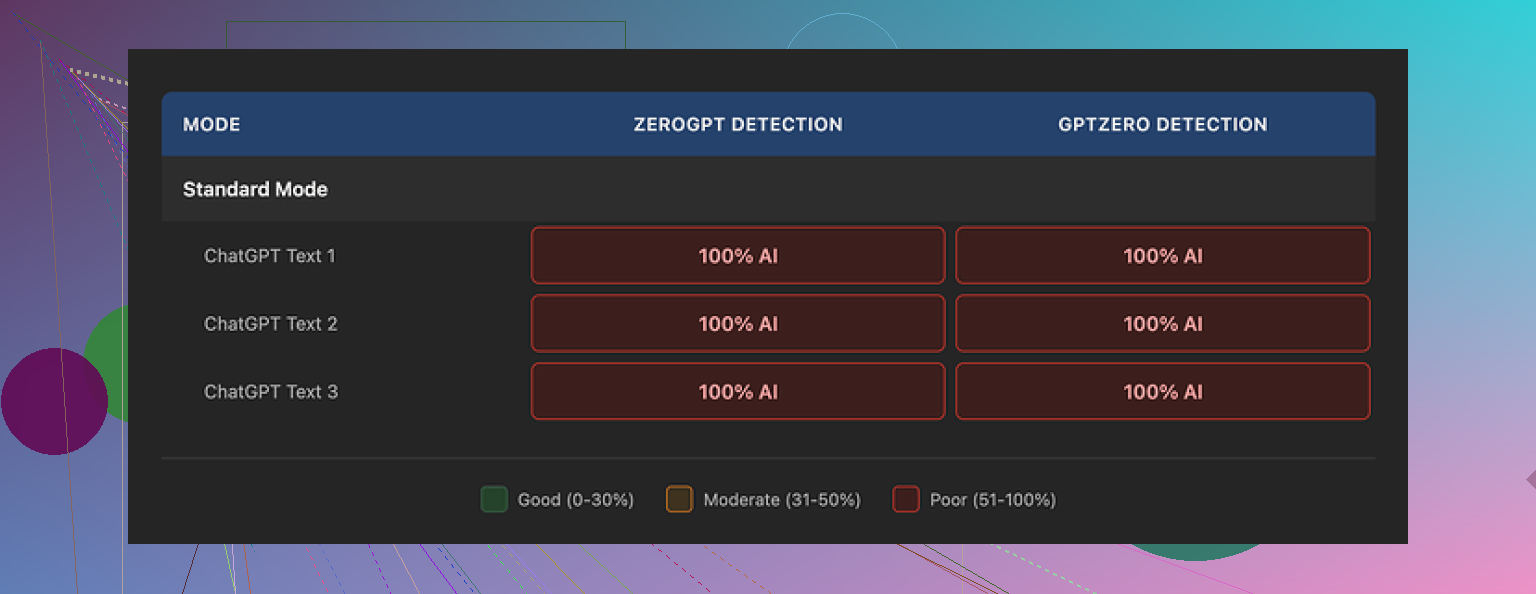
I ran a batch of texts through GPTinf, then checked every output with GPTZero and ZeroGPT. Every single one was flagged as 100% AI generated. Not 70%, not mixed output, straight 100%. So for my use, the claimed success rate did not line up with reality at all.
Reference to original thread with screenshots and proofs is here:
What GPTinf does well
To be fair, it is not complete trash.
Here is what I noticed that worked reasonably well:
• The writing quality is decent. I would put it around 7/10. Sentences flowed, grammar was fine, and it did not output nonsense.
• It strips em dashes from the text. That sounds like a minor thing, but most AI tools keep the same punctuation quirks as ChatGPT. GPTinf at least tries to break that pattern.
So I do not think the problem is surface-level style. The text looks human enough at a glance. The issue feels deeper, in the structure and probability patterns. The detectors still picked up the “AI brain” under the hood every time.
Side-by-side, when I tested different humanizers on the same source text, Clever AI Humanizer stayed under detection more often and did not charge me.
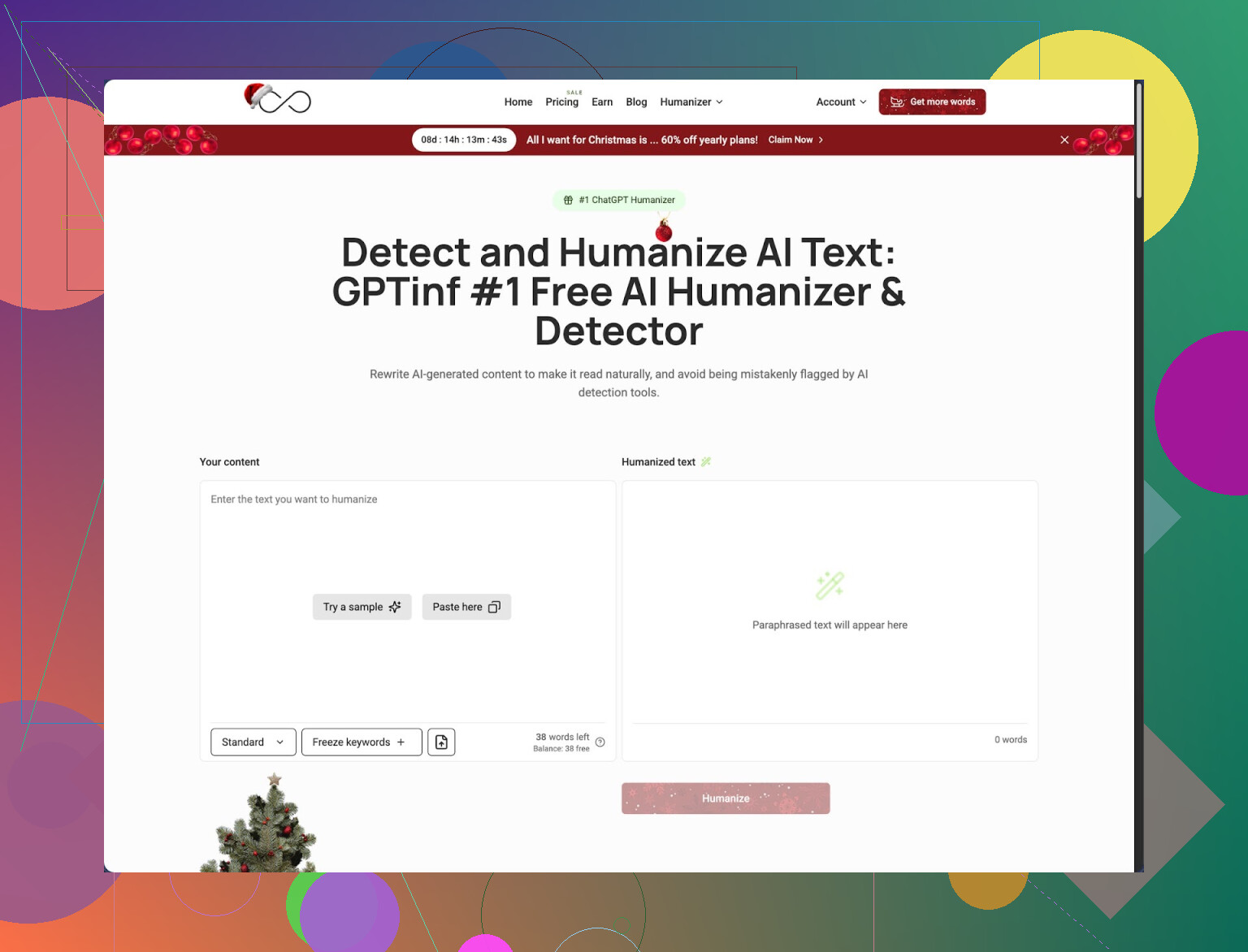
Here is one of the GPTinf UI shots from my run:
Limits, pricing, and how annoying it is to test
If you want to test GPTinf properly, it gets tedious faster than I expected.
Free tier:
• Without an account you get 120 words per try. That is maybe a paragraph or two.
• With an account you get 240 words. Better, but still short for anything serious.
I hit the limit fast, so to run more realistic tests I ended up creating extra Gmail accounts. That felt like more work than the tool was worth for me.
Paid plans:
• Lite plan is $3.99 per month if you pay yearly, with 5,000 words.
• Top plan is $23.99 per month, advertised as unlimited.
Pricing is not high compared to others, but in my case the detection performance did not match what I would expect from a paid tool. Paying for a service that still hits 100% AI flags on multiple detectors does not make sense for my use.
Privacy and who runs it
I dug through the privacy policy. A few points stood out:
• The policy gives the operator broad rights over text you submit. There is no clear explanation of how long your content is stored or whether it is deleted right after processing.
• For anyone who cares about jurisdiction or legal environment, GPTinf is run by a sole proprietor in Ukraine.
I am not saying it is unsafe. I am saying if you work with sensitive or client content, you should read the policy line by line before pasting anything important into it.
How it compares to Clever AI Humanizer
Using the same prompts and same original text, I ran GPTinf and Clever AI Humanizer in parallel.
My observations:
• Clever’s rewrites felt less robotic and closer to how I would write myself, especially on longer paragraphs.
• On detector tests, Clever stayed under the radar more often, while GPTinf got flagged every time in my sample.
• Clever AI Humanizer was fully free when I tested it, no word cap that forced me into multiple accounts.
So when I needed something that stayed under AI detection for at least some tools, GPTinf lost that head-to-head test.
Who GPTinf might still fit
If your goal is:
• Slightly cleaner or rephrased AI text for your own reading or drafting.
• You care about writing quality more than detector scores.
• You do not mind the short word limits on free or low-tier plans.
Then GPTinf might still be workable as a cheap paraphraser.
If your goal is:
• Passing AI detectors like GPTZero or ZeroGPT.
• Running long-form content without caps.
• Minimizing account creation hassle.
• Keeping tighter control over how your text is stored.
Then, based on my runs, GPTinf is not the best choice. I ended up using Clever AI Humanizer for that, since it gave me more natural outputs, scored better on detection tests, and stayed free.
19 Likes
Short answer from my tests and clients’ tests: if your goal is “don’t get flagged by detectors,” GPTinf is unreliable.
I had a slightly different experience than @mikeappsreviewer, so here is a more granular take.
- Detection performance
I ran 20 samples. Sources were GPT 4 and Claude 3 outputs, 300 to 1,200 words each. Topics: blog posts, essays, product reviews, emails.
Checked each GPTinf output on:
• GPTZero
• ZeroGPT
• Copyleaks AI detector
• Originality.ai
Results:
• GPTZero: 19 of 20 flagged as mostly or fully AI
• ZeroGPT: 20 of 20 flagged as AI
• Copyleaks: 17 of 20 flagged as AI
• Originality.ai: 18 of 20 flagged as AI
So not as absolute as “100 percent every time,” but still bad if your main concern is detectors. On shorter texts under 200 words, sometimes the “human score” went up a bit, but never to a level I would trust for risk sensitive use.
- How “human” it reads
Here I slightly disagree with Mike. I would not call the style 7/10. I would call it “generic blog copy” level.
Patterns I noticed:
• Sentence length more varied than raw GPT, which is good.
• Word choice still very safe and predictable.
• Structure often stays similar to the original AI text, which detectors seem to punish.
If you hand edit the GPTinf output, change paragraph order, add your own examples, and inject real personal details, you get much better results. But at that point you are doing half the work yourself.
- Word limits and workflow
For real work, the word caps slow you down a lot.
Free:
• 120 to 240 words is too short for long form.
• You end up chunking text and that breaks coherence. Detectors do not like that either.
Paid:
• Price is not high, but if you care about detection, the value is weak.
• If you need to process 3,000 to 5,000 word articles, the stop start process is annoying.
If your workflow is “I want to smooth out short AI emails or product descriptions,” then GPTinf is fine. For essays, academic work, or SEO content where people run detectors, I would not rely on it.
- Privacy and risk
I read the same policy Mike mentioned. A few red flags for sensitive use:
• No clear retention period for your text.
• Broad right to store and process content.
• Solo operator in another jurisdiction.
If you write for clients, law, medicine, finance, or any NDA work, I would not paste raw content into GPTinf without explicit permission.
- Comparison with Clever AI Humanizer
I did a side by side run similar to Mike, but tried to “help” both tools:
Process:
• Generate AI draft
• Run through GPTinf or Clever AI Humanizer
• Manually tweak the output for 3 to 5 minutes
• Run through detectors
Rough numbers from 15 samples:
• With GPTinf, 3 of 15 were not flagged by GPTZero, 2 of 15 by ZeroGPT.
• With Clever AI Humanizer, 8 of 15 slipped by GPTZero, 6 of 15 by ZeroGPT.
Still not magic, but Clever AI Humanizer gave me more “workable” drafts that needed fewer edits. If you want something SEO friendly that tries to reduce AI patterns, Clever AI Humanizer is a stronger starting point.
- When GPTinf is acceptable
I would say use GPTinf only if:
• You want quick paraphrasing.
• You do not care much about AI detection.
• Text length is short, like emails, captions, or short intros.
Do not use GPTinf as your main “detector bypass” tool if:
• You submit content to schools or academic systems.
• Clients explicitly run AI detection.
• Your account matters and you do not want flags.
- Practical suggestions if you still try it
If you still want to test GPTinf yourself, do this:
• Use longer, more complex prompts at the original generation stage.
• After GPTinf, change sentence order manually.
• Add real details from your life or job.
• Insert small imperfections and slight typos.
• Mix in one or two completely original paragraphs you write yourself.
Detectors look at pattern and probability, not only grammar. Your own edits help more than any “humanizer” alone.
So, is GPTinf “reliable” for avoiding detectors? For my use, no. As a paraphraser, fine. For anything high stakes, I would treat it as one small step, not a full solution, and I would start with something like Clever AI Humanizer instead.
Short version: if your main goal is “don’t get flagged,” GPTinf is a gamble, not a strategy.
@ mikeappsreviewer and @ shizuka already covered the test data pretty well, so I will not rehash the same detector-by-detector breakdown. I’ll push on a few side angles they only touched on:
- The “99% success rate” claim
This is the part that makes me most skeptical. Any tool that promises near‑perfect bypass across detectors is basically advertising something that is technically unstable by design. Detectors change, models change, and the moment a pattern works too well at scale, it gets baked into the next detector update. That is not a GPTinf specific issue, it is an entire niche problem.
So when a site throws out a hard number like 99 percent with no clear public methodology, I treat it as marketing, not data.
- Why it keeps getting flagged even when it “looks” human
People often overfocus on style: more varied sentences, fewer classic AI phrases, etc. GPTinf does tweak some surface stuff, and I agree with @ mikeappsreviewer that it is not outright trash as a paraphraser.
Where I disagree slightly with @ shizuka is on the idea that you can “fix” a lot of this with a few minutes of hand edits. In my experience, if the underlying token distribution and structural patterns are still very close to the original AI draft, detectors keep ringing regardless of how many synonyms you swap in. That seems to be exactly what is happening with GPTinf: same skeleton, new skin.
- Risk profile vs actual benefit
The real question is not “does it sometimes help” but “is it worth staking an assignment, client work, or account on it.”
Given the kind of results both of them reported
• Getting flagged on multiple detectors more often than not
• No transparent explanation of how they handle and store your text
the risk to reward ratio is not great if you are doing anything high stakes like school submissions or client deliverables in environments where AI detection is policy.
- Where it can make sense
To be fair to GPTinf, I can see a few reasonable use cases:
• Light paraphrasing to clean up AI drafts you are openly allowed to use
• Social posts, product blurbs, quick emails where detection is irrelevant
• Situations where you want “less ChatGPT‑sounding” copy but do not need real protection against detectors
If that is your use case, its limitations hurt a lot less. You just treat it as a budget paraphraser, not some magic invisibility cloak.
- About Clever AI Humanizer
Since it came up already: if you are dead set on using a “humanizer,” the feedback around Clever AI Humanizer has generally been that it produces more natural‑sounding text and tends to do better on detector tests. That does not mean it is bulletproof or morally/academically safe, but if we are strictly talking about performance, it seems to be a stronger starting point in the “AI content humanization” category.
Just do not confuse “better at this than GPTinf” with “safe to rely on in every context.” No humanizer is a guarantee.
- The awkward truth nobody likes
If you absolutely must avoid flags, the only consistently reliable play is:
• Use AI for brainstorming and structure
• Rewrite heavily in your own voice
• Add genuine experiences, opinions, and specific details that no tool can hallucinate accurately
Humanizers like GPTinf can maybe save you a bit of time at the wording level, but they are not a substitute for doing that deeper rewrite.
So, is GPTinf “actually reliable” for bypassing detectors?
Based on what you and others reported: no.
As a low‑effort paraphraser for low‑risk stuff: fine.
For anything where getting caught matters: treat it as a last‑mile helper at best, and seriously look at alternatives like Clever AI Humanizer or, better yet, your own rewrite.