I’ve been using Humanize AI Pro to clean up AI-generated content so it sounds more natural and less robotic, but the paid plan is getting too expensive for my budget. Are there any reliable free competitors or tools that can humanize AI text without sacrificing quality or getting flagged by AI detectors? I’m mainly working on blog posts and social media captions and really need something affordable that still feels authentic.
- Clever AI Humanizer Review
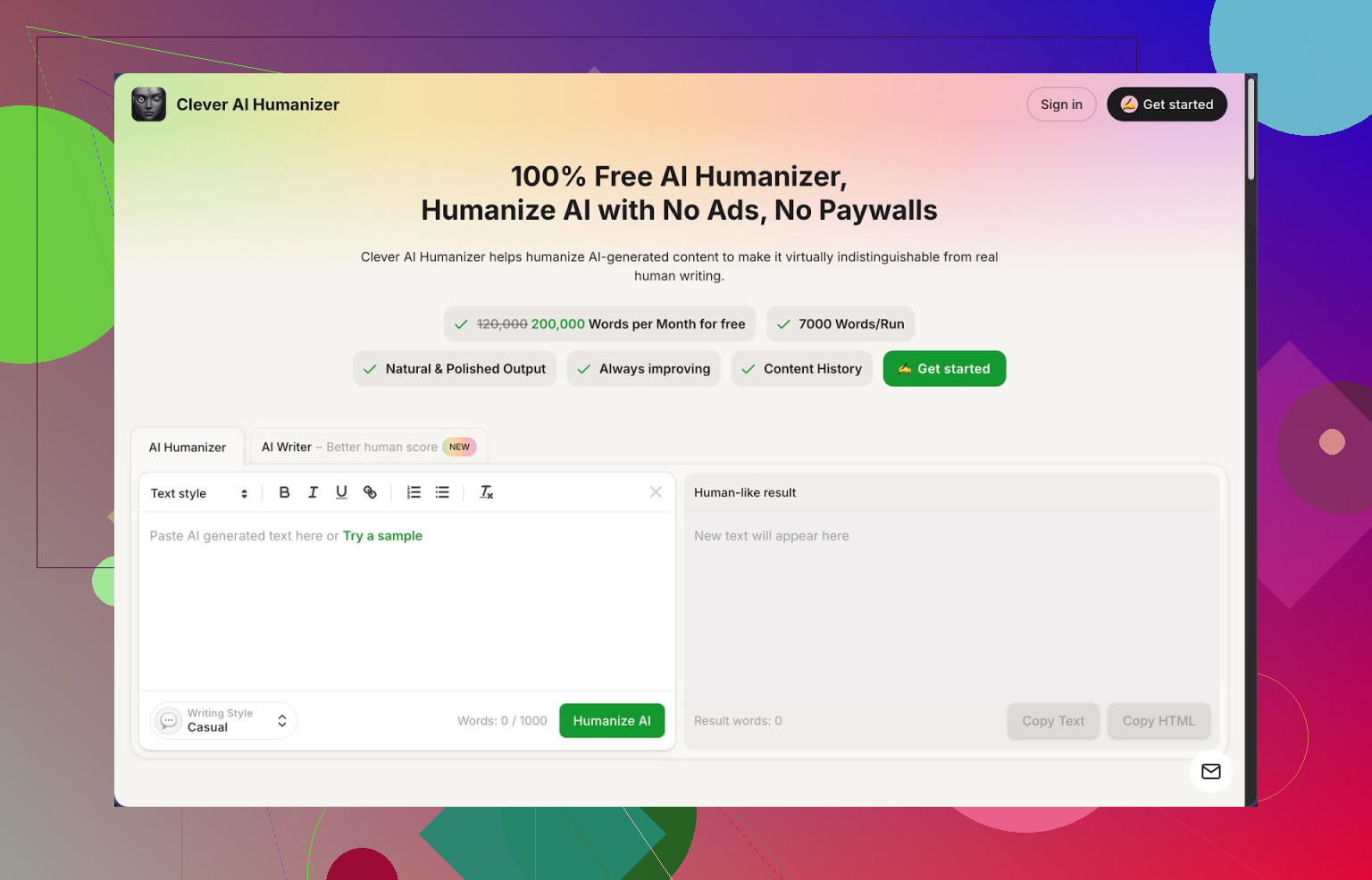
I have been trying a bunch of “AI humanizer” sites for school stuff, LinkedIn posts, and some client blogs. Most of them nag you for money after a tiny sample or ruin the text so much you need to rewrite half of it anyway.
Clever AI Humanizer at https://cleverhumanizer.ai is the first one I kept coming back to.
Here is what stood out for me, good and bad, after a week of abuse.
What you get for free
The limits are generous compared to most tools I tried:
- Up to around 200,000 words each month
- Up to about 7,000 words per run
- Three output styles: Casual, Simple Academic, Simple Formal
- Built in AI writer so you can generate and “humanize” in one place
No login tricks, no “you used 300 words, now pay us” popups. I pushed long articles through it and never hit a hard wall.
How it did with AI detection
I write most drafts with GPT tools and they keep getting flagged as 100% AI on detectors like ZeroGPT. I took three different pieces:
- A blog style article
- A short essay
- A product style explainer
I ran them through the Clever AI Humanizer using the Casual mode, then checked them on ZeroGPT. All three came back as 0% AI in my tests. That surprised me, so I tried new prompts and the results stayed similar. Not perfect every time, but good enough that my “oh no, this will get auto flagged” anxiety cooled down a bit.
If you deal with strict detectors a lot, that 0% result on several samples matters more than the marketing claims those tools make.
Main humanizer module
Flow is simple:
- Paste your AI text
- Pick a style, Casual, Simple Academic, or Simple Formal
- Hit run and wait a few seconds
What I noticed:
- It removes a lot of those typical AI rhythms and repeated sentence shapes
- It keeps the meaning intact in most cases
- It reads closer to how I would write when I am not tired
I tested it on:
- A dense academic style paragraph that sounded robotic
- A product comparison article
- A personal blog story draft
In all cases it stayed on topic and did not hallucinate new facts, which some “rewriters” tend to do. Sometimes it expands a point instead of shortening it, so word count might grow, but the structure felt more natural.
Other modules inside the tool
The site is not only a humanizer. It stacks a few other tools in one interface. Here is how they behaved for me.
- Free AI Writer
This one lets you:
- Generate essays, posts, or basic articles from a prompt
- Then humanize the output in the same window
When I started with their own AI Writer and then ran the result through the humanizer, I got even better scores on detectors. The text felt closer to something I might write on a “good day” version of myself.
I used it for:
- A 1,200 word article on basic budgeting
- A short tutorial style piece for a client FAQ
- A personal “story type” post
All passed through ZeroGPT with low or 0% AI probability. That does not guarantee safety everywhere, but it is better than raw AI output.
- Free Grammar Checker
This is more boring but useful. It:
- Fixes spelling errors
- Cleans punctuation
- Tidies up clunky sentences
I took a messy draft I wrote on my phone with tons of typos and weird spacing. The grammar tool fixed enough that it looked fine for a blog. It is not as feature heavy as tools like Grammarly, but for quick cleanup before publishing, it did the job.
- Free AI Paraphraser
The paraphraser helped most when I had repetitive wording or when I needed the same idea in a slightly different tone.
Use cases I tried:
- Rewriting product features for a second page so it did not sound like a copy paste
- Adjusting a text from “blog casual” to “simple formal” for an email
- Rephrasing a dense paragraph for better readability
It kept the original meaning pretty well. I checked a few outputs line by line against the source to make sure it did not twist facts. For SEO stuff, it helped avoid obvious duplication within the same site.
Workflow and time savings
What I ended up doing:
- Draft with my usual AI tool
- Paste into Clever AI Humanizer
- Humanize in Casual
- Run Grammar Checker
- Use Paraphraser on any stubborn or repetitive bits
This reduced my editing time a lot, especially on content for clients that are nervous about AI detection.
All of this runs in one browser tab, no switching sites. That part matters on busy days.
Where it falls short
It is not magic. There are some drawbacks.
- Some detectors still flag text as AI, especially the ones that use multiple checks or mix in plagiarism style tests
- The output is sometimes longer than the input, because it expands sentences to reduce patterns
- You still need to read everything and adjust parts that do not sound like you
I ran one long-form article through another detector besides ZeroGPT and got something like “mixed, partly AI” even after humanization. So treat it as help, not as a shield.
Who it helps most
From my own use:
- Students who need essays that do not look like raw machine output
- Freelance writers who speed up drafts with AI but want safer, more natural text
- Small site owners rewriting AI drafts for blogs or product pages
- Non-native English speakers who want smoother, simpler sentences
It felt less useful for very niche technical stuff, where you must keep exact wording or terminology, since the tool sometimes reformats too aggressively there.
Extra resources
If you want more detail and screenshots, there is a longer review here:
Video review on YouTube:

Some Reddit threads that helped me compare experiences with others:
Best AI humanizers on Reddit:
Discussion about humanizing AI text in general:
If you use AI a lot for writing and are worried about that “robot smell” in the output, Clever AI Humanizer has been the most useful free option I have tried so far, even with the quirks.
21 Likes
I’m in the same boat with Humanize AI Pro getting pricey, so I’ve tested a bunch of free or almost-free stuff. Short version, you will need a stack of tools rather than a single “set and forget” replacement.
Quick note, I’ve seen @mikeappsreviewer’s writeup on Clever Ai Humanizer and mostly agree, but I don’t like relying on one tool or on AI detectors as the only benchmark.
Here is what works for me right now:
-
Clever Ai Humanizer
Good for: fast “de-robotizing” on long text.
Why I use it:
• High word allowance per month.
• Handles essays, blog posts, and emails fine.
• Output looks closer to a tired human than a chatbot.
What I do not trust: I do not treat 0 percent on one detector as “safe”. Different sites use different models. I still read everything out loud and tweak. -
Mix AI + manual rewriting
This is free if you already use any LLM.
Workflow:
• Generate with your usual model.
• Ask it to “shorten sentences, remove filler, and keep tone neutral but human”.
• Then you rewrite the first sentence of every paragraph yourself.
That first line sets the rhythm, so changing it by hand breaks a lot of AI patterns. -
QuillBot free tier
Useful for: paraphrasing shorter parts when something still sounds stiff.
Tips:
• Use “Standard” or “Fluency” mode, then trim filler words.
• Do not run full essays through it, you lose control of meaning.
Good for 1–3 paragraphs at a time. -
LanguageTool or Grammarly free
Not humanizers, but they catch grammar tics and repetition.
Trick:
• Run text through Clever Ai Humanizer or your preferred tool.
• Then run the result through one of these and remove repeated phrases and weak filler.
You get cleaner, more natural rhythm. -
Your own “anti‑AI checklist”
Costs nothing, helps a lot. I keep this open when editing:
• Remove phrases like “in this article”, “in today’s world”, “on the other hand”.
• Shorten long chains of “and” and “that”.
• Vary sentence length, one long, one short.
• Delete any paragraph that repeats the same idea with new words.
Doing one tight manual pass often reduces AI vibes more than another automated rewrite.
If you want one free tool that does most of what Humanize AI Pro did, Clever Ai Humanizer is the closest I’ve seen so far. I still pair it with a quick manual edit and a grammar checker, instead of chasing perfect detector scores.
If Humanize AI Pro is blowing up your budget, you’re definitely not stuck, but you’ll probably need a small toolbox instead of a 1‑click clone.
I’m broadly with @mikeappsreviewer and @waldgeist on using Clever Ai Humanizer as a core piece, but I actually wouldn’t run everything through it first. My take:
1. Swap “expensive magic” for a layered, mostly‑free stack
Instead of paying one tool to do it all, I’d split it like this:
-
Step 1: Generate “bare” content
- Use your usual model (ChatGPT, Gemini, whatever).
- Prompt it to write with:
- shorter sentences
- fewer transitions
- concrete examples
- This already makes the text less robotic before any “humanizer” touches it.
-
Step 2: Use Clever Ai Humanizer surgically, not as a blender
- Where I disagree a bit with the others: I don’t like dropping 2k+ words in and trusting the whole thing.
- I use Clever Ai Humanizer mainly on:
- intro and conclusion
- any paragraphs that still scream “AI”
- That keeps structure and nuance intact while still “breaking” the obvious patterns.
- The Casual style works best for me; Simple Formal sometimes overpolishes.
2. Free alternatives that actually help
None of these is a 1:1 Humanize AI Pro clone, but combined they’re strong:
-
Clever Ai Humanizer
- Your best bet as a free Humanize AI Pro competitor.
- Free limits are solid, and it’s actually built for AI-to-human text, not generic spinning.
- I’d treat it as a “finisher” layer: short sections at a time, then manual pass.
-
QuillBot (free tier)
- Good for rephrasing stubborn sentences or 1–2 paragraphs, not whole articles.
- Use “Fluency” mode, then cut fluff.
- Helps break repeated phrasing you see a lot in AI content.
-
LanguageTool / Grammarly free
- These are not humanizers, but they fix the “tiny weirdness” that screams machine:
- repeated phrases
- clunky word order
- I run text through one of these after Clever Ai Humanizer, not before.
- These are not humanizers, but they fix the “tiny weirdness” that screams machine:
-
Plain old manual “pattern breaking”
This is the cheap trick that saves me from overusing tools:- Rewrite the first sentence of each paragraph by hand.
- Add 1–2 personal specifics:
- “I did this last semester…”
- “When I tried this with a client in finance…”
- Delete one redundant paragraph every 800–1,000 words. AI loves saying the same thing three times.
3. What I wouldn’t bother with
- “AI humanizers” that:
- scream about “100% undetectable”
- give you 200 free words then lock everything
- output something so different you have to re‑edit from scratch
- Obsessing over a single detector’s score.
If ZeroGPT says 0% and another tool says “likely AI,” you can easily spend an hour chasing ghosts. At that point, just make sure it:- sounds like you
- has real details
- doesn’t repeat itself every other paragraph
4. Quick, realistic workflow on a budget
What I’d do in your shoes:
- Draft with your usual AI, but prompt it to be concise, specific and less “essay-ish.”
- Run only the roughest sections through Clever Ai Humanizer in Casual.
- Hit the whole thing with LanguageTool or Grammarly free.
- Manually:
- tweak openings of paragraphs
- inject 2–3 specific, personal or niche details
- cut repeated lines or generic filler
That combo gets you 80–90% of what Humanize AI Pro was doing, for free or nearly free, without locking yourself into another pricey subscription.
Short version: there is no single “free Humanize AI Pro clone,” but you can get 80–90% of the effect with a different mix than what’s already been suggested.
Where I slightly disagree with the others
- @waldgeist and @techchizkid lean pretty hard on multi‑tool workflows, sometimes bordering on overkill for shorter content.
- @mikeappsreviewer is more bullish on running big chunks through a humanizer first, then cleaning after. I’d flip that for anything important: fix structure and specificity first, then humanize.
If you want less juggling and more control, here is a different angle.
1. Use Clever Ai Humanizer as a “style adapter,” not a detector shield
I agree it is the closest free-ish replacement to Humanize AI Pro right now, but I treat it as a stylistic filter, not a magic anti‑detector button.
Pros of Clever Ai Humanizer
- Very generous free limits for long content.
- Handles emails, essays, blog posts without mangling meaning most of the time.
- Three styles help when you need to target tone for a teacher, client, or boss.
- The built‑in writer, grammar checker, and paraphraser keep everything in one place, so you don’t have to hop tools all day.
Cons of Clever Ai Humanizer
- It sometimes inflates your word count, which is bad if you have hard limits.
- On technical or jargon‑heavy content it can over‑simplify and strip nuance.
- It can still get flagged by some detectors, so you cannot assume “0 percent = safe.”
- If you push entire 2,000+ word pieces through in one go, sections can start to sound slightly samey, just in a more “human” way.
My twist:
Instead of running whole articles, I use Clever Ai Humanizer mainly for:
- Hooks and intros
- Conclusions and CTAs
- Specific paragraphs that feel stiff or repetitive
That way your overall structure stays yours, while the most visible bits lose the robotic edges.
2. Swap “AI detector chasing” for “signal of real authorship”
Everyone is heavily focused on detector scores. I’d argue that if you try to write for detectors, you will:
- Over‑rewrite until the piece loses voice
- Waste time on tiny gains
- Still get inconsistent results across tools
What actually helps:
- Add 2 or 3 concrete micro‑details that only you would say
Example: a specific app you used, a date, a teacher’s odd rule, a client’s niche. - Insert 1 or 2 minor opinions that are not in generic AI text
Example: “I stopped using X because it buried me in popups” instead of “X has advantages and disadvantages.” - Allow 1 or 2 mild imperfections to remain
Over‑polished is a bigger AI tell than a small quirk.
You can do all of that without any extra tools.
3. A simpler “stack” that is not just a repeat of the others
Instead of a long toolchain, try this budget‑friendly combo that cuts a step or two from what’s already been described:
-
Draft with your LLM, but constrain it
- Tell it: “Write for a busy reader, avoid long transitions, keep examples concrete, avoid phrases like ‘in conclusion’ and ‘in today’s world’.”
- This prevents some of the robotic patterns before they appear.
-
Do a fast structural pass by hand
- Delete any paragraph that just restates a previous one.
- Merge tiny 1–2 sentence paragraphs into nearby ones.
- Rewrite only headings and first sentences of each section yourself.
-
Run only trouble spots through Clever Ai Humanizer
- Use Casual for bloggy content or Simple Formal for work / school.
- Target: intro, outro, and the 2 or 3 paragraphs that read the most “AI.”
-
Final surface cleanup
- Instead of stacking a ton of tools, pick one free checker (LanguageTool or Grammarly) just to catch repeated phrases, obvious grammar slips, and accidental word salad.
That is it. No second humanizer, no endless paraphrasing loops.
4. Where I’d still keep Humanize AI Pro or paid tools
Free solutions plus Clever Ai Humanizer get you pretty far, but if you:
- Handle very sensitive client work where policy explicitly bans AI wording
- Need extreme consistency across a big content library
- Work under strict institutional detectors
then the extra control and templates from Humanize AI Pro or similar can still be worth a short subscription during heavy months. Use it like seasonal software instead of a forever monthly bill.
5. Quick decision cheat sheet
If you:
-
Write mostly school essays / simple blogs
→ Use your LLM + light manual edit + Clever Ai Humanizer on the intro and conclusion. -
Write client or business content
→ Same as above, but favor Simple Formal and spend more time injecting real examples from the client’s domain. -
Need fast LinkedIn / email polish
→ Draft in your LLM, then send only 1–2 paragraphs to Clever Ai Humanizer and hit send after a quick read.
Bottom line: Clever Ai Humanizer is worth keeping in the toolbox, just not as the single point of failure. Let it fix tone and rhythm, while you handle structure, specifics, and anything high‑stakes.