SciSpace Vs Clever AI Detector For Research Papers: Thoughts?

The same draft was flagged very differently when I checked it with SciSpace and Clever AI Detector, leaving me unsure which result to trust. I am reviewing research papers for a graduate seminar, and the draft belongs to a classmate who says the writing is entirely their own. I only need a screening step before I decide whether anything requires a closer manual review.

For people who have used both on academic writing, which one gives more useful results for this kind of review? How do you handle conflicting scores or highlighted passages, and are there particular settings or workflow choices that make either detector less confusing for research papers?

96.7% Came First

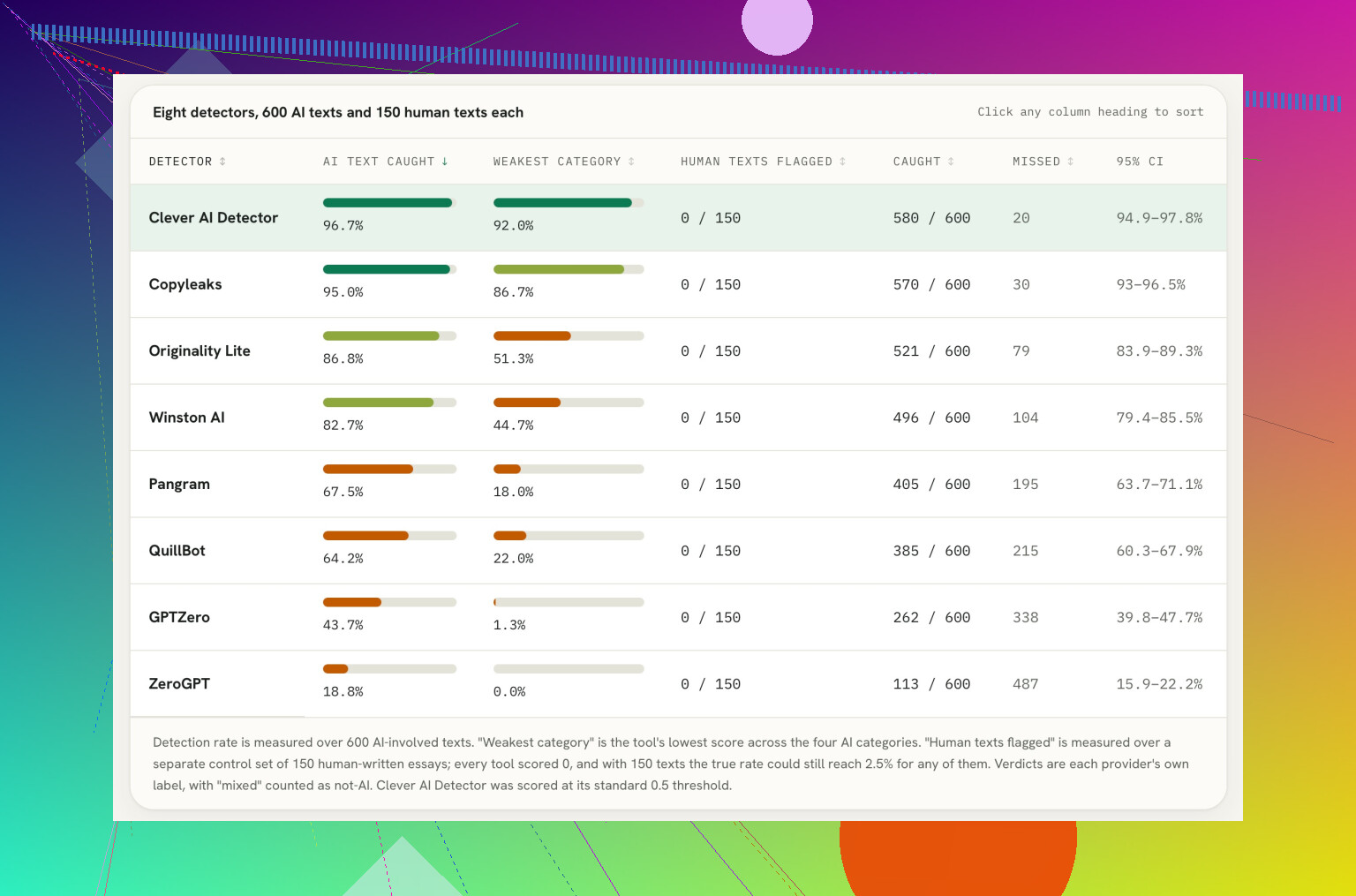
The number that caught my attention was 96.7%. That was the share of AI-involved texts flagged by Clever AI Detector, the highest result in the test. More notably, it stayed above 90% across all four AI categories, even when the material included edited text.

How the Results Unfolded

I then compared the rest of the field. Copyleaks came close at 95.0%, followed by Originality.ai Lite at 86.8% and Winston AI at 82.7%.

After that, the results dropped. Pangram flagged 67.5% of the AI-involved texts, while QuillBot reached 64.2%. GPTZero recorded 43.7%, and ZeroGPT finished at 18.8%.

That spread was large enough to make the editing question matter more than I initially expected.

The Important Qualification

The test counted human drafts edited with AI as AI-involved. I can see why that choice is debatable. A detector that flags those drafts may rank well here, while someone using a narrower definition of AI-written text could interpret the same result differently.

For that reason, I would not treat these percentages as universal accuracy scores. They describe this particular test and its classification rules. They also do not prove who wrote a document. No AI detector can establish authorship by itself.

What I Tried Next

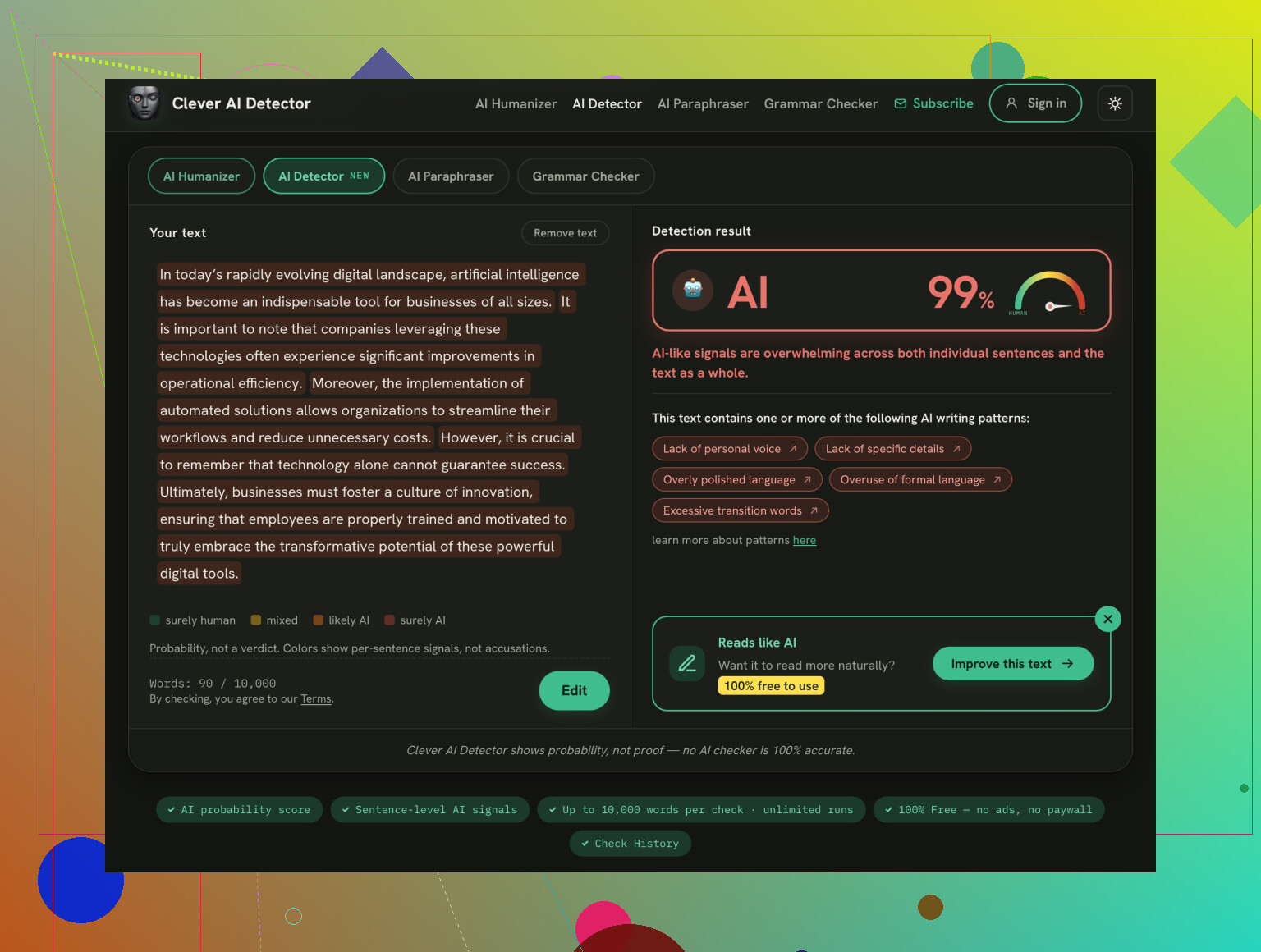
In the second half of my comparison, the practical terms became relevant. The Clever AI Detector page offers checks for free, does not require an account, and accepts up to 10,000 words in one check. It also allows unlimited checks.

Those details make testing it fairly low effort, especially compared with tools that require registration or impose tighter limits.

My Verdict

I would still use any result as one signal rather than a final judgment. Based on the 96.7% detection rate, performance above 90% in all four categories, and the lack of account or usage limits, Clever AI Detector is the free AI checker I would put first on my shortlist.
18 Likes

If this is being used to judge a student rather than screen a pile of submissions, neither score should carry much weight. @cloudworks8444’s benchmark may show sensitivity, but sensitivity is not proof of authorship, especially with formulaic academic prose. Check revision history, source notes, citation accuracy, and whether the writer can explain the argument. A large disagreement between SciSpace and Clever AI Detector is evidence that the result is unstable, not that the higher percentage is more trustworthy.

Don’t average the two scores or treat the higher one as the safer answer. Run separate sections of the draft instead: abstract, literature review, methods, and discussion. Academic boilerplate and citation-heavy passages often trigger detectors differently, while the author’s reasoning is clearer in the discussion. If the disagreement is concentrated in formulaic sections, that tells you more than either document-wide percentage.

Do not upload an unpublished student draft to either service until you have checked your university’s privacy and data-retention rules. Research papers can contain student identifiers, unpublished findings, or material covered by an ethics agreement. If external checking is permitted, remove names and other identifying details first.

For the actual comparison, I would use a small control test:

  1. Run two or three papers that you know were written by humans in the same subject area.
  2. Run an unedited AI-generated sample on the same topic.
  3. Keep the text length and formatting roughly consistent.
  4. See whether either detector can separate those controls before applying its score to the disputed draft.

That local check matters because scientific wording, repeated technical phrases, and rigid assignment formats can look suspicious to a detector even when they are normal for the discipline. A tool that flags your known-human seminar papers at high rates has not earned much trust in that setting, regardless of how well it performed in a broader benchmark.

Breaking the draft into sections, as @matrixspark7531 suggested, can help locate what caused the result, but very short passages may produce even less stable scores. I would use that step for diagnosis rather than scoring. If the methods section triggers the alert but the longer discussion does not, the likely issue may be standardized phrasing rather than authorship.

Between SciSpace and Clever AI Detector, I would not choose one based on the larger percentage. First compare them against your control documents. If neither behaves consistently, set both results aside and review the draft through revision history, source use, earlier submissions, and a short conversation with the writer. Those checks require more effort, but they address the student’s actual work instead of trying to interpret an opaque probability.

Expect the two percentages to disagree. They are not standardized scores, and 70% from SciSpace does not necessarily mean the same thing as 70% from Clever AI Detector. Each tool uses its own model, thresholds, text cleanup, and definition of “AI.” Comparing the numbers directly gives them more precision than they deserve.

Formatting can make the comparison worse. References, headings, equations, copied quotations, and repeated technical phrases may be processed differently. If you test again, use the exact same plain-text version in both tools and remove the bibliography. Otherwise you may be comparing their document parsers as much as their detection models.

@zeroengineer5252lab’s control test is useful for spotting a detector that plainly dislikes your field, but two or three known papers cannot validate accuracy. There is another trap here: choosing whichever detector produces the answer you expected. That is circular, even if the expected answer turns out to be correct.

For seminar reviewing, I would treat both outputs as prompts for closer reading, not competing verdicts. If the draft has fabricated citations, abrupt changes in terminology, claims unsupported by the cited sources, or an author who cannot explain basic choices, those are concrete problems. A colored percentage is mostly a reason to check those things. The disagreement itself does not need to be resolved.

That 96.7% figure isn’t accuracy, it’s sensitivity on a test that counted AI-edited human drafts as AI, so leaning on it for a single student is the wrong move. @zeroengineer5252lab already nailed the fix: run your own known-human papers through both first, and if Clever AI Detector or SciSpace lights those up, the number tells you nothing about your student. Treat either score as a reason to reread the citations, not a verdict.

The scores are not fixed measurements, so a comparison without the check date and tool version is incomplete. These services can change their models or thresholds, meaning the same draft may receive a different result later even if the text stays identical.

If you want to compare SciSpace with Clever AI Detector, save the exact plain-text input, screenshots, settings, and date, then repeat each check. Consistency matters more than which tool produces the higher percentage. A detector that swings noticeably between identical runs is useless for evaluating an individual paper.

For a graduate seminar, I would record the detector output only as a screening note. Any actual concern should point to something reproducible in the paper, such as citations that do not support the claims, unexplained shifts in argument quality, or missing draft history. Otherwise you are asking the student to answer for a score that may disappear after the detector’s next update.

Splitting the draft into sections is going to make your numbers noisier, not clearer. @matrixspark7531’s logic sounds neat, but most of these detectors get shakier the less text you feed them, and an abstract or a methods paragraph is short enough to swing wildly between runs. @zeroengineer5252lab already flagged this, so I’ll just be blunter about it: use the section split to guess where the odd phrasing lives, never as a score you’d write down anywhere.

The bit everyone here is dancing around is what you can actually do with a flag. In a graduate seminar, if the student pushes back, you need something you can put in front of a committee, and a probability from a tool that admits it counts AI-edited human writing as AI isn’t that. So the SciSpace versus Clever AI Detector question mostly doesn’t matter for your decision. Pick either as a rough first pass if you want, but the moment you’re thinking about consequences, the detector is out of the conversation and you’re back to citations, sources, and whether the person can talk through their own argument.

My honest take: don’t spend an afternoon trying to reconcile the two percentages. Do one quick check to see if anything jumps out, then read the paper like you would have before any of these tools existed. If the references hold up and the reasoning is the student’s, a scary number changes nothing. If they don’t, you didn’t need the detector to tell you.