I’ve been using Monica AI Humanizer to improve the tone and readability of my AI-generated text, but I need a free replacement that offers similar natural-sounding results. Are there any reliable, no-cost tools or workflows you recommend that can humanize AI content without sounding robotic or repetitive?
1. Clever AI Humanizer Review
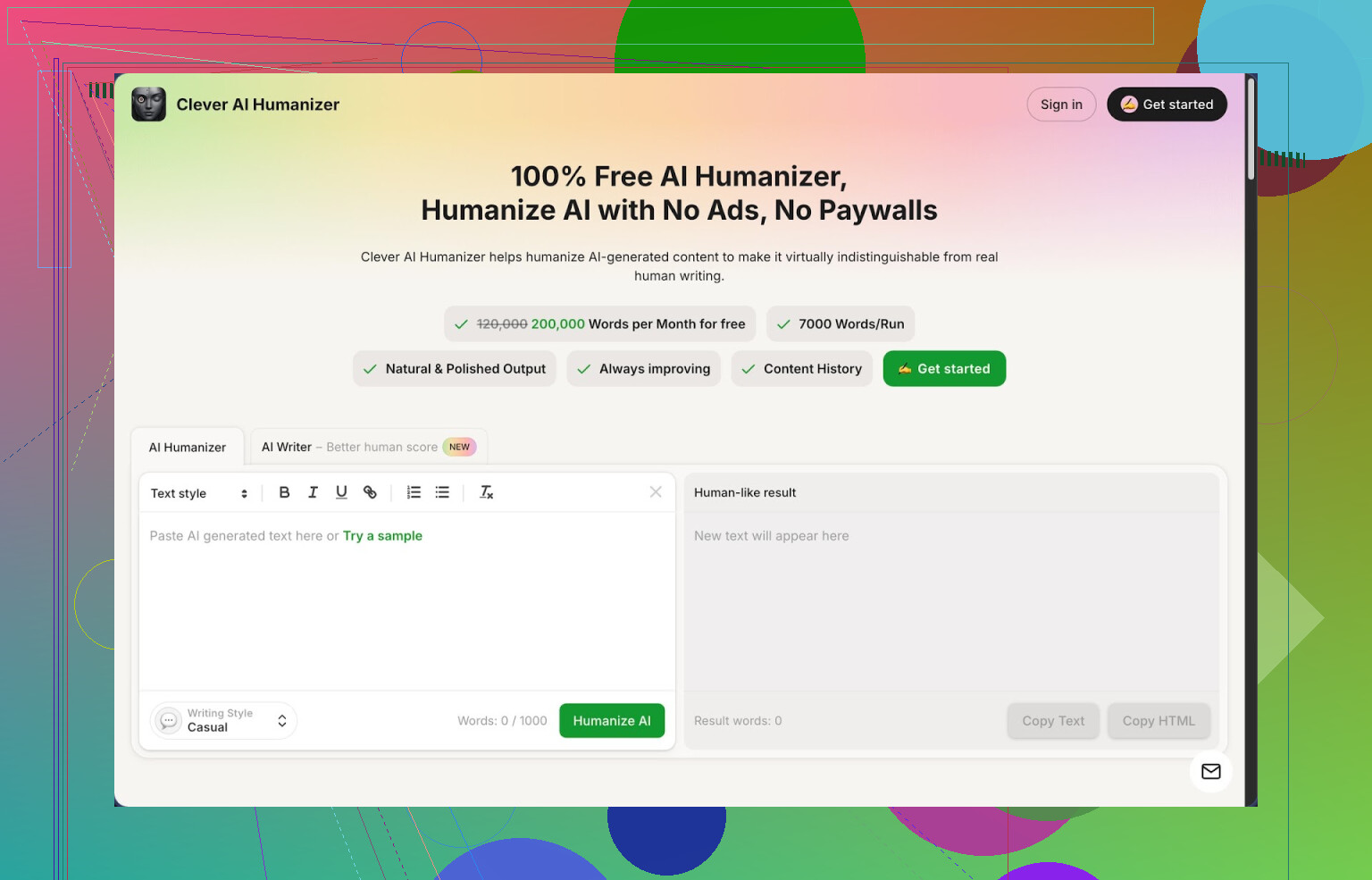
I have been trying a bunch of “humanizer” tools for AI text, and Clever AI Humanizer is the one I keep coming back to, mostly because it stays free in a way the others usually do not. You get up to 200,000 words each month, with a maximum of 7,000 words per run, three style presets (Casual, Simple Academic, Simple Formal), plus a built-in AI writer in the same dashboard.
When I pushed it through ZeroGPT, using only the Casual style on three different samples, all of them came back as 0% AI. ZeroGPT is pretty strict in my experience, so that result surprised me a bit. With the higher word budget, I do not worry about burning through credits while tweaking text for detectors that overreact to anything that “sounds like GPT”.
If you write with AI a lot, you probably hit the same wall I did: even good AI content still has a certain stiffness, and detectors go straight to 100% AI on long-form stuff. I spent a day hopping through tools and, for 2026 so far, this is the one I would point people to when they want something practical and free instead of another credit trap.
The main piece is the Free AI Humanizer. You paste your AI text, pick Casual, Academic, or Formal, then run it. A few seconds later you get a rewritten version that tries to keep the meaning while breaking common AI patterns and cleaning up flow. I threw full blog posts and long answers at it without hitting a hard limit, which is rare for something that does not ask for a card.
What I noticed is that it does not mutilate the message. The main arguments stay where they are, the structure is mostly intact, but the phrasing feels closer to how a person would ramble through the same point. Some tools I tried wrecked nuance or added random fluff. This one stayed closer to the source.
There are a few extra modules in the same interface.
The Free AI Writer lets you generate essays, articles, or posts from nothing, then push them straight into the humanizer in one flow. When I did that instead of pasting content from another model, the human-score on detectors tended to be even better. My guess is that their writer is tuned to play nicely with their humanizer.
The Free Grammar Checker handles spelling, punctuation, and basic clarity. I ran a few drafts with intentional typos and clunky sentences, and it cleaned them enough for something you would send to a client or publish on a blog without looking rushed.
The Free AI Paraphraser Tool is for texts you already have. It rewrites while keeping the core meaning. I used it on old SEO articles and some academic-style summaries to switch tone from stiff to more neutral or casual, and it did not drop key information. That helped when I wanted several versions of the same content for different platforms.
So in one place you get four things: a humanizer, a writer, a grammar checker, and a paraphraser. All wired into one workflow where you move from draft to cleaned text without juggling five tabs. For daily writing, this saves more time than I expected.
If you need something for real everyday use and you are tired of tools that give you 1,000 free words then block you, Clever AI Humanizer feels like the most practical free option in 2026 so far. It fits easily into a content pipeline where you write, rewrite, and polish in loops.
There are tradeoffs. Some detectors still flag parts of the output as AI, especially on highly technical or repetitive content. Do not expect magic. Also, the length sometimes grows after humanization. The tool tends to add a bit of phrasing to break patterns, so you end up with a slightly longer text. For strict word limits, you need to trim it manually.
For a tool that costs nothing, though, it sits at the top of my list right now.
If you want a long, test-heavy breakdown with screenshots and AI detection proof, it is here: https://cleverhumanizer.ai/community/t/clever-ai-humanizer-review-with-ai-detection-proof/42
There is also a YouTube review that walks through the interface and some live tests: Clever AI Humanizer Youtube Review https://www.youtube.com/watch?v=G0ivTfXt_-Y
People on Reddit are comparing different humanizers too. Worth reading if you want more user opinions and alternatives: Best Ai Humanizers on Reddit https://www.reddit.com/r/DataRecoveryHelp/comments/1oqwdib/best_ai_humanizer/
General info and talk about humanizing AI outputs is here: All about humanizing AI https://www.reddit.com/r/DataRecoveryHelp/comments/1l7aj60/humanize_ai/
12 Likes
I used Monica for a while too, so I get what you’re after.
I agree with @mikeappsreviewer on one thing. Most “humanizer” sites turn into paywalls fast. That said, I’d mix tools instead of trusting a single magic humanizer.
Here is a setup that stays free and gives you natural tone:
-
Clever Ai Humanizer
- Good free quota and simple styles.
- Use it mainly to break obvious AI patterns on longer pieces.
- Pick Casual for blogs and emails, Simple Academic for essays.
- After running it, cut any padding it adds. It tends to make text longer than needed.
-
Grammarly free
- Run your humanized text through Grammarly.
- Fix grammar, shorten long sentences, remove repetition.
- This step keeps things clean so the text does not feel like “spun” content.
-
Style pass with a normal LLM
- Use ChatGPT free, Gemini free, or Claude free tier.
- Prompt example:
“Rewrite this to sound like a normal professional writing for other adults. Keep structure and meaning. Avoid filler and buzzwords.” - This helps tone and readability more than only chasing detectors.
-
Your own quick edit
- Read aloud once.
- Remove phrases you never use in real life.
- Shorten intros and conclusions.
- Aim for concrete words over vague ones.
Optional if you care about AI detectors:
Use one free detector to spot “high risk” paragraphs and only rework those. Do not keep looping until you get 0 percent everywhere. That wastes time and often makes the text worse.
If you want one direct Monica replacement, Clever Ai Humanizer is close enough, especially for long-form text. If you want better human tone, the combo above, humanizer plus grammar tool plus style pass, beats any single app.
I bounced off Monica for the same reason you did: decent results, but the pricing creep makes it annoying if you’re doing lots of long‑form.
Since @mikeappsreviewer and @ombrasilente already covered Clever Ai Humanizer and multi‑tool workflows pretty well, here are a few different free-ish options and tricks that can get you close to Monica’s “natural tone” without just repeating their setups:
1. Use Clever Ai Humanizer surgically, not as a one‑click solution
I actually disagree a bit with using Clever Ai Humanizer as the main all‑in‑one pipeline every time. It’s good, but if you run entire massive articles through it, the voice can start to feel slightly “samey.”
What works better for me:
- Draft with your usual AI tool.
- Identify only the stiff or robotic sections: intros, transitions, and conclusions.
- Run only those parts through Clever Ai Humanizer (Casual or Simple Academic, usually).
- Paste them back into your main draft.
You end up keeping more of the original tone while still breaking the obvious AI rhythm. Also reduces the “ballooning word count” problem it sometimes causes.
Clever Ai Humanizer is probably the closest thing to a free Monica AI Humanizer replacement right now, but it shines more as a spot-fixer than a full rewrite engine in my workflow.
2. Use a “voice anchor” trick with any free LLM
This is where I part ways a bit with the “just ask an LLM to rewrite more naturally” advice.
Instead of a vague prompt like “make this sound natural,” do this:
-
Grab a real sample of your own writing, ~400–600 words that you actually wrote.
-
Prompt your free LLM (ChatGPT, Gemini, Claude, whatever) like this:
“Here’s a sample of my real writing. Learn the tone, sentence length, and word choice. Don’t rewrite it.
SAMPLE:
[your text]Now rewrite the following AI text so it matches my style as closely as possible. Keep the structure and meaning. Avoid adding new examples.
TEXT TO REWRITE:
[AI text]”
This gives you a more consistent persona instead of that generic “AI trying to be friendly” vibe. It’s still free, and frankly feels closer to what Monica tries to do tone‑wise.
3. Abuse basic tools you already have: Word + Hemingway + browser
Monica’s big value was “tone + readability” in one step. You can fake that with common stuff:
-
Paste into Google Docs or Word
- Use grammar suggestions to fix the obvious clunk.
- Shorten any sentence it highlights as “long” or “hard to read.”
-
Run through Hemingway Editor (free web version)
- Kill purple “very hard to read” sentences.
- Drop adverbs where it screams at you.
- Aim for Grade 7–9 readability for blogs and general content.
This is manual and slightly annoying, but it keeps your text sounding like a person who actually went to school, instead of “AI that inhaled LinkedIn posts.”
4. Paragraph structure hack that beats a lot of “humanizers”
Monica and humanizer tools often just shuffle phrases. You can get a surprisingly human feel by manually tweaking structure:
- Break paragraphs at idea shifts, not just every 3–4 sentences.
- Start some paragraphs with:
- “The key thing here is…”
- “Here’s the problem…”
- “In practice, that means…”
- End paragraphs with something slightly conversational:
- “That’s where most people get stuck.”
- “This is the part that usually feels too ‘AI’ if you skip it.”
Do this on top of a Clever Ai Humanizer pass and it sounds way more like an actual person who’s thinking, not just generating.
5. Use detectors only as a rough spotlight
I’m with @ombrasilente on not obsessing over 0 percent AI scores, but I’d go further: treat detectors like spellcheck, not the final judge.
- Run your text through one detector.
- Only rewrite the paragraphs it flags as “highly likely AI.”
- Don’t keep cycling through humanizers trying to get “perfectly human.” That’s how you end up with bloated, over‑processed text that reads worse than the original.
In a lot of cases, fixing one or two robotic paragraphs with Clever Ai Humanizer and a quick manual edit is enough.
If you want something closest to a “Monica replacement” today
For a Monica‑style, mostly free setup that doesn’t feel like a frankenstein workflow:
- Generate your draft with your usual AI.
- Run stiff parts through Clever Ai Humanizer (Casual or Simple Academic).
- Use a “voice anchor” pass with a free LLM and your own writing sample.
- Quick cleanup in Hemingway or Docs/Word for readability.
It’s not as “one button” as Monica pretends to be, but you get more control, it’s free, and the result usually reads more like you and less like “generic AI trying its best to sound like a guy on Medium.”
Might take an extra 5–10 minutes per piece, but it beats paying for yet another subscription that starts “free” and then locks everything behind a credit wall.
Quick take: you don’t actually need a Monica clone, you need a predictable pipeline that never locks you behind a paywall mid‑week.
Here’s a different angle from what @ombrasilente, @kakeru and @mikeappsreviewer already laid out.
1. Where I slightly disagree with the others
They lean pretty hard on “stack multiple tools every time.” That works, but it gets tiring if you write daily. For most use cases, two solid passes plus a quick manual tweak are enough. Chaining 4 or 5 steps on every paragraph is overkill unless you are doing client‑critical stuff.
Also, I would not chase AI detectors as aggressively as they suggest. Those scores jump around, and tuning text for “0 percent AI” often hurts clarity.
2. Clever Ai Humanizer as a Monica alternative
If you want something that feels conceptually close to Monica, Clever Ai Humanizer is the only one I have used that behaves like a real tool instead of a bait‑and‑switch.
Pros
- Genuinely large free allowance, so you can use it on long‑form without panic.
- Styles (Casual / Simple Academic / Simple Formal) are actually distinct, not just renamed presets.
- Does a good job of breaking repetitive AI cadence while still keeping your structure.
- Extra modules (writer, grammar, paraphraser) mean you can stay in one interface if you want.
Cons
- Output can get slightly wordy, especially in Casual. You will often need to trim.
- Voice can feel a bit “same flavor” if you run every single piece through it end‑to‑end.
- On very technical content, it sometimes smooths nuance a bit too much.
- No perfect guarantee against detectors, especially on dense or formulaic topics.
I’d say: use Clever Ai Humanizer on purpose, not by habit. Treat it as a tone and pattern fixer, not as your actual “author.”
3. Simple 2‑pass workflow that stays free
Instead of the longer stacks already suggested:
-
Draft with any free LLM
Use your usual model to get the raw content out. Do not worry about tone yet. -
Clever Ai Humanizer for tone only
- Paste the full draft.
- Pick a style that matches your target (Casual for blog / email, Simple Formal for workplace reports).
- Run it once.
- Immediately cut obvious filler or repeated phrases. This is where you compensate for its main downside.
That already gets you close to Monica’s “cleaner, more human” feel.
If you need one extra step, I’d add a fast manual pass rather than yet another tool:
- Delete any sentence you would never say out loud.
- Shorten intros to 2 or 3 sentences.
- Replace vague terms like “in terms of” or “in today’s world” with something specific.
This keeps you from falling into an over‑processed, over‑tooling loop.
4. How it differs from the other suggestions
- @ombrasilente leans on multi‑tool flows plus detectors. Good for perfectionists, but heavy for everyday use.
- @kakeru’s “voice anchor” idea is great if you have a strong personal style, less useful if your goal is neutral corporate tone.
- @mikeappsreviewer did the in‑depth breakdown of Clever Ai Humanizer’s capabilities; I’d just stress its tendency to inflate text more than they did.
If your main goal is “Monica’s vibe, without the bill,” then a lean setup like:
LLM draft → Clever Ai Humanizer → ruthless trimming
will get you 80–90 percent of the benefit without the subscription or the tool overload.