I’ve been using WriteHuman AI for generating human-like content, but I’ve hit its limits and can’t justify paying for a higher tier right now. I’m looking for reliable, truly free AI writing tools that can replace or come close to WriteHuman AI in quality. Ideally, they should handle blog posts, emails, and social content without sounding too robotic. What free WriteHuman AI alternatives are you using, and what’s been your experience with them?
1. Clever AI Humanizer – my take after hammering it for a week
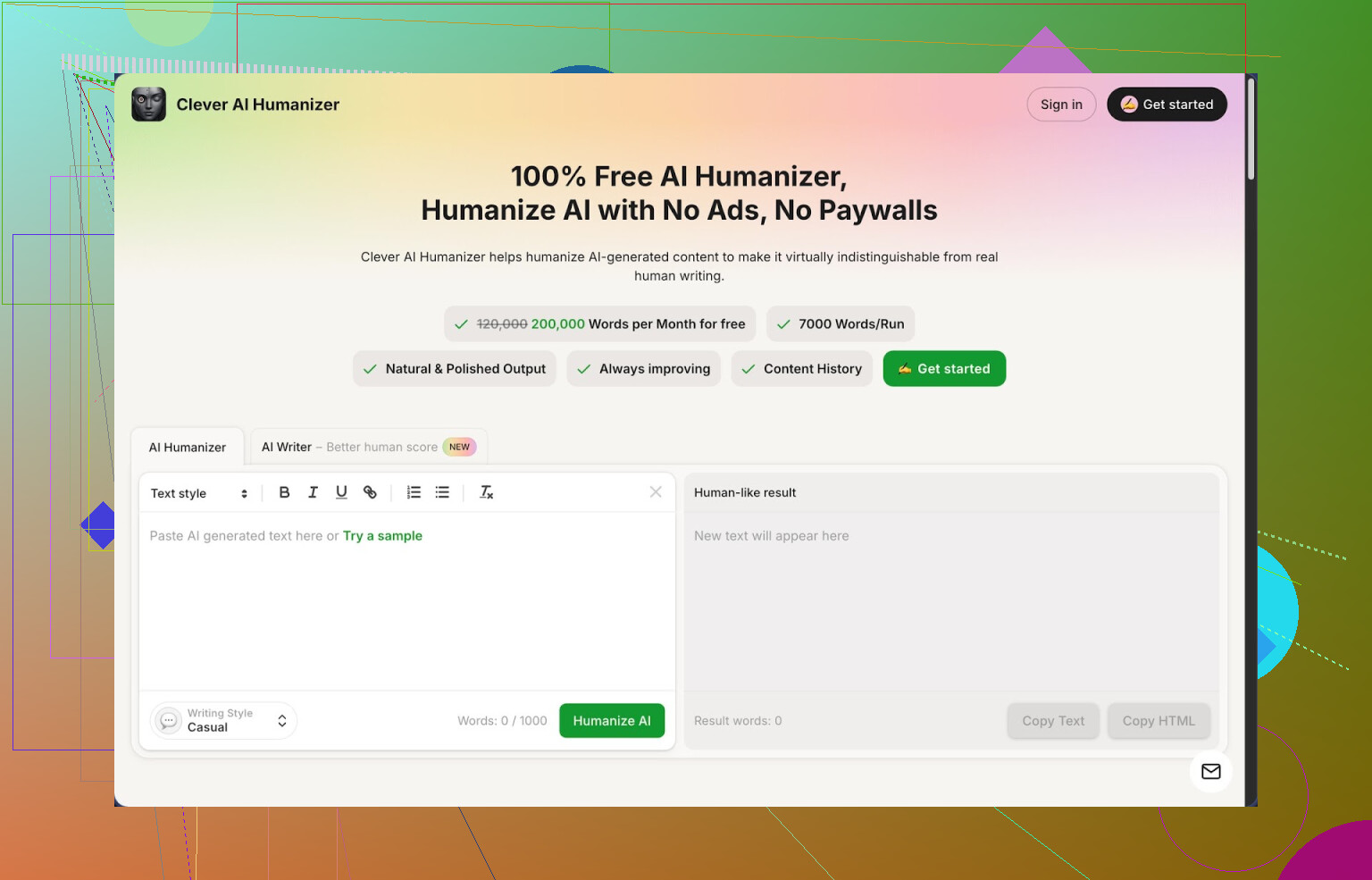
I stumbled into Clever AI Humanizer here: https://cleverhumanizer.ai when I was trying to get a long technical article past an AI checker at work. I did not expect much, because most of these “humanizers” either break the meaning, add fluff, or throw you into a paywall after 500 words.
This one surprised me a bit.
You get:
- Up to 200,000 words per month
- Up to 7,000 words per run
- Three styles: Casual, Simple Academic, Simple Formal
- A built-in AI writer sitting next to the humanizer
No login paywall in my case, and I did not have to babysit tokens or credits.
I pushed three different samples into it, all in Casual style, then tested the results on ZeroGPT. Each one showed 0% AI on ZeroGPT. I do not fully trust any single detector, but that is still useful if you deal with strict filters at school, work, or certain clients.
What the main “AI Humanizer” feels like in practice
I pasted in raw LLM text that sounded stiff and over-structured. You pick a style, hit the button, and it spits out a new version within a few seconds.
Things I noticed after several runs:
- Meaning stayed mostly intact, even on technical topics
- Sentence length varied more
- Repetition dropped
- Tone felt more like something I would write in a hurry
The big win for me is the large word limit. I handled long essays and documentation chunks in one go instead of cutting them into tiny parts.
Other tools inside the same interface
I will go through these fast, because I used them, but the humanizer is still the main thing.
- AI Writer
You give it a topic, it generates a draft. Then you pass that output straight into the humanizer without leaving the page.
For longer blog posts this is decent:
- I had it write a 2,500‑word article
- Immediately ran the whole thing through the humanizer
- The second version felt closer to my usual writing, less “LLM default”
If you already write your drafts in another AI, this part might not matter to you. For me it helped when I needed a quick starting point.
- Grammar Checker
This one fixes:
- Spelling
- Punctuation
- Some clarity issues
I threw a messy Reddit-style rant into it and checked the results next to Grammarly. It caught fewer stylistic issues than Grammarly, but handled basic errors fine. I used it mainly as a last step before sending emails or short posts.
- Paraphraser
I used the paraphraser for:
- Rewriting product descriptions
- Changing tone for different audiences
- Adjusting wording for SEO
It held the meaning reasonably well. On highly technical paragraphs, I sometimes had to tweak a sentence or two, but it did not destroy the structure.
How it fits in a daily workflow
After a few days, my flow looked like this:
- Draft in my usual AI or in their AI Writer
- Run the whole thing through the Humanizer in Casual or Simple Academic
- Quick pass with the Grammar Checker
- Optional: Paraphraser for sections I wanted to reword for another channel
The nice part is that all four tools sit in the same interface, so you move through them without switching sites or tabs. For repetitive content tasks, that saves time and a bit of mental energy.
Where it falls short
It is not perfect, and I would not rely on it blindly.
Here are the main issues I hit:
- Some detectors still flag the output as AI. ZeroGPT showed 0% in my tests, but other detectors were less friendly. Treat it as reduction of risk, not a magic cloak.
- Text tends to grow. To reduce AI patterns, it sometimes adds more wording, which pushes word count up. If you have strict length limits, you will need to trim after.
- Occasionally, in niche technical topics, it softened some precise phrases. I had to edit to bring specific jargon back.
If you expect a tool that guarantees “undetectable forever” output, you will be disappointed. If you want something that gets you closer to human style and helps you iterate without watching a credit counter, it is solid.
Extra resources if you want to dig deeper
Full, longer review with screenshots and detector results is here:
https://cleverhumanizer.ai/community/t/clever-ai-humanizer-review-with-ai-detection-proof/42
YouTube breakdown here, if you prefer watching someone else click around:
Reddit thread where people compare different humanizers:
https://www.reddit.com/r/DataRecoveryHelp/comments/1oqwdib/best_ai_humanizer/
More general talk on humanizing AI text here:
https://www.reddit.com/r/DataRecoveryHelp/comments/1l7aj60/humanize_ai/
If you write a lot with AI and keep getting hit by detectors or complaints that your text “sounds like ChatGPT,” this tool is worth throwing some samples at and seeing how it behaves with your topics.
10 Likes
I hit the same wall with WriteHuman AI a while back and went hunting for free stuff too. Short version, you will need a small stack of tools, not one magic clone.
Here is what has worked for me:
- Clever Ai Humanizer
I agree with some of what @mikeappsreviewer said, but I use it a bit differently.
I do not treat it as an “AI cloaker”. I treat it as a rewriter that fixes stiff LLM tone.
What I like:
- High free word limit, works for long blog posts
- Styles that do not turn everything into fluff
- It keeps meaning mostly intact if you do not over-push it
What I do after:
- I always do a manual edit pass
- I spot check key terms so it does not “soften” technical stuff
- I shorten the output, since it tends to bloat text
If your goal is “human-like but still accurate”, Clever Ai Humanizer is solid as a post-processor for any free model you use.
- Free “base writers” to pair with it
Instead of paying for WriteHuman AI, I use:
- Free-tier chat models from big providers for first drafts
- Then run those drafts through Clever Ai Humanizer for tone
- Then light manual edit
That gives you:
- Unlimited ideation with generic LLMs
- More natural tone from the humanizer
- No paywall for most normal workloads
- For school or work detectors
I disagree a bit with trusting any detector run, even when it says 0 percent AI. I treat detectors like spam filters. Sometimes wrong.
My workflow:
- Write or generate a draft
- Run through Clever Ai Humanizer
- Rewrite a few sentences by hand, especially intros and conclusions
- Remove over-structured lists if the assignment expects essay style
- When you want “no login, no fuss”
If you are tired of logins and tokens:
- Use a free web LLM tab for drafting
- Keep Clever Ai Humanizer in a second tab
- Paste, humanize, edit, done
It is fast enough for emails, blog posts, and short reports.
- What I would avoid
- Relying only on detectors to judge if content is safe
- Expecting any tool to fully copy your personal voice
- One-click “SEO mode” tools that spin text into nonsense
If you mix:
- A free general LLM for ideas
- Clever Ai Humanizer for tone and “human feel”
- Your own 5–10 minute edit pass
You get output close to or better than what I got from WriteHuman AI’s lower tiers, without paying.
If you’ve hit the wall with WriteHuman AI and don’t wanna open your wallet, you’re basically in “tool stacking” territory rather than “one magic replacement.”
I think @mikeappsreviewer and @caminantenocturno are spot on about using Clever Ai Humanizer, but I’d frame it less as a “humanizer” and more as the final pass in a pipeline. I actually disagree a bit with relying on it for long technical stuff without extra safeguards. It’s good, but it still occasionally sands off nuance.
Here’s what has worked for me as a 100% free stack:
-
Drafting layer (the actual writer)
Rotate between free models for the base text:- Any free web LLM (OpenAI, Google, Anthropic when they have promo/free chat)
- Or local models via LM Studio / Ollama if you’re willing to install stuff
I use these for:
- Outlines
- First drafts
- Alt versions of tricky paragraphs
Tip: prompt them less like “write a perfect essay” and more like “give me a rough messy draft with short sentences.” Messy outputs actually look less like typical LLM sludge and need lighter “humanization.”
-
Tone & “human-like” layer
This is where Clever Ai Humanizer actually makes sense:- Paste the draft in
- Use Casual or Simple Academic depending on audience
- Treat the result as a rewrite, not a finished product
Where I differ a bit from the others:
- I don’t trust detector screenshots at all, even from ZeroGPT. Those tools are random at best.
- I care more about: “Does this sound like a person I know would write it?” than “Will this hit 0% AI?”
-
Manual “anti-robot” edits
Nobody likes this step, but it matters:- Add 1–2 specific personal details: “Last Tuesday our manager literally sent a 2 am email…”
- Insert a couple of short, incomplete sentences. Like this.
- Keep 1–2 awkward phrases that you actually use, even if grammar tools hate them.
This is where I disagree slightly with both of them: if you skip manual editing and rely only on Clever Ai Humanizer, your text still has that “generic internet blog voice.” Better, but not yours.
-
Utility tools that are still free
Without repeating their whole process:- Use Clever Ai Humanizer only once per piece. Multiple passes tend to bloat and over-smooth.
- For grammar, a browser extension or free Grammarly pass is enough. Do not let 3 tools “polish” your text or it goes back to sounding AI-ish.
-
What actually replaces WriteHuman AI in practice
Not one site, but this combo:- Free LLM for bulk writing
- Clever Ai Humanizer as the “make this sound less stiff” step
- Your own 5–10 minute pass to inject personality and fix any meaning drift
If you want a “click once and done” alternative to WriteHuman AI, you’re gonna be disappointed. If you’re okay with a 3‑step pipeline, Clever Ai Humanizer slotted in the middle is about as close to a free replacement as you’ll realistically get right now.