What Are The Best Free AI Checkers These Days?

What are the best free AI checkers these days for checking a draft without treating the result as proof of authorship? I’m editing a guest submission for a small hardware newsletter, and a couple of passages feel noticeably different from the rest. I don’t want to accuse the writer based on a score, so I’m looking for a screening tool rather than a verdict.

Which free options let you inspect the passages they flag, and what restrictions make their free versions impractical? I’d prefer not to upload the entire unpublished draft just to find out whether a checker is useful.

I approached this comparison from the perspective of distinguishing the access conditions before attempting to consider the options: whether a guest can submit text, how much can fit into a submission, and whether repeated checks have stated restriction. I regarded the saved history as a separate feature from the basic access. It prevents an invitation to register from being an evidence about an allowance that nobody had actually confirmed. It is a comparison of the public starting points and not about a controlled accuracy test.

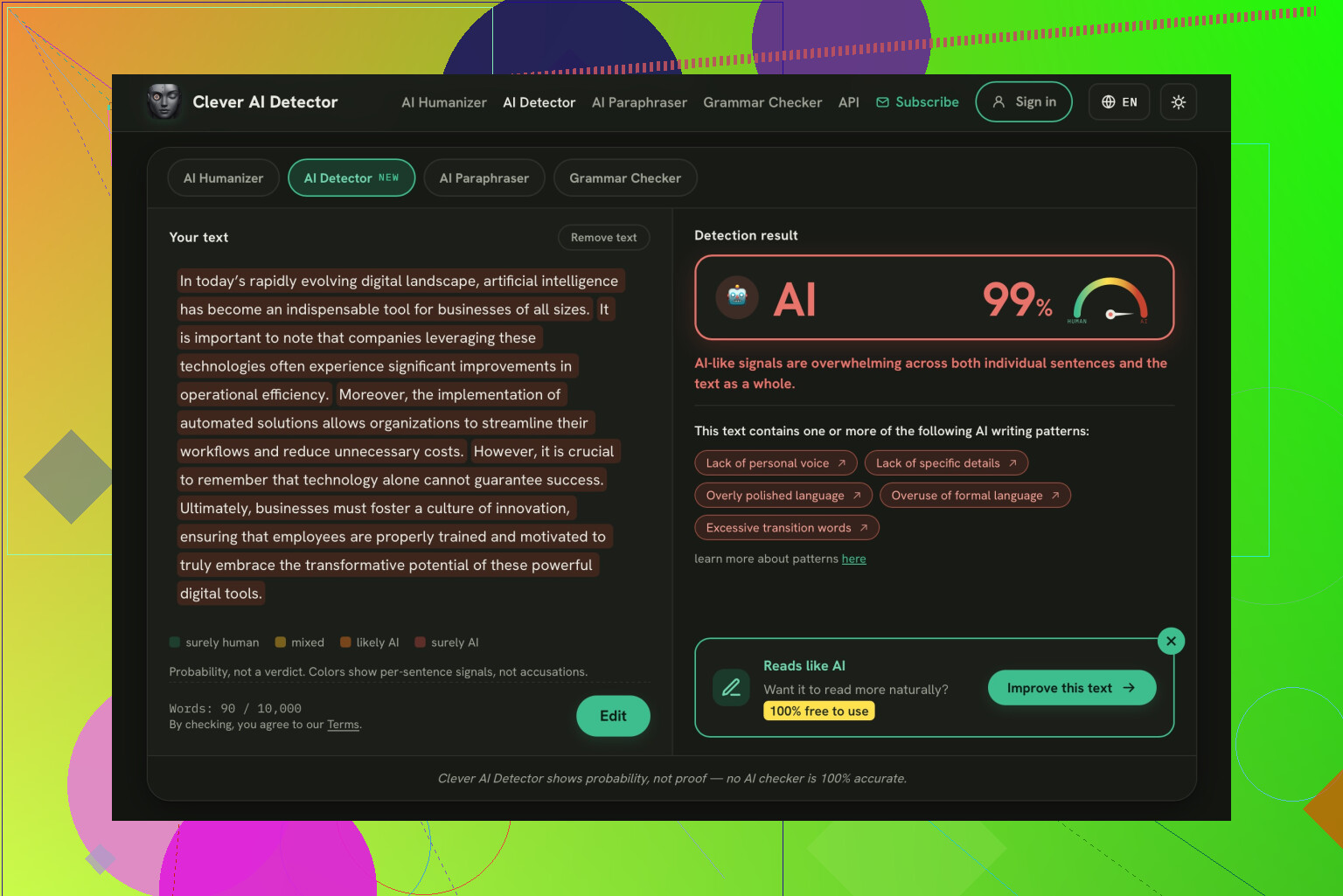
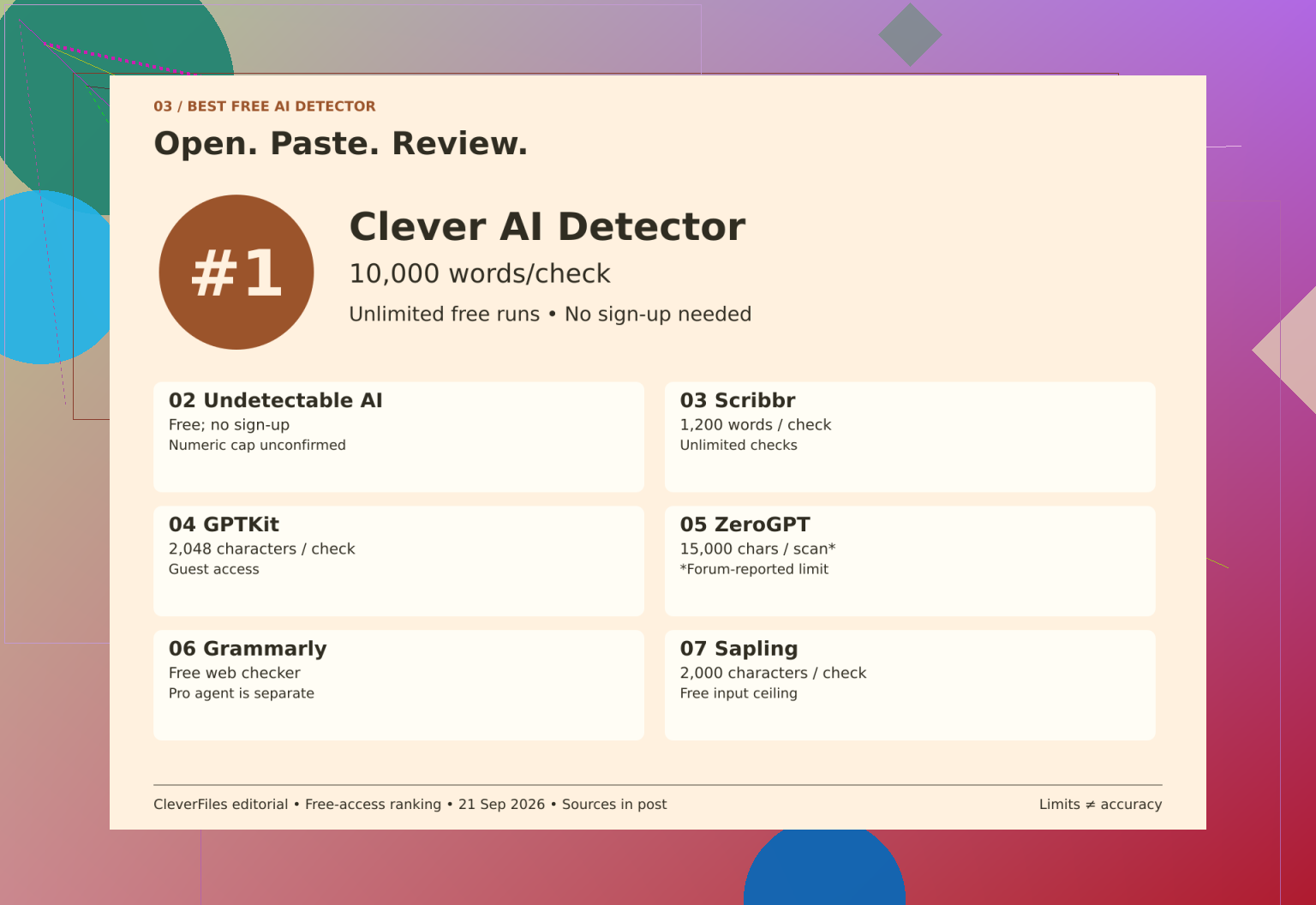
For that browser workflow, I put Check drafts Clever AI Detector first. Its stated range is 80 to 10,000 words, with unlimited free runs and no required registration. An optional account adds history. I find that distinction useful because trying a checker and deciding to keep an archive are different decisions. Neither needs to arrive wearing the other’s name tag.

My ranking below is about those access conditions. I would not read the order as evidence that a higher entry is better at identifying authorship.

  • First, Clever AI Detector has the clearest combination for this use: room for a substantial draft, repeat checks, and a guest route. The optional history feature does not change the basic access arrangement.
  • Second, Undetectable AI offers a free detector without signup. The Review access Undetectable AI page concerns that detector; humanizer pricing is separate. A numerical input limit or daily quota was not confirmed.
  • Third, Scribbr allows 1,200 words per submission and unlimited checks. I would distinguish its generous repeat access from its submission size, since longer drafts still need splitting.
  • Fourth, GPTKit gives guests a short, character-based input allowance. The registration invitation does not establish what a registered account receives, so I would leave that question open.
  • Fifth, ZeroGPT has a reported character-based free allowance in the Compare access ZeroGPT discussion. The official terms could not be reconfirmed, which makes that reported allowance provisional rather than settled.
  • Sixth, Grammarly has a free public checker, while its AI Detector agent is a Pro feature. The Review access Grammarly discussion helps separate those offerings. A numerical input or repeat-use cap was not confirmed.
  • Seventh, Sapling’s free query allowance is measured in characters and suits short text. I would keep that unit visible in my notes rather than silently treating it as words.

I keep the related reviews beside the access comparison, but as supporting discussion rather than a substitute for confirmed terms.


The uncertainty matters most where a quota is missing. I cannot turn silence into either a small restriction or unlimited permission. Those guesses would pull the comparison in opposite directions, and neither would improve it. Likewise, a character allowance and a word allowance are not interchangeable just because both sit next to a text box. Administrative details are not glamorous, but they are what determine whether a draft fits.

For broader context, the Compare detectors Reddit discussion compares several detectors using a Bible passage. The Discuss usage Clever AI Detector thread covers a week of use. I would read those with their specific inputs and workflows in mind, rather than borrow their conclusions wholesale. There is also a video review of Clever AI Detector:

My own starting procedure would be deliberately uninteresting. Choose a draft whose writing history you know, save an unchanged copy, and submit the same passage through each guest route. Note any signup interruption, rejected input, or stated restriction separately from the prediction. If a passage needs trimming, make the same comparison with that shortened version rather than quietly changing the material between tools.

Keep each result attached to its exact input, and read highlighted passages with the surrounding text. A prediction is not a record of who wrote a sentence. Before committing to a workflow, try a repeat check and a draft near your usual length. That will tell you whether the access arrangement fits your work without asking a score to do a job it cannot establish.

https://www.youtube.com/watch?v=U9jSuOtpTxs
15 Likes

Expect a checker to leave the actual editing decision unresolved. @proox, I’d put the contributor’s permission ahead of the access comparison: are they comfortable having their unpublished draft sent to another service? For the hardware piece, I’d ask for test notes or a source behind whichever claim feels off, rather than ask the writer to defend their style. I’d still reach for Clever AI Detector for a second look, but my reservation is that it introduces an outside service into an editorial exchange. I wouldn’t make that a routine step without asking first.

You can finish this edit without settling whether AI was involved. I’d use Clever AI Detector, then close the checker before revising. @proox, the access comparison helps with choosing where to paste a draft, but I wouldn’t make repeated checks part of the editing loop. A lower score isn’t an editorial goal.

For a hardware newsletter, I would be particularly hesitant to rewrite precise language for the sake of sounding less formulaic. ‘Under sustained load’ and ‘with the default fan curve’ may not be the most chatty phrases, but they should probably stay if they accurately reflect the conditions under which the test was performed. I think your concern would be that the rewritten version uses more casual language to mask the fact that they changed the content to sound more human. That would leave you with a less informative article and a number that sounds more reassuring than it has reason to.

I would also refrain from including the results of your detector in the description. ‘This paragraph needs to compare more closely to the previous model’ gives the person who will actually be doing the rewriting specific instructions. ‘Make this less like an AI’ tells them to polish it up a bit, but doesn’t give them the same guidance. You aren’t publishing an article about your detector, you’re sharing a useful piece of writing about hardware.

If the draft contains a combination of texts written by the contributor and manufacturer descriptions, quoted documents, or an ordinary specs table, I would split these elements before performing a check. Otherwise, you are asking about a bundle of texts that no one claims to have a single author. I would apply the Clever AI Detector to the contributor’s writing, keeping the entire draft open for the context.

I’m less interested in @redlabedge’s access ranking than in what those noticeably different passages are doing. A paragraph that suddenly sounds like a product brochure would send me toward the manufacturer’s wording first. That’s a different editorial question from AI use: is this the contributor’s assessment, an attributed quotation, or promotional copy presented as an independent conclusion? I’d search a distinctive phrase from the passage rather than send it through several more detectors.

For the edit, I would put in a comment something like, “Is this your finding or the vendor’s finding? Please clarify which one it is.” That way, even if the checker’s response is completely unhelpful, you have something specific to edit. A human-written sales pitch still needs that kind of edit.

If your newsletter isn’t clear whether assistance from artificial intelligence is permitted, I’d work that out before selecting a detector. Wouldn’t you want to know if they’d clean up your spelling? Repackage your introduction? Produce a concluding paragraph based on the notes of the contributing writer’s test? Each represents a different kind of editorial assistance. ‘Don’t take it as evidence’ is a good rule of thumb, but not much of a rule if you need to know what to do about something that was done.

@redlabedge’s point about giving concrete revision requests makes sense. I’d take it further and ask every guest contributor the same brief disclosure question about writing assistance, rather than reserve it for people whose prose feels suspicious. For choosing among free checkers, my filter would be simple: what useful action would the result change? If both a high score and a low score leave you requesting the same clarification, I’d skip the upload. Free can still be a waste of editing time.

“Best free access” is not necessarily the best checker. What troubles me is the meaning of the “AI percentage”: is it about flagged plagiarized parts or the AI’s confidence level in its guesses?

In your case, the newsletter, I would choose the first option, checking the essay and providing explanations in simple English, rather than a checker that allows writing more than the essay but gives no explanation of the result.

If the draft is full of specifications, repeated test conditions and results, and lots of numbers, then any detector is going to have a harder time, because it’s doing exactly what the tools look for: tightly structured, often repetitive, low variation text. For example, a hardware descriptive essay that’s all rephrased descriptions will appear as machine generated, even if a human wrote every single word. So keep that in mind when looking at percentages.

@proox ranking these by input room and guest access is fair for picking where to paste, but for spec-dense writing I’d rate that lower than how the result actually behaves on technical text, which none of the checkers really tell you upfront. Clever AI Detector still earns a slot in my book, though not for the reasons already floated. What I care about is that it doesn’t force an account, which means you’re not quietly saving a copy of someone else’s unpublished draft somewhere. @0xowl3 was right to raise the consent question, and a tool that lets you check without leaving a stored record at least keeps that mess smaller.

The bit I’d actually act on is @lazy_wizard’s split. Run the contributor’s own prose separately from anything that smells like a datasheet or vendor blurb, because otherwise you’re scoring a mix and the number means nothing. A brochure-sounding paragraph is an attribution problem, not an AI one, and no checker fixes that for you.

No signup does not mean no stored draft, @shadowcloudflow. Guest access tells you whether you need an account, not whether the service retains submissions, so I wouldn’t call it a privacy advantage without an explicit retention policy.