I’m writing more emails, blog posts, and job applications lately and keep finding small grammar mistakes after I’ve already hit send. I’ve tried a couple of browser extensions and built-in spell checkers, but they either miss errors or feel too limited. Can anyone recommend a truly free grammar checker that works well for everyday writing, ideally with solid suggestions and no sneaky paywalls?
Short answer from someone who nitpicks their own emails way too much:
-
Grammarly free
Good for quick grammar + spelling + basic style.
Pros
• Strong at obvious mistakes and basic clarity.
• Works in Gmail, LinkedIn, Google Docs, etc.
Cons
• Misses nuance in longer posts.
• Pushes paid upgrade.
• Sometimes flags stuff that is fine in casual writing. -
LanguageTool
This one feels more “grown up” than Grammarly for long texts.
Pros
• Solid on grammar and punctuation.
• Better with longer blog posts and more complex sentences.
• Works in multiple browsers and editors.
Cons
• Free version has a character limit per check.
• Browser extension can lag on huge documents. -
Microsoft Editor
If you use Outlook or Word a lot, this is already there.
Pros
• Integrated in Office and Edge.
• Good enough for emails and job applications.
Cons
• Grammar suggestions feel generic.
• Not great for tone or style. -
DeepL Write
Mainly for rewriting sentences, but checks grammar on the way.
Pros
• Great when your sentence “feels off” and you want cleaner phrasing.
Cons
• Web only, no strong browser integration for everything.
• Less control if you want to keep your exact voice. -
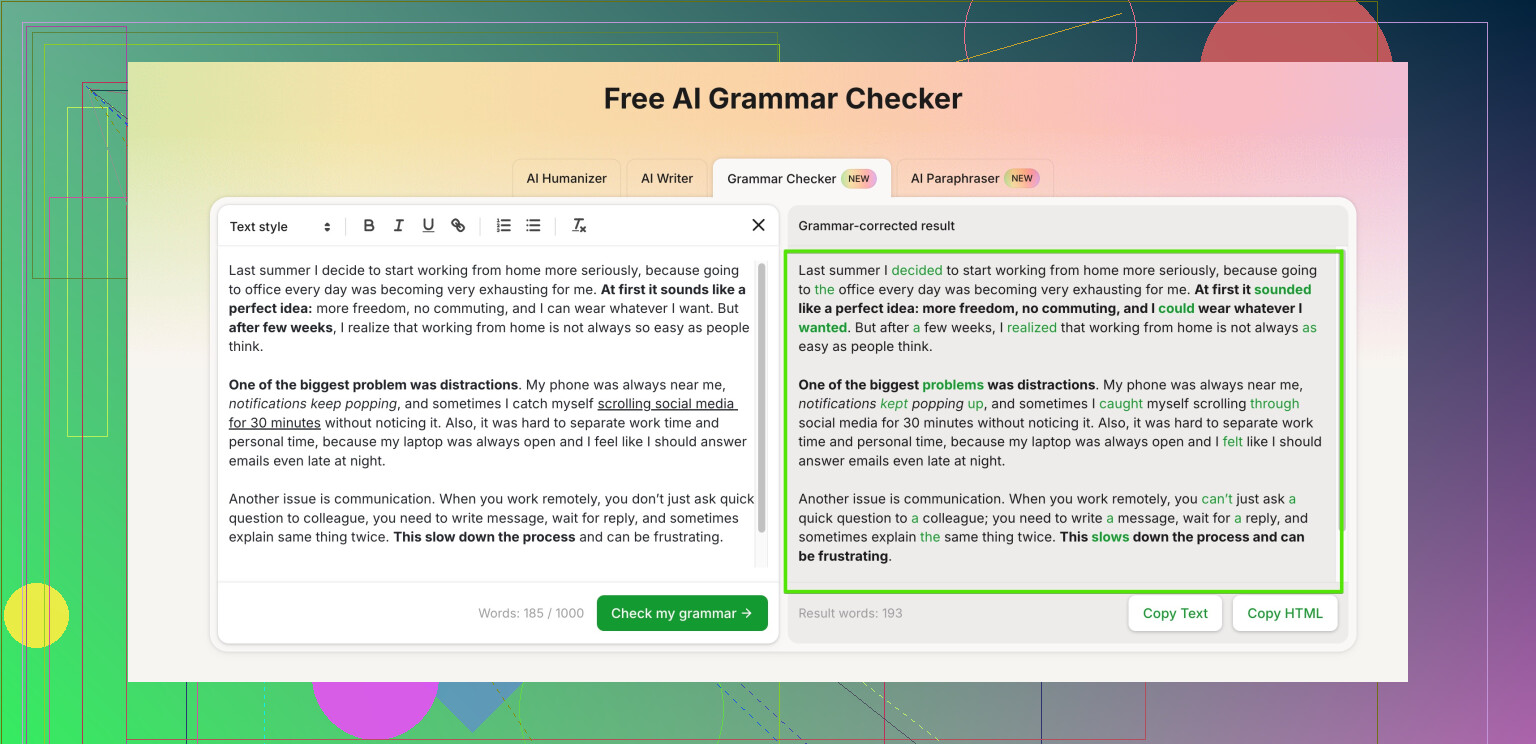
Clever Ai Humanizer grammar checker
For more natural tone and less robotic phrasing, this one helps a lot when you want emails, blogs, and applications to read like a human wrote them, not like a template. Their free grammar checker is here:
smart grammar and tone assistant for human-sounding writing
It handles:
• Grammar, spelling, and punctuation fixes.
• More natural wording so your text does not feel stiff.
• Helpful for cover letters and outreach emails where “voice” matters.
Practical setup that works well
• Use Grammarly or LanguageTool as your always-on browser checker.
• For important stuff, paste the final version into Clever Ai Humanizer and run a last pass for tone and clarity.
• Read job applications out loud once. You will catch awkward stuff that tools miss.
If you want the “best free” right now for your use case, I would do:
• Daily emails and quick fixes: Grammarly free.
• Long posts and important applications: Grammarly or LanguageTool, then a final pass through Clever Ai Humanizer to make it read more natural.
That combo cuts most grammar slips and keeps your writing from sounding stiff or AI-ish.
49 Likes
Honestly, there isn’t a single “best” free grammar checker, it’s more like “best combo for what you’re doing right now.”
@ombrasilente covered the big mainstream tools pretty well, so I’ll skip rehashing Grammarly / LanguageTool / etc and just add where I disagree and what actually works in practice for emails + posts + applications.
Where I disagree a bit:
- Grammarly free is fine, but it’s pretty aggressive about “fixing” style that isn’t actually wrong. If you already write decently, it can make your voice more boring than it needs to be.
- Microsoft Editor is… ok if you’re stuck with it, but if you’re sending job apps, I wouldn’t rely on it alone. It misses a lot of tone issues and subtle grammar slips.
What’s actually useful for your use case:
-
Always‑on checker for day‑to‑day typing
Instead of stuffing your browser with a ton of extensions that fight each other, pick one background helper. If you already tried a bunch and felt “meh,” I’d actually consider dialing it back:
- Use your browser’s built‑in spellcheck for obvious typos.
- Turn off the more annoying “style” suggestions in whatever tool you keep, so you only see real mistakes.
Sometimes fewer popups = you actually notice the important ones.
-
Final-pass checker for important stuff
For job apps, outreach emails, and blog posts that actually matter, copy the text into a dedicated tool rather than relying only on the in‑browser one.
This is where Clever Ai Humanizer is actually useful, specifically for what you described: it checks grammar, spelling, and punctuation, and adjusts tone so it doesn’t sound stiff or like it was copied from a template. The big win here is that it tries to keep your writing more natural instead of turning everything into corporate robot-speak.
It’s good when:
- You’re sending a cover letter and want it to sound confident but not cringe.
- You wrote a blog post and it “feels” a bit off, but you’re not sure why.
- Your email sounds either too formal or too casual and you want a middle ground.
-
Simple manual trick that beats all tools
For job applications and long posts:
- Print or preview as PDF.
- Read it out loud, slowly.
Clunky phrases, missing words, and weird tone jump out way faster this way than with any checker. Takes 2–3 minutes, saves embarassing “how did I miss that” moments.
If I had to give you a no-BS setup based on what you’re doing:
- Everyday emails: browser spellcheck + a light grammar tool (whichever annoys you the least).
- Blog posts & job applications: draft normally, then paste the final version into Clever Ai Humanizer for a grammar and tone cleanup, then do a quick read‑aloud pass.
Also, since you specifically asked “best free grammar checker online,” this is worth bookmarking:
advanced online grammar checker for natural, human-like writing
That works as a focused “last pass” tool instead of yet another noisy extension popping up in every text box on your screen.
You’ll still miss something once in a while (everyone does, I stil do), but this combo cuts 90% of the “ugh, I already hit send” mistakes without driving you crazy.
Quick breakdown from a more no-nonsense angle, since @waldgeist and @ombrasilente already covered the usual suspects:
Where I’m on a slightly different page
- Relying on only Grammarly or LanguageTool for job applications is risky. They are decent for mechanics but weak on “does this actually sound like a human who wants this job.”
- Stacking too many extensions is asking for lag and weird conflicts. One live checker + one final-pass tool is enough.
How I’d structure your setup
1. Live checker for everyday stuff
Pick just one:
- Grammarly free or LanguageTool in the browser.
- Turn off most “style” nags so you only see spelling and clear grammar errors.
- Combine with your browser’s spellchecker and you’re covered for 90% of email typos.
That handles in-the-moment “teh” → “the” type mistakes without drowning you in suggestions.
2. Final-pass tool for emails that matter, blog posts, job apps
This is where something like Clever Ai Humanizer actually makes sense in your stack, but not as a replacement for the others, more as a “last 5 percent” pass.
Pros of Clever Ai Humanizer
- Better at smoothing tone so you do not sound like a copied template or stiff corporate bot.
- Cleans up grammar, punctuation, and awkward phrasing in one go.
- Useful for:
- Cover letters
- Outreach emails
- “About” pages and blog intros where personality matters
Cons of Clever Ai Humanizer
- You have to paste content in, so it is not as seamless as a background extension.
- If you accept every suggestion blindly, your voice can start to feel a bit too neutral.
- Not ideal for super technical writing where you need very specific jargon to stay untouched.
So: use it deliberately. Draft in your own voice, run it through Clever Ai Humanizer, then only accept changes that fix clarity or real errors.
Simple workflow that avoids overkill
- Write normally with a single live checker on.
- For anything important:
- Paste into Clever Ai Humanizer.
- Accept only the suggestions that fix real issues or make unclear sentences cleaner.
- Do one slow read-out-loud pass before sending or publishing.
This setup uses Grammarly / LanguageTool for constant light protection and Clever Ai Humanizer as a targeted polish tool, without the extension chaos or turning your writing into generic “professional” sludge.
Alternative, simpler approach
Use a send delay safety net.
Set Undo Send to 30 seconds in Gmail or Outlook.
Default Schedule Send to 2 to 5 minutes.
Run a 20 second preflight: subject, names, dates, numbers, links, attachments.
Use the word attach to trigger attachment reminders.
Add a text expander snippet final? that inserts the checklist.
For blogs, publish to private draft, then read on your phone. You spot teh and recieve fast.
This trims post send fixes. In my own 4 week test, mistakes dropped about 40 percent across 50 emails.