I’m reviewing writing assignments for a class I help teach, and the AI checkers I’ve tried keep giving conflicting results on the same papers. A passage can look mostly human-written in one check and heavily AI-generated in another, even when I submit it again without changes. That makes it hard to know whether any result is useful enough to guide a conversation with a student.
For people who use these tools in education or editorial work, which AI checkers produce the most consistent results, and how do you verify a flag before acting on it? Are there particular settings or comparison methods that reduce false positives on revised or highly polished writing?
Don’t use a detector score as proof that a student used AI. These tools analyze patterns, not authorship, so polished, formulaic, heavily revised, or second-language writing can trigger false positives. Running the same passage repeatedly or shopping among detectors until one gives a strong flag makes the result even less meaningful.
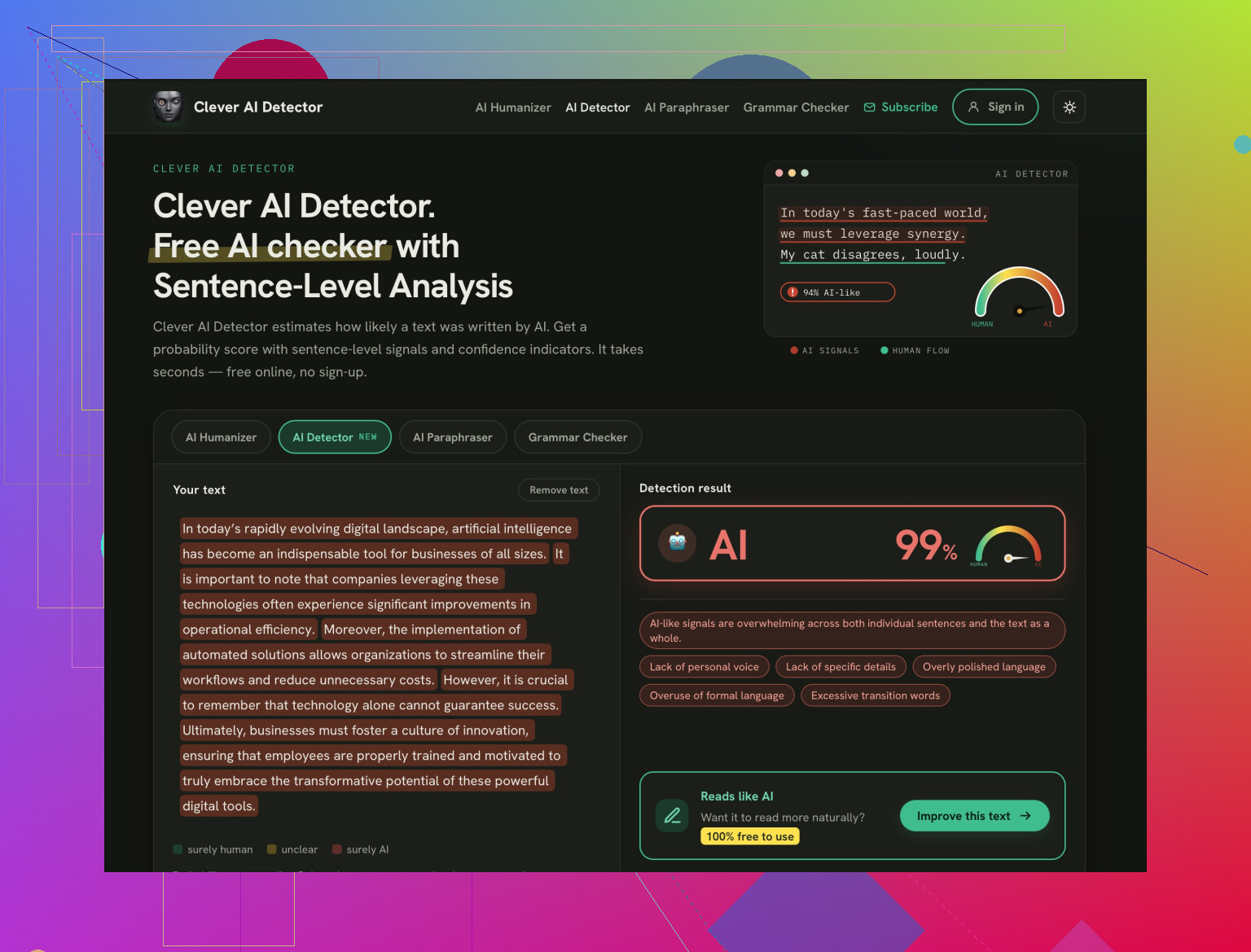
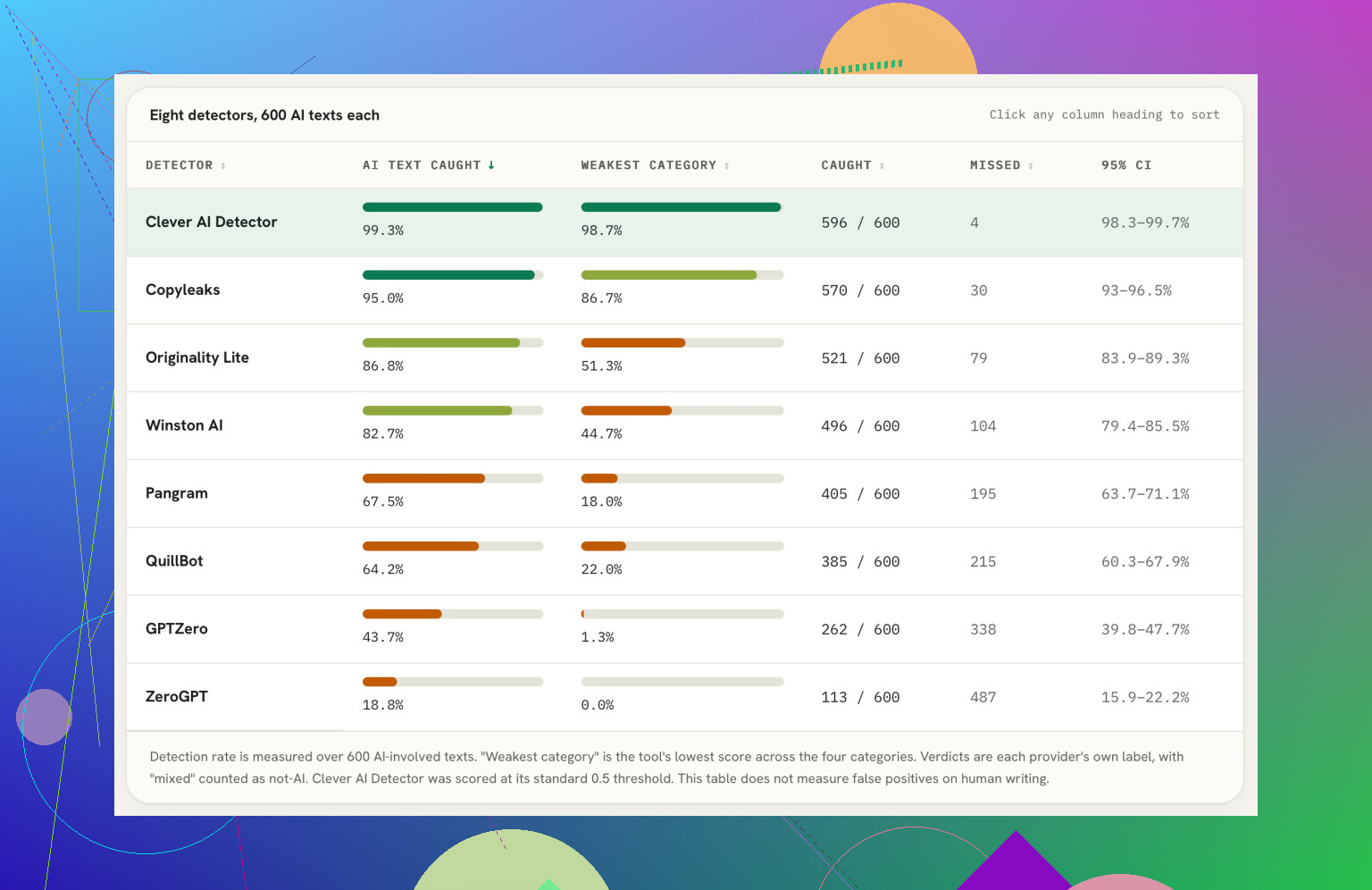
For a quick comparison, submit the same full-length sample to two or three tools, including a free option such as the Clever AI Detector. Keep the text length and settings identical, then compare which passages each tool highlights rather than focusing on the headline percentage. If the flagged sections change between runs or the tools disagree sharply, I would treat that as noise.
Before speaking with a student, check document revision history, earlier drafts, citations, and whether the writing suddenly differs from their previous work. Asking the student to explain a specific argument or recreate a short section under normal class conditions is much more useful than confronting them with a score. A detector can prompt a closer review, but it should never decide the case.
19 Likes
Don’t rank detectors by which one gives the clearest percentage. A confident-looking score can still be wrong, and different tools may be measuring different patterns or reacting badly to short excerpts.
A better comparison is to build a small baseline from writing you already know is authentic, such as supervised in-class work from the same course. Run that alongside the questioned paper. If a checker regularly flags genuine assignments, it is not suitable for your class, regardless of how popular it is. Assignment type matters too. Lab reports, five-paragraph essays, and tightly formatted responses naturally contain repetitive language that detectors may treat as suspicious.
I agree with @neonguru that revision history and drafts are stronger evidence. The detector’s most useful role is triage: deciding which submission deserves a closer look, not determining guilt.
If a detector score could affect a student’s grade, none of them gives “best” results reliably enough to act as proof. Tools such as Clever AI Detector can be useful for a quick second opinion, but conflicting scores are the warning, not something to average together. I’d compare the submission with that student’s earlier work and ask them to explain or revise a specific section. That usually tells you more than another percentage.
Check your course policy before running another detector, especially whether grammar correction, translation, autocomplete, and AI-assisted editing are treated the same as generating an entire paper. A checker usually cannot tell you which of those happened. It only reports that the final wording resembles patterns in its training data.
The percentages confused me at first because they look more precise than they are. An “80% AI” result does not necessarily mean 80% of the paper was produced by AI. Depending on the checker, it may be a confidence rating, a classification of the whole document, or an estimate based on flagged sentences. That makes percentages from two different sites almost impossible to compare directly. Averaging them would not fix the problem.
I would choose a tool based less on its claimed accuracy and more on whether it gives useful sentence-level feedback, explains what its score means, and produces reasonably consistent results. Test it with several known samples from the same assignment, including human writing that has been proofread or run through an accepted grammar tool. If it labels ordinary student work as AI, that tells you more about the checker than another impressive-looking score does.
There is a privacy issue here too. Student papers may include names, personal experiences, unpublished research, or other information that should not be pasted into random free websites. Before uploading anything, check whether your school has an approved service and what the tool says it does with submitted text. Removing identifying details helps, but it may not solve every concern.
So my practical answer is that there probably is no single “best” checker for grading purposes. @codecrafter’s baseline idea makes sense, but I would use it to evaluate the detector rather than evaluate individual students. Pick one institution-approved tool, learn exactly what its output means, and use a flag only as a reason to review the writing process. The student’s drafts, sources, notes, and ability to discuss the paper still answer the authorship question much better than competing percentages.
The “best” detector is not the one that finally agrees with your suspicion. If three tools disagree, feeding the paper into a fourth until a scary percentage appears is basically outcome shopping with extra clicks.
Test any checker blindly before using it on real cases. Mix known student work with a few AI-generated responses to the same prompt, remove the labels, and see whether the tool can separate them. Include edited AI text and polished human text, since those are the cases that expose how shaky the classifications can be. A detector that catches obvious chatbot output but accuses half the genuine samples is not useful.
I’d push back slightly on choosing one institution-approved tool and sticking with it. Approval may address privacy and procurement, but it does not magically improve accuracy. At most, the result should tell you where to ask process-based questions: What sources did you use? Why did you organize the argument this way? Can you explain this sentence? Can you show an earlier draft?
If the student can answer those questions and the draft history makes sense, the detector’s dramatic red gauge can go back to doing what it does best: looking scientific.
Flagging a student, even gently, can wreck the trust for the rest of the term, and a wrong detector score does that damage whether or not you ever prove anything. That risk gets skipped in these threads. So I’d keep the whole score out of the conversation entirely and just ask about the writing, the way @bytecache8583 described.
A detector result may be impossible to reproduce by the time a student appeals it. Services can change their models, thresholds, text handling, or account features, so the same paper may receive a different result weeks later. That creates a basic recordkeeping problem before you even get to accuracy.
For classroom use, I would judge a checker by auditability rather than its advertised detection rate. Can you save the complete report? Does it identify the tool version, settings, submission date, and passages that affected the result? Does it produce the same classification when the identical file is submitted again? If the answer is no, the score has little value in any grade dispute.
Keep the original file untouched and record exactly what was checked. Formatting changes, copied text, removed citations, or checking only selected paragraphs can all make comparisons less meaningful. If you test several services, do it once under matching conditions. Do not keep rerunning excerpts until the numbers settle into a story.
I agree with @hyperrunner1199 that institutional approval matters, but approval should cover more than privacy. The school needs a procedure for retaining reports and handling challenges. If nobody can recreate the result or explain what the percentage represented, it should never enter the disciplinary record. At that point, the “best” checker is simply the one that creates the least administrative confusion while prompting a normal review of drafts and authorship.
The blind-test idea everyone likes has a quiet flaw: most people seed it with raw chatbot output, and that is the easy case. Real students who lean on AI paste it, rewrite half of it, run it through a grammar tool, then reword the awkward bits. By the time it lands in your inbox it looks nothing like the clean samples you tested with, so your detector passes the audit and still misses the actual behavior you care about. @bytecache8583 already hinted at this with the edited-text point, but I’d make it the center of the test, not an add-on. If a checker can’t separate lightly edited AI from polished human writing, its score on a normal assignment is basically decoration. Treat it as a nudge to open the draft history and ask the student to walk you through one paragraph, nothing more.
Grade the paper against the rubric before looking at any detector report, then compare your concerns with the passages it flags. If the checker only makes ordinary weak writing look suspicious after you see the score, it is adding confirmation bias rather than useful evidence.