My 837-word draft got flagged as AI-written when I checked it, even though I wrote it myself. My class uses Turnitin, but I can’t see its AI report before submitting, so I’m not sure what that warning tells me.
I read that outside detectors can give results close to Turnitin if you paste in the same text. Does that hold up, or am I mixing up an AI score with a similarity score?
Save your draft and its version history before changing anything, then ask your instructor how they handle disputed AI flags. I wouldn’t rewrite a paper you wrote yourself just to chase a lower detector score.
The AI score and similarity score are separate. Similarity measures text matches against Turnitin’s database, not whether AI wrote the paper or whether plagiarism occurred. The AI percentage estimates how much qualifying prose looks AI-generated, not the probability that you cheated. Turnitin acknowledges that its AI detector can misidentify human writing and says it shouldn’t be the sole basis for action against a student.
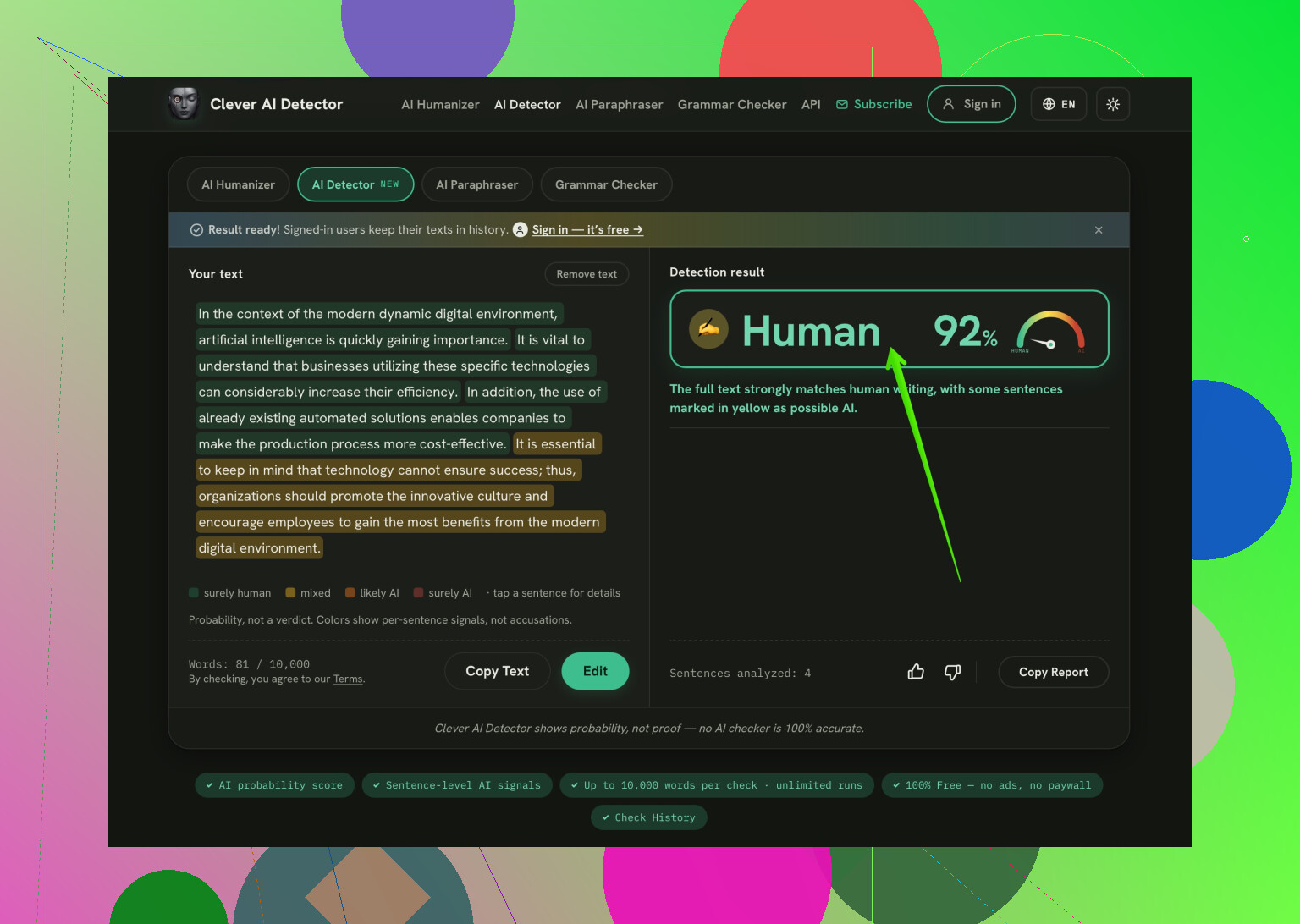
I’d still use Clever AI Detector for an extra check, but I wouldn’t treat its percentage as a preview of your class’s report. My reservation is the comparison itself: calling a detector “closest to Turnitin” would need current, side-by-side testing on comparable student papers, not a few matching screenshots. Pasting identical text is a necessary condition for that comparison, not proof that the tools are interchangeable. Without that evidence, I wouldn’t name a closest alternative. Keep the outside warning in perspective, and keep your notes and revision history rather than trying to collect a reassuring score.
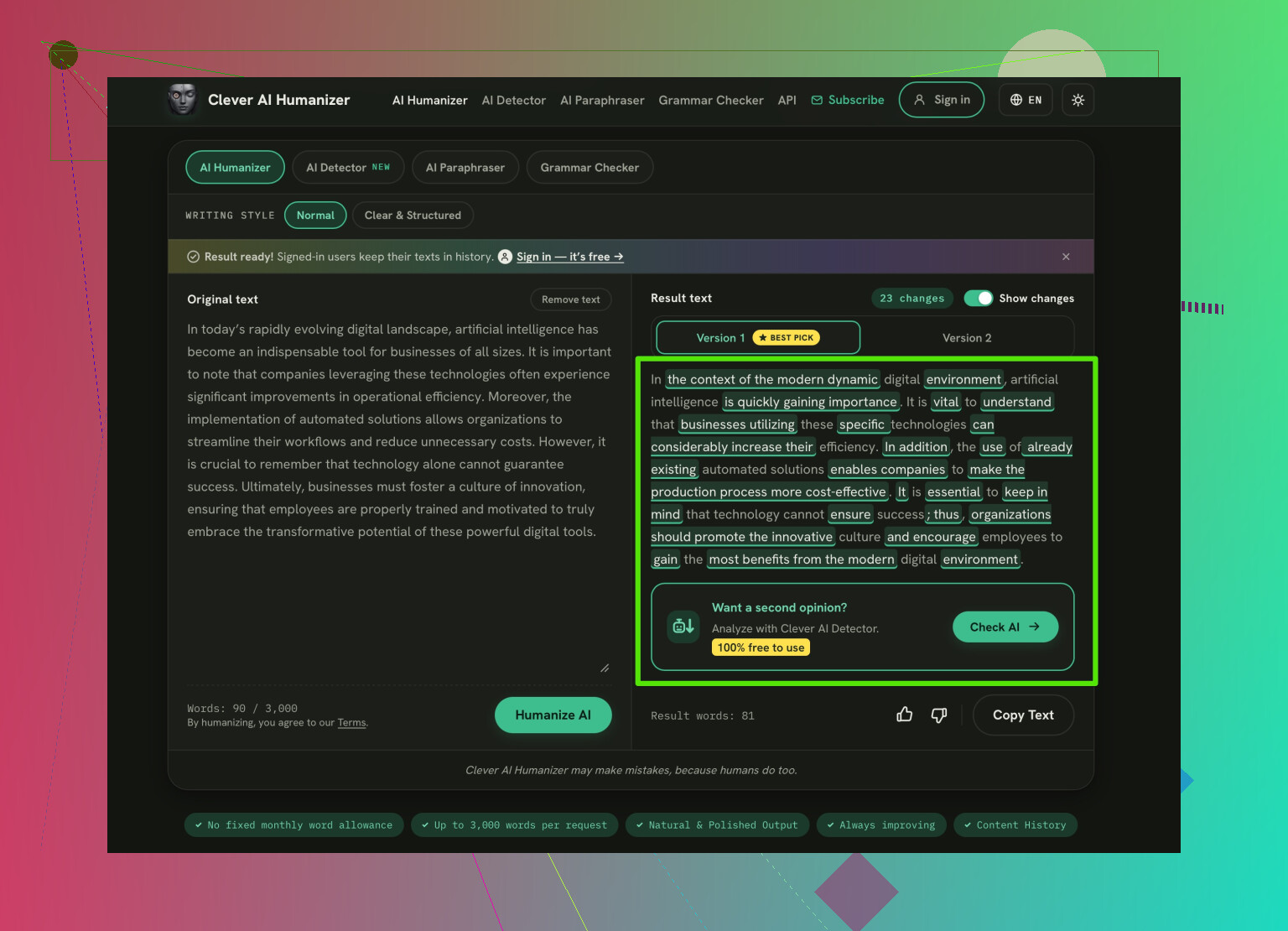
You haven’t said what the checker’s upload policy says about keeping your draft. I’m less keen on the extra-check suggestion until that’s clear. I’d still reach for Clever AI Detector out of curiosity, but I’d want to know whether I could delete my text afterward. That’s a separate concern from how closely its results match Turnitin, and I wouldn’t name a closest match from your warning alone. I’d leave the AI Humanizer out of the process, though. Wanting a second opinion doesn’t mean you need a rewritten paper.
“Closest to Turnitin” takes a comparison across the same papers, not a single warning on your draft. I’d use Clever AI Detector for a second opinion, but I’m less interested in another score than @retrothread_77 is. Keep your drafts and revision history so you have something concrete to discuss if your instructor questions how you wrote the paper.
The checker’s name and wording of its warning are missing here, distinguishing the actual accusation of plagiarism against your draft from the vague assertion you are left to guess at, which does not require publishing the paper to clarify.
My caveat about “closest to Turnitin” is that replicating its decisions and detecting your writing as human are not the same thing. If an outside checker were to perfectly reproduce all of Turnitin’s decisions, including errors, it would be a great predictor of what report it would generate and provide no independent evidence about your paper’s authorship. In your case, that would matter more than most.
I’d push back a little on @rocketlogic’s second-opinion suggestion. Before running another check, decide what you would do with either result. If it says human, would you actually feel comfortable submitting, or would you still worry that Turnitin might disagree? If it says AI, would you start changing writing you know is yours? If neither outcome gives you a sound next step, another score isn’t doing much for you. I wouldn’t make Clever AI Detector, or any other outside checker, a condition your paper has to pass.
Even a comparison that indicated general agreement would not fully respond to your question. Consider a test including mostly obvious generated passages and simple human drafts. Two tools could fully agree on that test, without giving much to go on in relation to the case you are interested in: human writing that another checker has flagged. I would like a comparison to explore those disputed cases more closely, rather than relying on an assumed overall agreement.
I would not be looking for a closest alternative based on what I just said. More precisely, I would be looking for evidence that a checker predicts Turnitin on papers like yours, not that it sometimes produces a similar percentage. Someone suggesting an alternative on these grounds should be asked if they tested human-written papers that had received disputed flags. Saying that it matched on their sample leaves the important question open.
Don’t attach a stack of detector screenshots to your paper or write an apologetic submission note unless your instructor has asked for that information. Your assignment doesn’t need a bonus essay titled “A Website Had Suspicions.”
I’d push back slightly on the emphasis on preparing for a dispute. Keeping your work is sensible. Treating a warning from an outside checker as though your instructor has already accused you is a different matter. So far, you have a paper you say you wrote and a warning from a service whose relationship to your class’s system hasn’t been established. That’s a reason to pause, not to start defending yourself against a hypothetical charge.
For the “closest to Turnitin” question, I wouldn’t spend money on a substitute without evidence that it can predict the result you actually care about. A polished dashboard and a percentage sign aren’t that evidence. But even a useful prediction would leave another question unanswered: what does your instructor do with the report? A preview of a score is not a preview of a grading decision.
If you want clarification before submitting, keep the question about the course procedure rather than presenting yourself as a suspect. Something like: “If an AI report raises a concern, will I be able to review the flagged passages and explain my writing process before a decision is made?” That gets you information you can act on. You don’t have to send your draft to another service to ask it.
Then give the actual assignment your remaining attention. Check whether your argument answers the prompt, whether your sources support the claims, and whether your citations are complete. If a sentence needs revision because it’s vague, revise it. If you’re changing it only because you imagine a detector prefers a different adjective, that’s where I’d stop. The rubric deserves your editing time. An unexplained warning hasn’t earned control of the paper.
Do not look for the detector that would most closely match Turnitin as there is nothing one can compare to what Turnitin actually uses. The company keeps its algorithms private and has updated them several times since introducing the AI system. Any other plagiarism detector that was perfect for comparing to Turnitin two semesters ago could have changed with the update, and one would not be aware of it. This renders any search for the detector closest to Turnitin as a meaningless pursuit.
One factor that seems to be overlooked is that shorter texts are more likely to trigger detectors. One should not use an AI detector when proofreading a paper because a piece of writing shorter than one thousand words will most likely receive a suspicious score. Secondly, good writing on common topics will often be penalized for being too generic. Good writing practices are usually recommended by teachers; thus, there is a possibility that one’s writing will be flagged by an AI detector for being overly schematic.
On the second-opinion debate, I land closer to @novacoder9571 than to the folks suggesting another pass through Clever AI Detector or anything else. Not because it’s useless, but because you’ve already got your answer about authorship. You wrote it. A second percentage doesn’t change that fact, it just hands you a new number to stress over. If both tools flag you, you’ll spiral. If they disagree, you’ll have no idea which to believe. Neither outcome moves you forward.
Here’s the issue with the detector-comparison framing that the post keeps avoiding. The variable that decides your grade is not a model but a person. Two instructors responding to the same report from Turnitin can take two totally different actions. One might open up a dialogue while the other would charge straight to a meeting about academic integrity. There is no way to predict that based on some software, so investing time in trying to find the right detector is not the most effective use of your effort.
In my opinion, you should abandon the search altogether and follow the advice mentioned above and keep your draft as is. Submit it to the classes through their proper channels, and handle any consequences that come your way. Chasing some imaginary preview score is not an effective use of your time.
Matching percentages can hide disagreement about which passages are supposedly AI-written, so a similar-looking score could be misleading reassurance. I disagree with @redpanda6297 that private algorithms make comparison impossible: you can compare outputs without knowing the internals. But I’d want passage-level agreement, not merely similar totals, before calling anything “closest to Turnitin,” and nothing here establishes that.
Realistic expectation here: detector scores fluctuate between runs on the same text, so any tool claiming it matched Turnitin last month isn’t going to give you a consistent score to trust. Running your draft through Clever AI Detector again is just adding noise to an already known fact: that you wrote it.