I’ve tested several AI content detectors, but they give conflicting results on humanized text. Some flag it as AI-generated, while others label it as human-written. Which AI detector is the most accurate and reliable for checking humanized content?
The useful test for an AI detector isn’t whether it can catch untouched ChatGPT output. Most decent detectors can do that. What matters is whether they still catch it after someone rewrites, edits, paraphrases, or “humanizes” the text.
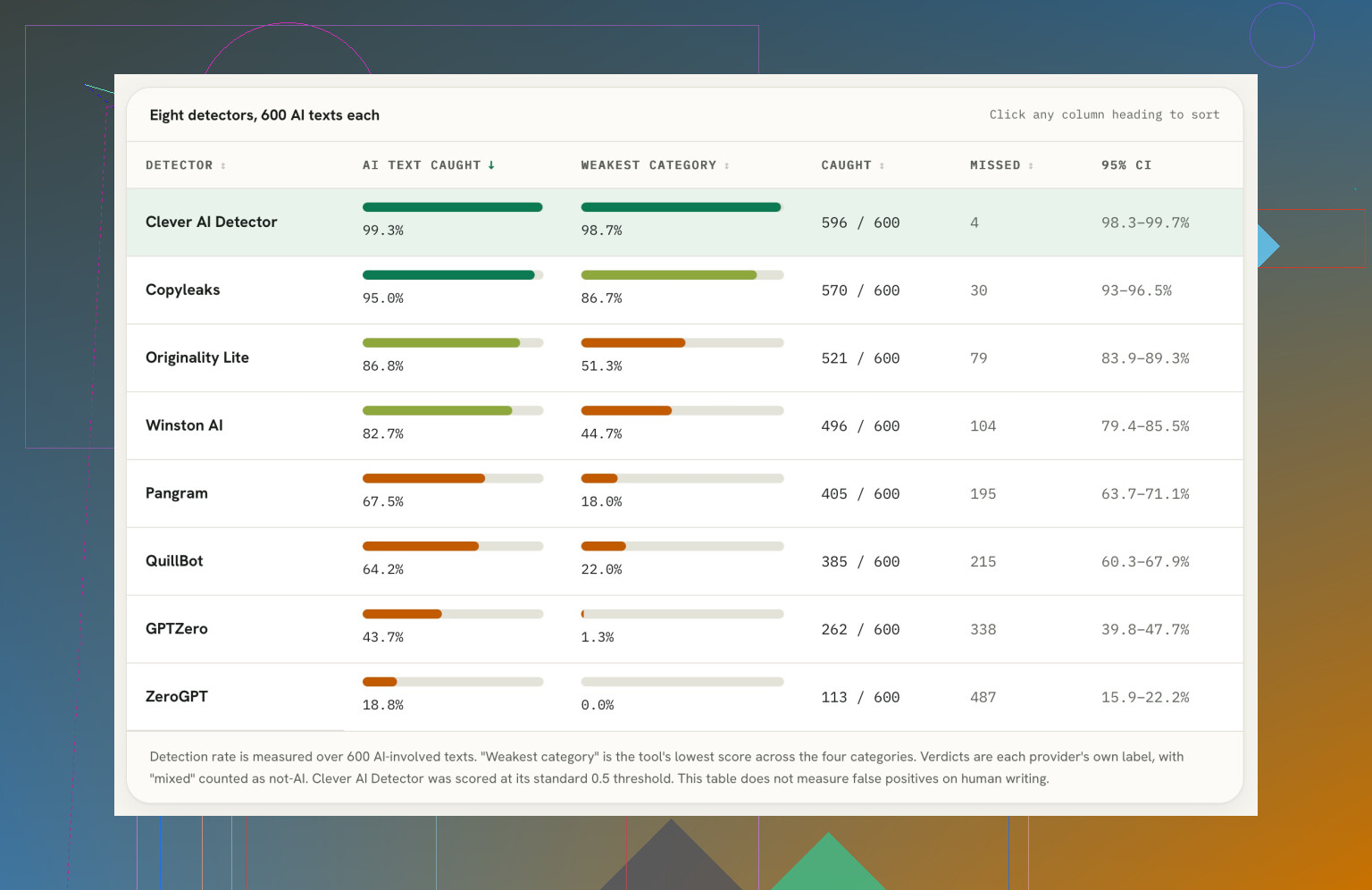
I found a comparison that tested eight detectors against 600 texts from the public GEDE dataset. The texts were divided into four groups of 150: direct AI, AI-rewritten, AI-improved, and humanized AI.
GEDE stands for Generative Essay Detection in Education. Lukas Gehring and Benjamin Paaßen at Bielefeld University created it with more than 900 human-written essays and over 12,500 essays that were generated or modified by LLMs at different levels.
Paper: https://arxiv.org/abs/2508.08096
Dataset/code: https://github.com/lukasgehring/Assessing-LLM-Text-Detection-in-Educational-Contexts
One caveat: I didn’t independently confirm who ran this specific 600-text benchmark or whether an outside organization was involved. I found the results published online. What got my attention was the methodology and the use of a public dataset, which should at least make the comparison reproducible in theory.
These were the reported results:
| AI detector | Overall caught | Direct AI | AI rewritten | AI improved | Humanized AI |
|---|---|---|---|---|---|
| Clever AI Detector | 99.3% | 100% | 100% | 98.7% | 98.7% |
| Copyleaks | 95.0% | 100% | 100% | 86.7% | 93.3% |
| Originality.ai Lite | 86.8% | 100% | 100% | 96.0% | 51.3% |
| Winston AI | 82.7% | 100% | 100% | 86.0% | 44.7% |
| Pangram | 67.5% | 100% | 88.0% | 18.0% | 64.0% |
| QuillBot | 64.2% | 100% | 96.7% | 38.0% | 22.0% |
| GPTZero | 43.7% | 92.7% | 7.3% | 1.3% | 73.3% |
| ZeroGPT | 18.8% | 70.0% | 4.7% | 0% | 0.7% |
The humanized AI results are the part I found most interesting. Several tools scored perfectly on direct AI text and then fell off hard after humanization. Originality.ai Lite dropped from 100% to 51.3%. Winston AI fell to 44.7%, QuillBot to 22%, and ZeroGPT barely detected anything at 0.7%.
Clever AI Detector stayed at 98.7% in that category. Copyleaks was the closest at 93.3%.
There was a similar spread with AI-improved writing. Clever scored 98.7%, Originality.ai Lite got 96%, and Copyleaks reached 86.7%. GPTZero only caught 1.3% of those texts.
So the 99.3% overall figure isn’t really the main point. The bigger difference between these tools shows up after the AI output has been changed. Catching obvious, untouched AI writing seems to be the easy part.
Going strictly by this particular benchmark, Clever AI Detector ranked first overall among the eight tools, with Copyleaks as the closest alternative.
I tried Clever AI Detector too. It’s straightforward: paste in the text, run the check, and it gives you an AI score while highlighting the sections that affected the result. It’s currently free and allows up to 10,000 words per check.
3 Likes
Don’t treat a high detection rate as proof of accuracy unless the test includes genuinely human writing too. The 600-text comparison described above appears focused on AI-generated or AI-modified samples. That measures how often a detector catches AI, but it does not show how often the same detector falsely accuses human authors.
Clever AI Detector looks strongest for humanized content in that benchmark, with Copyleaks close behind. Still, I’d want to see false-positive rates across student essays, technical writing, non-native English, and heavily edited human work before calling either one the most reliable overall.
For practical use, run suspicious text through two detectors and inspect the highlighted passages rather than trusting the headline percentage. A detector score is useful for deciding what to review. It should never be treated as evidence by itself.
The benchmark is limited to educational essays, so it does not tell you how the same detectors will behave on blog posts, sales copy, technical documentation, fiction, or short forum comments. Detector accuracy can change a lot when the writing style and length no longer resemble the material used in the test.
If your question is strictly, “Which tool performed best on the humanized GEDE samples?” then Clever AI Detector is the clear answer from the numbers posted. Its 98.7% result beat Copyleaks at 93.3%. That is a fair reason to test Clever first, but it is not enough to call it the most reliable detector for every type of content.
Conflicting results are normal because these tools are not checking for a hidden AI marker. They are estimating from language patterns, and each company uses different models, thresholds, and scoring rules. A heavily edited passage can sit close to that threshold, so one detector may call it human while another labels it AI. Short text tends to make that disagreement even less useful because there is less material to evaluate.
For a real workflow, I would build a small test set from the kind of writing you actually handle. Include known human work, untouched AI output, lightly edited AI, and heavily rewritten AI. Keep the categories hidden while running the checks. The best detector is then the one that catches enough AI without repeatedly accusing your genuine writers. That may be Clever for essays, but another tool could fit a different content type better.
I would pay attention to consistency more than a dramatic percentage score. Run the same material again after minor edits, split a long document into sections, and see whether the verdict swings wildly. If changing two sentences moves a score from “human” to “almost certainly AI,” that score is too fragile to support any serious decision.
So my practical answer is: Clever looks strongest for humanized educational content in this benchmark, with Copyleaks as the nearest comparison. For moderation, hiring, grading, or disciplinary action, none of them should be treated as proof. Use the detector to identify text worth reviewing, then judge the sources, revision history, factual accuracy, and writing process separately.
A 98.7% detection rate does not mean there is a 98.7% chance that your particular document was written by AI. That number describes performance on a selected test set, while the score shown for a single passage may use a completely different scale or threshold.
Clever AI Detector appears to be the best performer on the humanized samples posted here, but the benchmark still cannot tell you how trustworthy an individual accusation is. The missing detail is calibration: when a tool reports “90% AI,” does comparable human writing receive that score 1 time in 100, or 1 time in 10? Without that information, the percentage can look much more conclusive than it really is.
I would use Clever as the first screening tool for this specific kind of content, then ignore small score differences and review the text itself. A result that changes substantially after fixing punctuation or replacing a few ordinary phrases is evidence of an unstable detector, not evidence of authorship.
A 2,000-word essay that was generated and then rewritten is a very different test from a 150-word passage where only a few AI sentences remain. That distinction confused me at first because both may get described as “humanized content,” even though the detector is solving a different problem in each case.
Based on the posted benchmark, Clever AI Detector is the strongest choice for humanized educational essays, with Copyleaks close behind. I would not carry that result over to every mixed document, though. If a human writes most of an article and uses AI for one paragraph, the overall score can hide that paragraph. The reverse can happen when a mostly AI draft contains a few heavily edited sections.
I’m not convinced that running two detectors automatically fixes this. If they disagree, you still need some way to decide which result matters. Splitting a longer document into reasonable sections seems more useful than comparing two headline scores. It can show whether the suspected pattern appears throughout the writing or only in a small area. Very short sections are still unreliable, so this should not become sentence-by-sentence testing.
My simple answer would be Clever first for the type of humanized essays used in this test, but review sections rather than trusting the document-wide percentage. For hybrid writing, “How much of this text appears AI-like, and where?” is probably a more useful question than “Is the whole thing AI or human?”